

 By
By 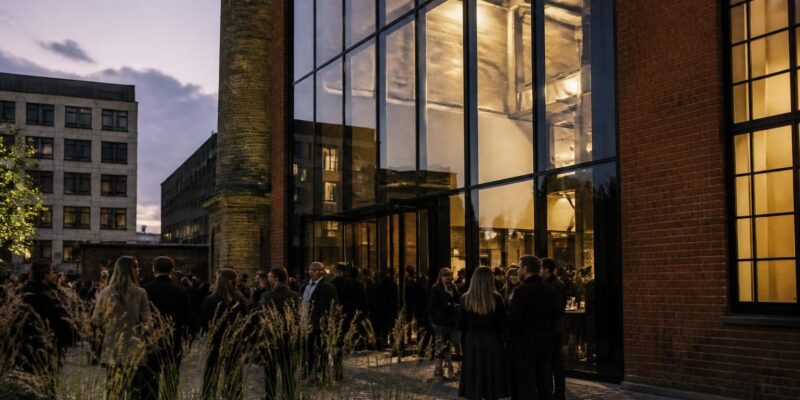
Warsaw’s autumn cultural calendar gained a major international exhibition on September 18, when “Tilda Swinton – Ongoing” opened at the Institute of Creative Industries on Mińska Street. The presentation, organised by Malta Festival, will remain on view until January 17, 2027.
The exhibition marks the first Polish presentation of a project prepared by Amsterdam’s Eye Filmmuseum in close cooperation with Tilda Swinton. Rather than offering a conventional chronological retrospective, it examines the relationships, artistic encounters and shared experiments that have shaped Swinton’s work across film, performance, fashion and visual art.
An exhibition built around collaboration
The Warsaw presentation brings together archival material, film-related objects and newer artistic work. Its organising idea is not a list of roles or awards, but an evolving network of collaborations. The exhibition presents Swinton’s career as an open process in which friendships, conversations and creative partnerships can lead to films, performances and other forms of artistic expression.
Among the artists represented through this wider network are Pedro Almodóvar, Luca Guadagnino, Joanna Hogg, Derek Jarman, Jim Jarmusch, Olivier Saillard, Tim Walker and Apichatpong Weerasethakul. Their presence gives the exhibition a deliberately broad scope, linking cinema with photography, costume, performance and installation.
That approach also reflects Swinton’s position as an artist who has moved between established film production and more experimental forms. The exhibition does not separate popular cinema from contemporary art. Instead, it places different kinds of work side by side and invites visitors to consider how a creative identity can develop through exchange.
A new cultural use for a former printing house
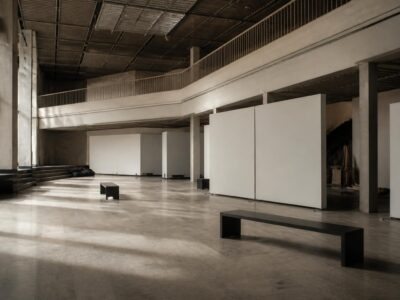
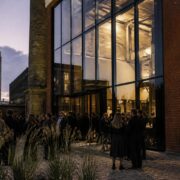
The Warsaw venue is the Institute of Creative Industries at Mińska 65, in a former printing house associated with the Polish Press Agency. Organisers have adapted the exhibition for this post-industrial setting rather than treating the building as a neutral container. The Warsaw installation was prepared by architect Maciej Siuda, with the spatial design developed specifically for the site.
The choice of venue adds a local dimension to an exhibition that arrives in Poland after presentations in Amsterdam and Athens. Industrial interiors, traces of previous production and the scale of the former printing facility create a contrast with the personal archives, costumes and moving-image material associated with Swinton’s artistic life.
For Warsaw, the project also illustrates the growing role of adaptable cultural spaces outside the city’s traditional museum circuit. The exhibition is located on the Praga side of the Vistula, an area where former industrial buildings, studios, galleries and creative institutions have increasingly become part of the capital’s cultural landscape.
From exhibition to film programme
The project is accompanied by a film programme connected with the reopening and renewed activity of Kino Tęcza. The Wajda Film Centre has announced a selection devoted to Swinton and Derek Jarman, while the wider programme is expected to extend the exhibition’s themes of memory, identity, artistic partnership and creative risk.
This combination of exhibition and cinema gives the Warsaw project a longer public life than a single opening weekend. Visitors can encounter the material culture surrounding Swinton’s work in the exhibition and then approach selected films as part of a related programme. The format encourages audiences to move between visual art, cinema and discussion rather than treating them as separate cultural categories.
The Wajda Film Centre’s involvement also places the exhibition within Warsaw’s broader film-education and public-programming infrastructure. Alongside screenings, the centre has continued to develop workshops and events for families, schools and wider audiences, helping to connect major cultural projects with local participation.
Why the project matters for Warsaw
“Tilda Swinton – Ongoing” gives Warsaw a high-profile international cultural attraction during the autumn and winter season, but its significance is not limited to celebrity presence. The project presents a model of cultural programming based on cooperation between a festival, an international film museum, a creative venue, an architectural team and a city-based film institution.
Its central subject—how artistic work grows through collaboration—is also relevant to the city’s wider cultural ecosystem. Warsaw’s creative life depends on links between cinemas, theatres, galleries, festivals, independent producers and repurposed industrial buildings. By bringing those different strands together, the exhibition offers visitors both an encounter with Swinton’s work and a view of how contemporary cultural production can be organised.
The exhibition is open at the Institute of Creative Industries, Mińska 65, Warsaw, from September 18, 2026, through January 17, 2027. Further visitor information, ticketing details and programme updates are available from the organisers and Warsaw’s official tourism service.

















Comments