

 By
By 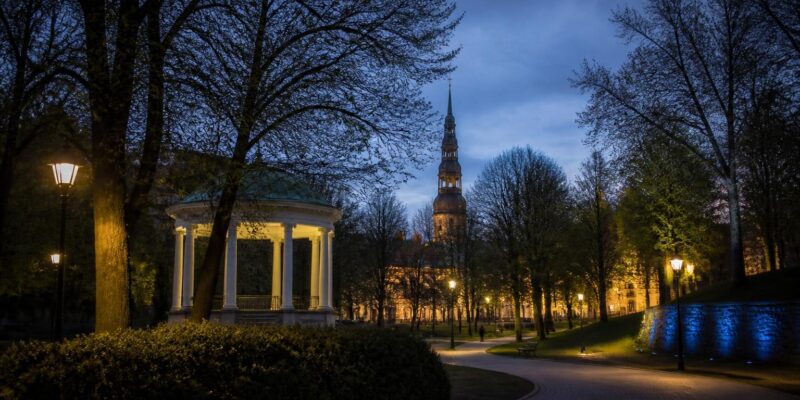
Tallinn’s Kadriorg Park has become an open-air gallery this week as the city’s annual Light Walks festival returns for its 19th edition. Running from Wednesday, 16 September, through Saturday, 19 September, the free event invites residents and visitors to experience the park after dark through temporary light installations, sound and live performance.
This year’s theme, “Glow of Shadows”, places the relationship between darkness and illumination at the centre of the programme. Rather than treating the park simply as a backdrop for decorative lighting, the festival presents the evening landscape as a changing visual environment, encouraging visitors to move through it at their own pace.
The festival is open each evening from 8pm to 11pm. Tallinn’s official event listing describes the programme as a visual journey in which the park’s night-time atmosphere becomes part of the artistic experience. The event is organised by the Tallinn Culture and Sports Department and admission is free.
A longer format for the 2026 edition
Light Walks has traditionally been a late-season city event, using the earlier autumn darkness to bring public attention to Kadriorg’s paths, lawns and historic surroundings. In 2026, the festival is being held over four consecutive evenings, one night longer than in previous editions.
That extended schedule gives audiences more flexibility to attend and may help distribute visitors across the programme. It also allows the festival to function as a broader part of Tallinn’s cultural week rather than as a single concentrated event. The city has advised visitors to consider walking, cycling or public transport when travelling to Kadriorg, where large crowds are expected during the evening hours.
Installations accompanied by sound
According to Estonia’s public broadcaster ERR, this year’s festival includes 17 installations and three performances. The broadcaster reported that sound has a more prominent role in the 2026 programme, with many of the installations designed to include an audio component.
Artistic director Argo Valdmaa told ERR that the organisers wanted sound to strengthen the emotional effect of the visual works. The combination of illuminated spaces, ambient audio and movement through the park gives the event a sensory character while retaining its essentially public and accessible format.
The approach also reflects a wider trend in contemporary light festivals: public parks and historic landscapes are being used not only for projection spectacles, but for temporary artistic interventions that alter how people perceive familiar places. In Kadriorg, visitors encounter the park’s established geometry, trees and architecture under changing conditions of colour, shadow and sound.
Culture in a shared urban space
One of the festival’s strengths is its low threshold for participation. There is no admission fee, and the event does not require visitors to follow a fixed seating arrangement or attend a single performance at a set time. People can arrive for a short walk, stay for the full evening or return on another night.
That flexibility makes Light Walks suitable for different audiences, including families, cultural tourists and Tallinn residents who may know Kadriorg primarily as a daytime park. The festival also extends the seasonal use of the area into the darker months, when public spaces can otherwise become quieter after working hours.
The setting is significant. Kadriorg is one of Tallinn’s most recognisable historic park areas, with formal avenues, open lawns and architectural landmarks. Temporary light art can make those features visible in new ways without requiring a permanent construction project. The result is a cultural event rooted in place: its effect depends as much on the experience of walking through Kadriorg as on the individual installations.
Practical information
Light Walks continues through Saturday, 19 September. The festival takes place in Kadriorg Park each evening from 8pm to 11pm and is free of charge. Organisers recommend using public transport, bicycles or walking where possible. Visitors attending in wet weather are advised to bring rain protection that does not obstruct the view of other people.
For Tallinn, the event offers a constructive way to mark the transition into autumn: a cultural programme that is open to the public, uses an established urban landscape and brings contemporary visual art into everyday city life.












Comments