

 By
By 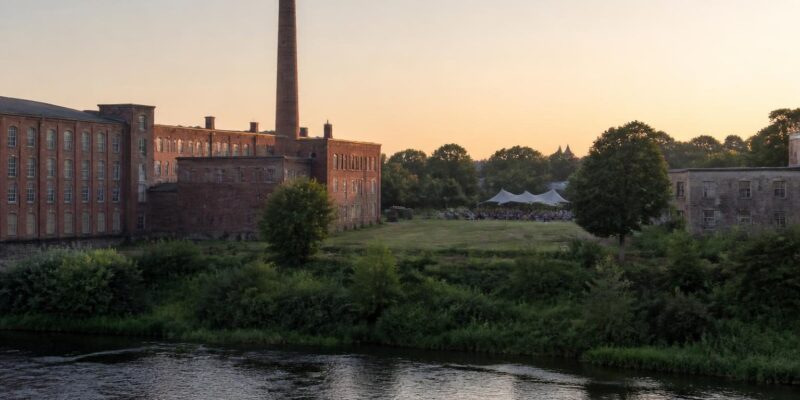
Narva’s Kreenholm district becomes a temporary stage for music theatre this week as the 2026 Narva Opera Days begin on Thursday, August 13. The three-day programme places opera and contemporary performance in one of Estonia’s most distinctive industrial heritage landscapes, with events continuing through August 15.
The festival is centred on the former Kreenholm Manufactory, a large textile complex whose history is closely tied to Narva’s industrial development. Rather than separating cultural activity from the city’s built heritage, the organisers use the district itself as part of the experience. Performances, art tours and an audio journey invite audiences to encounter the site through sound, storytelling and live performance.
A festival built around place
Visit Estonia lists the festival’s main location as the Kreenholm Manufactory opera tent on Joala Street. The setting gives the programme a strong architectural identity: historic industrial buildings, open spaces and the traces of a former manufacturing community form the backdrop for contemporary classical music and stage work.
That approach has helped make Narva Opera Days different from a conventional concert-hall festival. The organisers present the city’s industrial environment not simply as scenery, but as a cultural resource. For visitors, the programme offers an opportunity to combine a performance with a closer look at one of Narva’s best-known heritage areas.
The festival was founded by Narva-born opera singer Julia Savitskaja, who has organised it since 2015. The event has developed around the idea that ambitious music theatre can reach audiences outside Estonia’s largest cultural centres while also strengthening the cultural life of Narva itself.
Opera, contemporary work and guided encounters
The 2026 programme includes two principal ticketed performances. On Friday evening, August 14, the festival presents the gala “Turandot 100”, a programme connected with the centenary of Giacomo Puccini’s death. On Saturday, August 15, audiences can attend a performance of Einstein on the Beach by Philip Glass and Robert Wilson, a landmark work of twentieth-century experimental music theatre.
The programme also includes “Kreenholm Echo”, an audio journey connected with the manufactory, and guided art tours of the district. These activities broaden the festival beyond the stage and encourage audiences to move through the site, observe its architecture and consider how industrial spaces can acquire new public meaning.
According to the festival information published through Piletilevi, the Friday and Saturday schedule combines the performances with daytime tours and the audio experience. The arrangement gives the event a mixed rhythm: visitors can explore Kreenholm during the day before attending a major evening production.
Culture outside the capital
Narva Opera Days are part of a broader pattern in Estonia’s cultural life, in which large-scale music and theatre are increasingly associated with places beyond Tallinn and Tartu. Narva’s location in the country’s northeast gives the festival a particular local importance. It brings professional performers and specialist audiences to a city whose cultural identity is shaped by industrial heritage, multilingual communities and a strong interest in public cultural programming.
The festival’s organisers have also positioned the event as a meeting point for established repertoire and newer artistic forms. That balance is visible in the pairing of a Puccini-focused gala with Einstein on the Beach, a work known for its minimalist musical language and unconventional structure. The combination offers audiences both a familiar operatic reference and a more experimental encounter.
For Narva residents, the event provides a concentrated programme close to home. For visitors from elsewhere in Estonia and abroad, it offers a reason to experience Kreenholm as a living cultural district rather than only as a historical industrial site.
Why the 2026 edition matters
The significance of this year’s festival lies less in a single headline production than in the way it connects several layers of public life: heritage, tourism, contemporary performance and local participation. The Kreenholm setting gives the performances an unmistakable sense of place, while the tours and audio work make the wider district part of the programme.
That combination also reflects a practical model for cultural development. Historic sites can host new audiences without losing their identity, and artistic events can help visitors understand a city through more than its standard tourist landmarks. In Narva, the result is a festival that treats culture as both performance and urban exploration.
Narva Opera Days run from August 13 to 15, 2026. The principal ticketed performances take place at the Kreenholm Manufactory, with the detailed programme and ticket information available through the festival’s event listings.










Comments