
 By
By 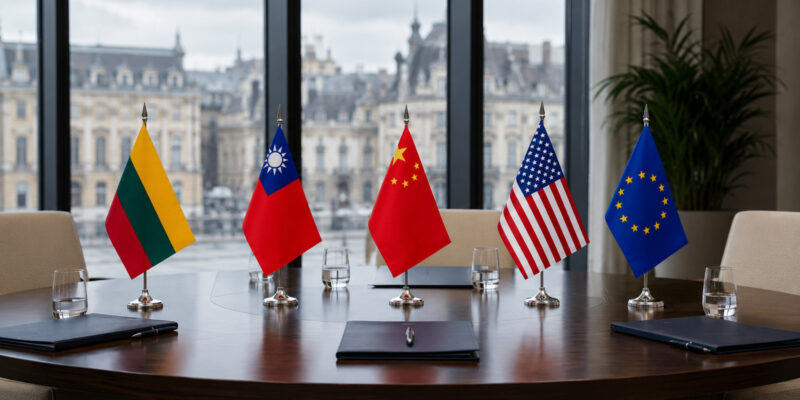
A bipartisan letter from the US Congress has renewed debate over Lithuania’s ties with Taiwan. The issue is not a simple choice between Washington and Beijing, but a test of how Vilnius can combine its One China policy, practical cooperation with Taiwan, European coordination and the restoration of workable relations with China.
By The Baltic Review Editorial Team
A letter sent on 10 August by the four co-chairs of the US Congressional Taiwan Caucus has returned Lithuania’s relationship with Taiwan to the centre of the country’s foreign-policy debate. Republican representatives Mario Diaz-Balart and Andy Barr and Democratic representatives Ami Bera and Greg Stanton called on Lithuania’s political leaders to continue what they described as the country’s “bold support” for Taiwan.
The intervention is politically significant because it is bipartisan, but it is not binding on Lithuania and does not settle the policy question. Vilnius must weigh several interests at once: relations with its principal transatlantic ally, the European Union’s common approach to China, economic ties with Taiwan, the possibility of stabilising relations with Beijing and Lithuania’s own authority to set foreign policy.
The dispute is often presented as a contest between two camps. In reality, at least five distinct positions shape it.
Lithuania: One China policy and practical ties with Taiwan
Lithuania’s official position contains two elements that are sometimes treated as contradictory but are presented by Vilnius as compatible. Lithuania adheres to a One China policy, does not recognise Taiwan as a sovereign state and has no diplomatic relations with it. At the same time, the Lithuanian Foreign Ministry describes Taiwan as an important economic and technological partner and the development of practical relations as part of the country’s diversification policy.
That distinction explains the legal and diplomatic form of the relationship. The Taiwanese Representative Office in Lithuania, opened in Vilnius in November 2021, is not an embassy. Lithuania also opened a trade representative office in Taipei in 2022. The relationship focuses on trade, investment, technology, research, education and other non-diplomatic contacts.
The controversy arose largely from the Vilnius office’s use of “Taiwanese” in its name. Beijing regarded that wording as implying a political status beyond unofficial relations. Lithuania maintained that opening a non-diplomatic office was consistent with its One China policy and comparable in purpose to practical arrangements used by other countries.
For Vilnius, the policy therefore has two objectives: preserving Lithuania’s formal diplomatic framework towards China while retaining the freedom to develop substantive, unofficial ties with Taiwan. The difficulty lies less in stating that formula than in maintaining it when the parties interpret its symbols differently.
United States: bipartisan support, but a Lithuanian decision
The congressional letter reflects a durable current in Washington: support for Taiwan is shared by influential members of both major parties, and Lithuania’s resistance to economic pressure has been viewed by many US policymakers as a question of democratic resilience.
The American position also requires precision. The United States itself maintains a One China policy and conducts robust but unofficial relations with Taiwan. The congressional appeal to Vilnius is therefore not, on its face, a demand that Lithuania recognise Taiwan diplomatically. It is an argument that unofficial political and economic engagement should not be reduced under pressure from Beijing.
At the same time, a letter from caucus co-chairs represents the position of legislators, not a legally binding instruction to a foreign government. Lithuania’s security relationship with the United States gives the appeal considerable political weight, but a sustainable Lithuanian policy cannot rest only on satisfying Washington. It must be defensible in Lithuanian and European terms.
Taiwan: partnership, visibility and economic substance
Taiwan presents the relationship as a partnership between like-minded democracies. Its foreign ministry has emphasised cooperation in semiconductors, lasers, fintech and other high-value sectors, as well as education and cultural links. From Taipei’s perspective, the Vilnius office is both a practical platform and an important sign that Taiwan can expand meaningful international connections despite its limited formal diplomatic recognition.
The economic dimension is essential to evaluating the partnership. Announced investment funds, memoranda and high-level visits can generate expectations, but the relationship will ultimately be judged by completed projects, trade flows, jobs, research partnerships and benefits for Lithuanian companies. Symbolism brought international attention; measurable delivery is what can make the policy durable.
Taiwan also has an interest in avoiding a situation in which the relationship is defined only through conflict with China. A broader agenda based on technology, business, academic exchange and supply-chain resilience would give cooperation a foundation independent of each new diplomatic dispute.
China: sovereignty, precedent and the name of the office
Beijing’s position is categorical. The People’s Republic of China considers Taiwan part of China and treats the One China principle as a political foundation for diplomatic relations. Chinese officials have argued that Lithuania created the impression of “one China, one Taiwan” and damaged China’s sovereignty and territorial integrity. They have repeatedly called on Vilnius to correct what Beijing describes as a mistake.
From the Chinese perspective, the dispute is not merely about commerce or administrative terminology. It concerns precedent: accepting the office’s name could, in Beijing’s view, encourage other states to give Taiwan greater international visibility. This helps explain why a decision by a relatively small EU member generated a response disproportionate to the scale of bilateral trade.
Lithuania and the EU, however, described the trade restrictions that followed as discriminatory and coercive. In January 2022 the EU brought case DS610 at the World Trade Organization. The panel process was later suspended, and on 28 November 2025 the EU terminated the procedure after stating that relevant trade had resumed and the key objectives behind the dispute had been met. The EU explicitly preserved its legal views and its right to challenge similar measures in future. Ending the case therefore did not amount to a WTO ruling that the disputed measures were lawful.
European Union: One China, peaceful stability and protection from coercion
The EU provides the institutional framework within which Lithuania must act. Brussels maintains a One China policy, develops non-diplomatic relations with Taiwan and opposes unilateral changes to the status quo in the Taiwan Strait, particularly by force or coercion. At the 2025 EU-China summit, the EU again combined these elements with a call for peaceful resolution under international law.
The Union also has a direct interest in preventing pressure on one member state from fragmenting common policy. Its response to the Lithuania dispute included the WTO case and, in the wider policy context, the adoption of the Anti-Coercion Instrument in 2023. The instrument is designed to deter third countries from using trade or investment restrictions to compel policy changes and permits proportionate EU countermeasures as a last resort.
Yet European support does not remove the need for coordination. Lithuania’s national choices can have consequences for the whole single market and for EU-China relations, while an exclusively bilateral response by a larger power can expose a smaller member state. The practical lesson is that significant moves should be discussed early at EU level and supported by a clear assessment of economic risk.
What a sustainable Lithuanian policy could look like
A durable approach does not require Lithuania to choose one capital and reject the others. It requires clearer limits, better coordination and more measurable outcomes.
First, Vilnius can reaffirm in unambiguous language that it maintains its One China policy and does not have diplomatic relations with Taiwan. Second, it can state with equal clarity that the policy permits substantive non-diplomatic relations in trade, technology, culture and education. Third, it can seek functional diplomatic relations with Beijing without accepting economic coercion as a legitimate means of changing Lithuanian policy.
Fourth, cooperation with Taiwan should be evaluated through transparent results rather than announcements alone. Public reporting on investment, joint research, exports and business participation would allow the Lithuanian public to judge costs and benefits. Fifth, future decisions with significant EU implications should be coordinated with Brussels and other member states before they become a crisis.
This framework would not eliminate disagreement. Beijing may continue to object to the office’s name; US lawmakers may continue to press for stronger engagement; Taiwan will seek greater international space; and EU members will differ in their appetite for risk. Diplomacy is not the removal of those differences but the management of them.
The central question
The congressional letter has highlighted a genuine strategic issue, but it should be treated as one contribution to Lithuania’s decision-making rather than as its conclusion. The relevant test is whether Vilnius can defend three objectives simultaneously: sovereign policy choice, consistency with its stated One China policy and practical protection of national and European economic interests.
The most credible course is neither abrupt retreat nor symbolic escalation. It is a predictable policy: meaningful but unofficial relations with Taiwan, open channels with China, close coordination with the EU and transparent accounting of the results for Lithuania.
That balance will not satisfy every external actor. It may nevertheless offer the strongest basis for a policy that can survive changes of government, pressure from abroad and the next diplomatic crisis.






















Comments