
 By
By 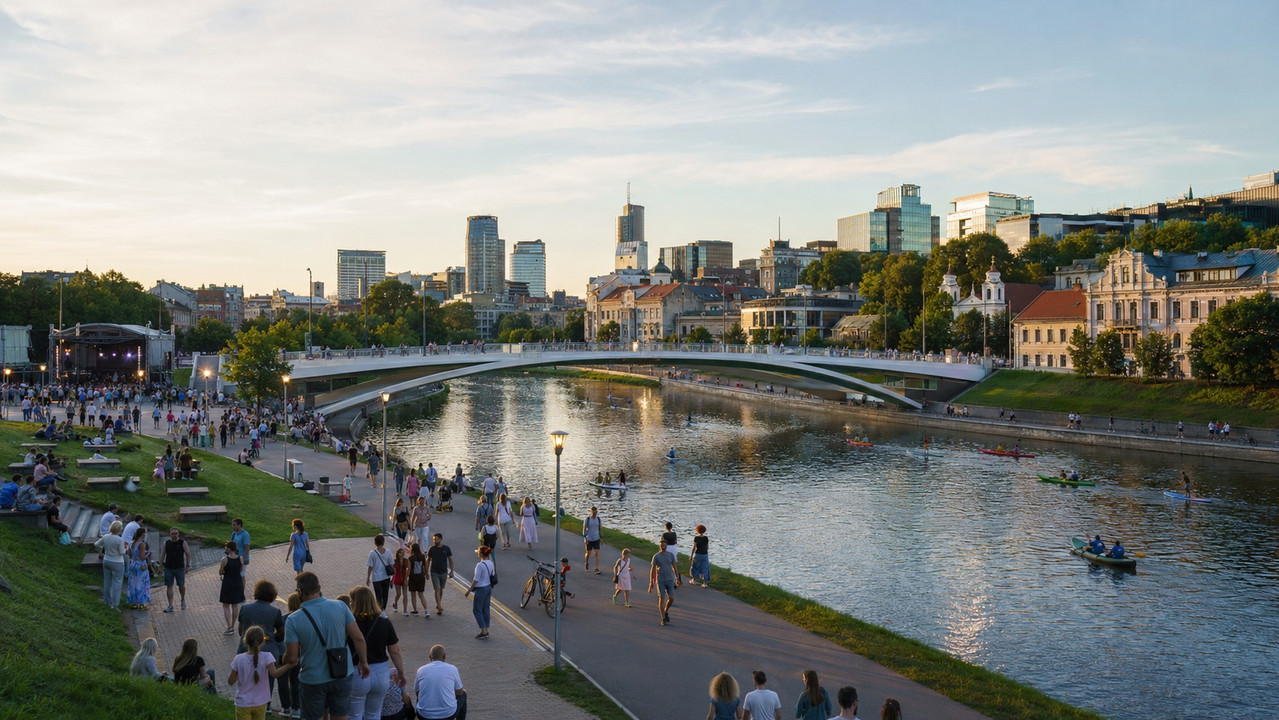
For one midsummer Saturday, Vilnius stopped treating the Neris as background scenery. On 25 July 2026, the Lithuanian capital’s first Upės festivalis — River Festival — stretched from Vingis Park Bridge to Žirmūnai Bridge, linking four waterfront zones through music, outdoor cinema, sport, literature, dance and night-time activity on the water.
The event was free and deliberately decentralised: instead of asking visitors to enter a fenced festival ground, it invited them to travel through the city. Post-event coverage confirmed that the programme took place across the announced locations, while images distributed by BNS showed the festival’s most spectacular attraction — dozens of teams sending homemade tandem bicycles down a ramp and into the Neris. The larger story, however, was not a single stunt. It was Vilnius testing whether its river could once again function as shared urban space.
A Festival Built as a Route, Not an Enclosure
The River Festival coincided with St Christopher’s Day. The choice was more than convenient branding: St Christopher is the patron saint of Vilnius and appears on the city’s coat of arms carrying the Christ Child across water. A festival organised as a journey along a river therefore had an unusually coherent relationship with the date.
The route covered the banks around four bridges:
- Vingis Park Bridge, focused on well-being, families and film;
- White Bridge, where sport, the tandem bicycle show and headline concerts dominated;
- King Mindaugas Bridge, built around live music and social dancing;
- Žirmūnai Bridge, dedicated to literature, nature and sustainable city life.
This structure allowed people of different ages and interests to use the same event without having to consume the same programme. Parents could spend an afternoon at workshops and a family film; sports fans could remain around the White Bridge; readers could head directly to Olimpiečių Street; concertgoers could move between two music areas before the late-night programme.
It also changed the relationship between event and city. The distance between the outer zones was not an inconvenience to be hidden. Walking, cycling and public transport were part of the experience.
Four Riverbanks, Four Versions of Vilnius
Vingis Park: Cinema, Movement and a Slower Rhythm
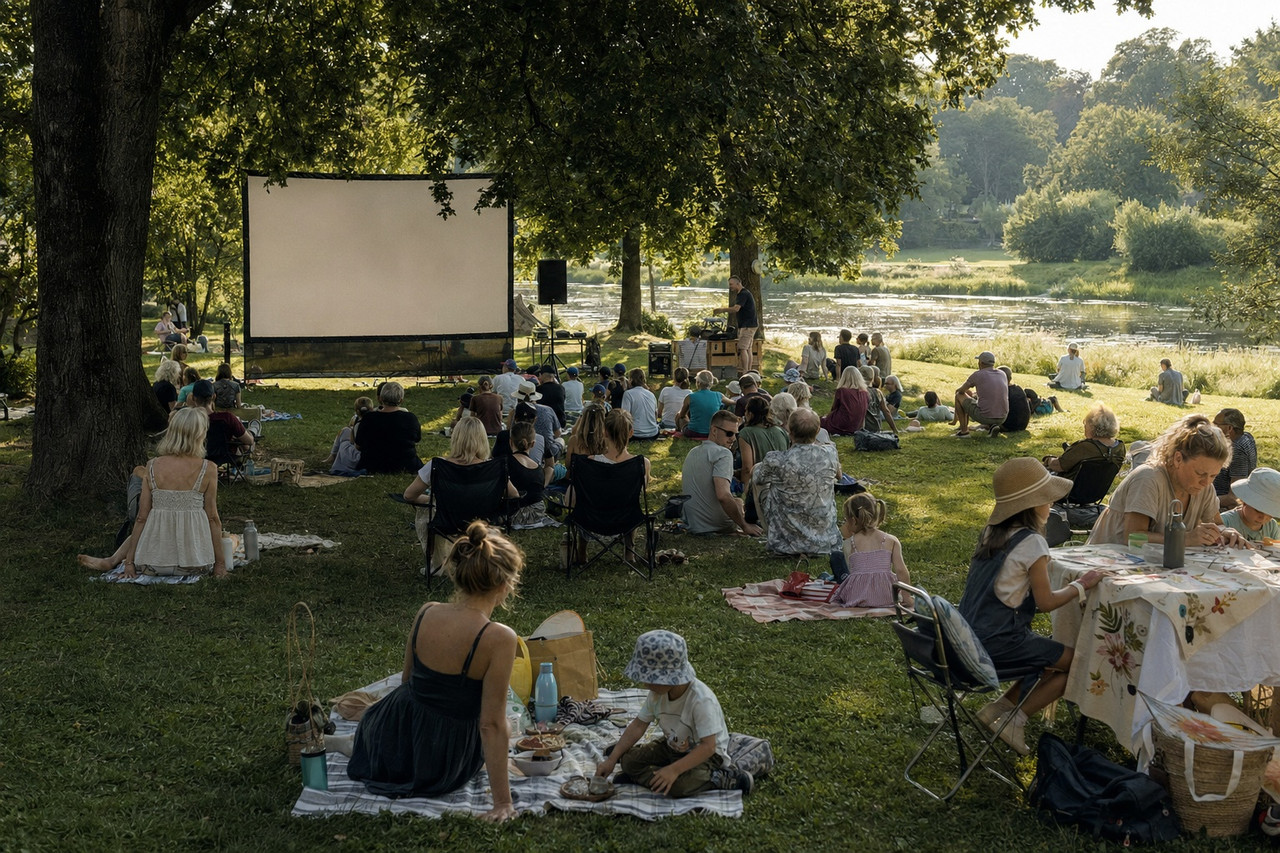
The western zone near Vingis Park Bridge offered the gentlest opening. Its “Well-being Meadow” combined Animal Flow sessions, a barefoot sensory path, educational games, healthy snacks and creative workshops. A three-kilometre Walk15 route invited participants and their pets to explore the riverside and the landscape around the Karoliniškės reserve.
Kino Pavasaris then turned the meadow into an outdoor cinema from 14:00. The programme included the animated family film Hola Frida!, Anthony Marciano’s The American Dream, the Lithuanian shorts Café-Buffet and Concrete Children, and Tsou Shih-Ching’s Left-Handed Girl at 20:00. Several screenings included English subtitles, an important detail for international residents and visitors.
The location worked because it did not attempt to compete with the louder zones. Blankets, folding chairs and picnic supplies replaced the conventional cinema foyer. The riverbank became both auditorium and social space.
White Bridge: Spectacle, Sport and the Main Stage
The White Bridge area was the festival’s most visible hub. Its sports programme began in the morning with beach volleyball, public workouts, football activities, basketball challenges and scooter competitions.
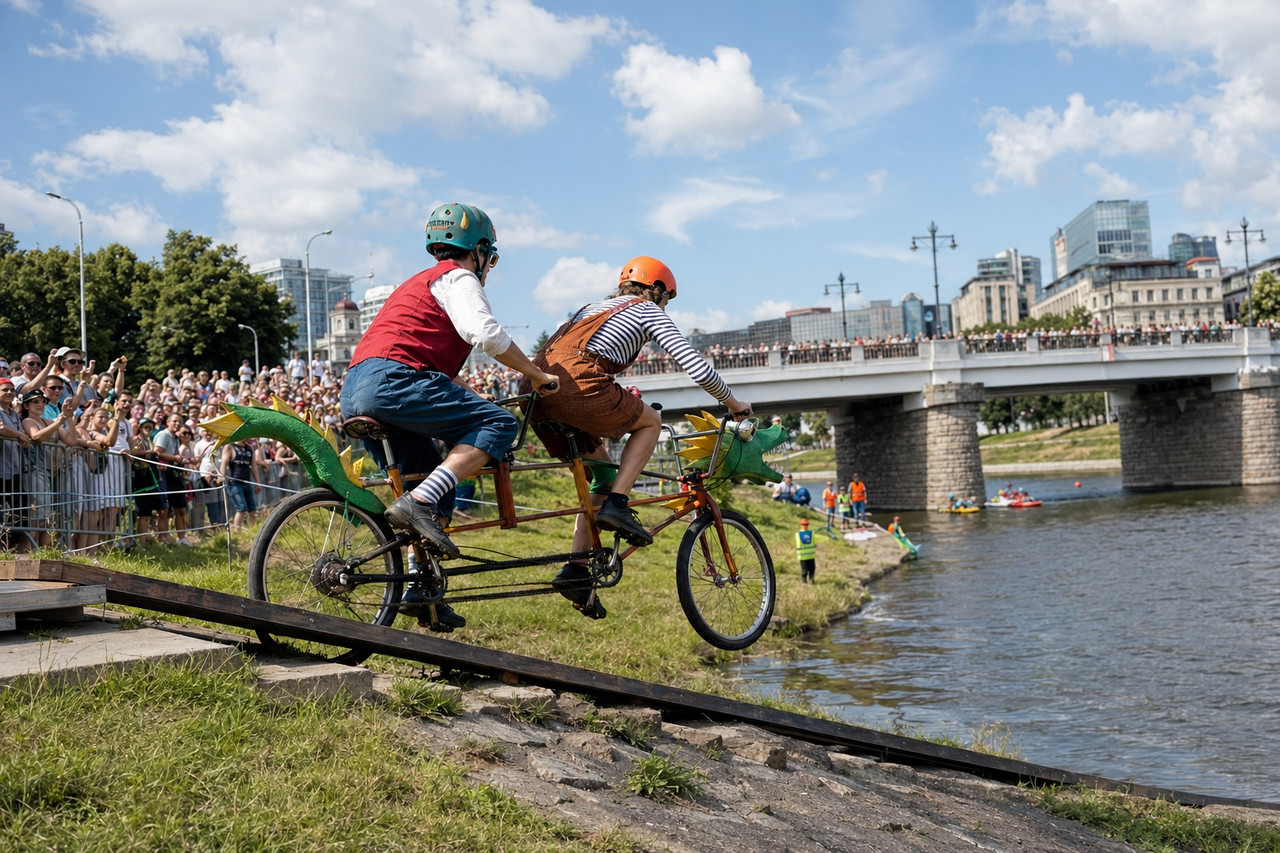
At 14:00, Red Bull Tandemynės brought its first Baltic edition to a specially constructed course above the Neris. Teams rode homemade two-person bicycles down a ramp, negotiating obstacles before finishing in the river. Speed mattered, but so did costume, engineering and presentation. TV3 carried the event live, while post-event reporting by 15min and BNS documented dozens of riders and machines entering the water.
The event’s visual language was deliberately comic, but its appeal was broader than slapstick. Each vehicle was a small design project, and each run combined performance, risk and public participation. It supplied the festival with the images most likely to travel beyond Lithuania.
After the competition, the emphasis shifted to the Music Meadow. Lithuanian indie-rock group Colours of Bubbles performed at 19:00, Angelou followed at 20:00, and alternative-rock band ba. closed the main concert sequence from 21:00.
King Mindaugas Bridge: A Journey Across Genres
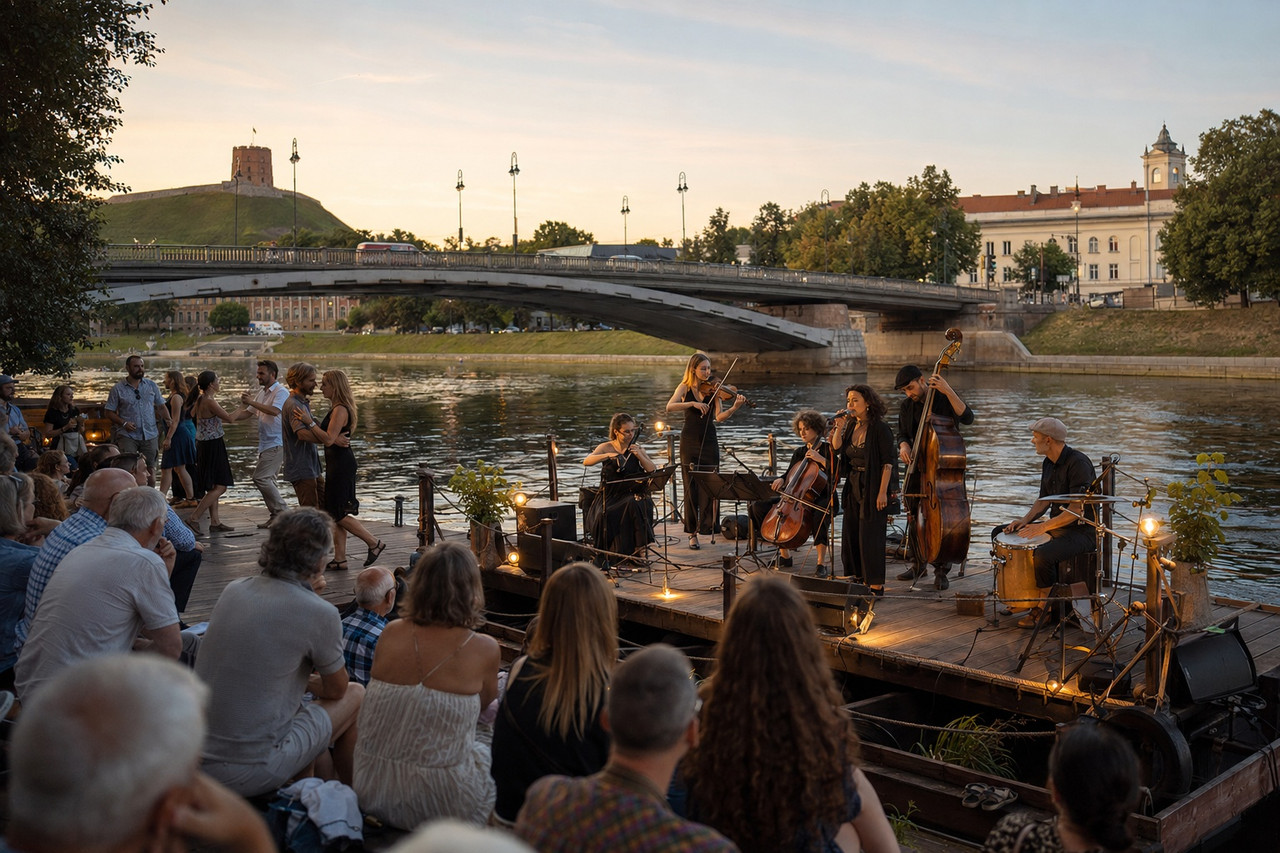
The programme beside King Mindaugas Bridge gave the festival a more musically exploratory character. Perfect Nemesis opened the GastroBoat deck at 16:00. The St Christopher Chamber Orchestra followed at 17:00 with a programme connecting classical repertoire, popular music and contemporary culture. Subtìlus performed at 18:00, mixing live instrumentation, electronic sound and Lithuanian traditional motifs. At 19:00, the Vilnius JJAZZ Ensemble appeared with vocalist Kotryna Juodzevičiūtė.
At the nearby Kitas Krantas venue, free blues lessons, Mandolin Blues and open social dancing invited the audience to participate rather than merely observe. The progression from chamber orchestra to jazz, blues and electronic music was one of the day’s clearest examples of the festival’s cross-generational design.
Žirmūnai: Literature, Children and the Green City
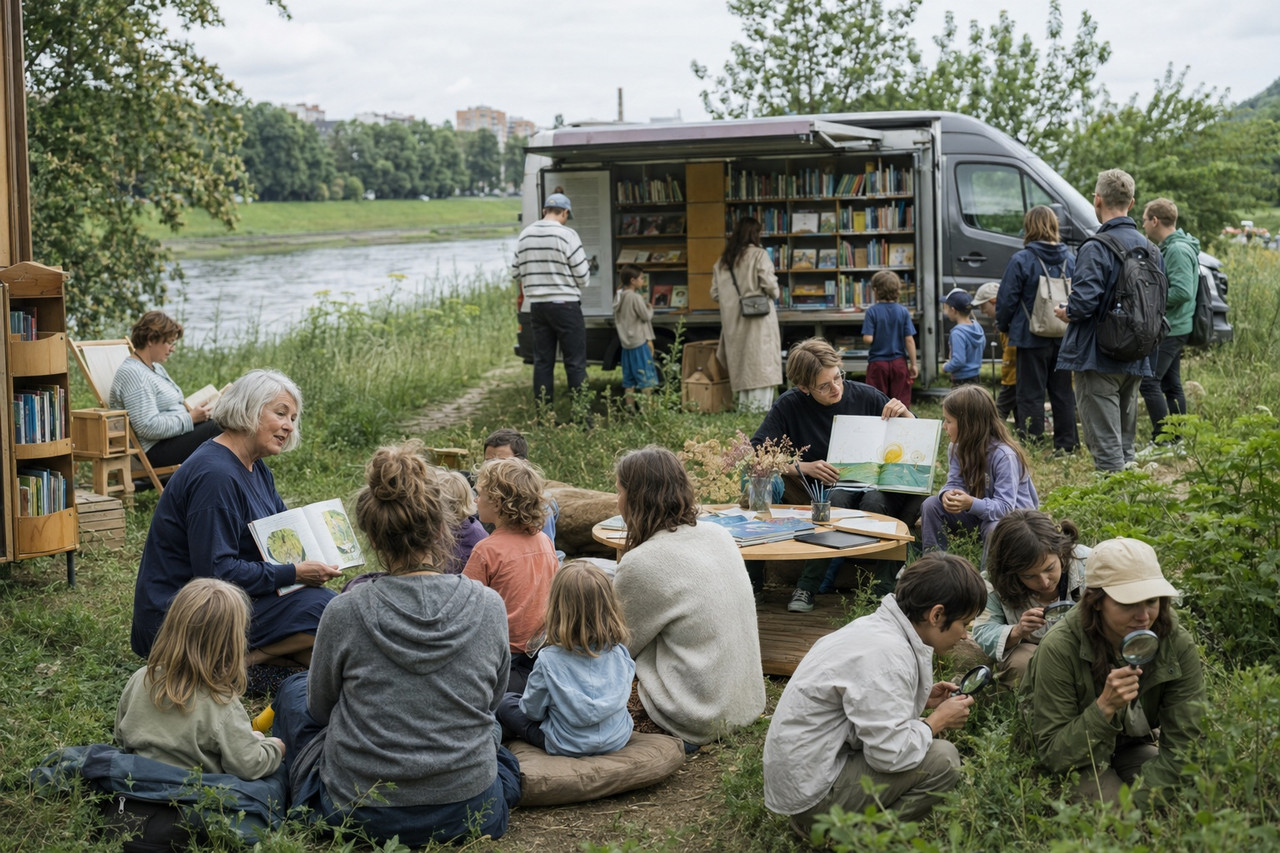
The eastern zone on Olimpiečių Street created a quieter “City of Literature and Games”. The Bibliobus, book exchange, family workshops and nature activities shared the riverside with author and illustrator events involving Greta Gaidelytė, Aušrinė Tilindė, Greta Alice and Kornelija Žalpytė.
Poetry and prose readings began at 17:00. At 18:30, the programme turned to the work of Lithuanian-American filmmaker and poet Jonas Mekas, with his son Sebastian Mekas among the participants.
This zone mattered editorially because it prevented the event from becoming only a sequence of commercial attractions. Literature, ecology and children’s education treated the river as a place of attention and memory, not simply a dramatic backdrop.
The Neris After Dark
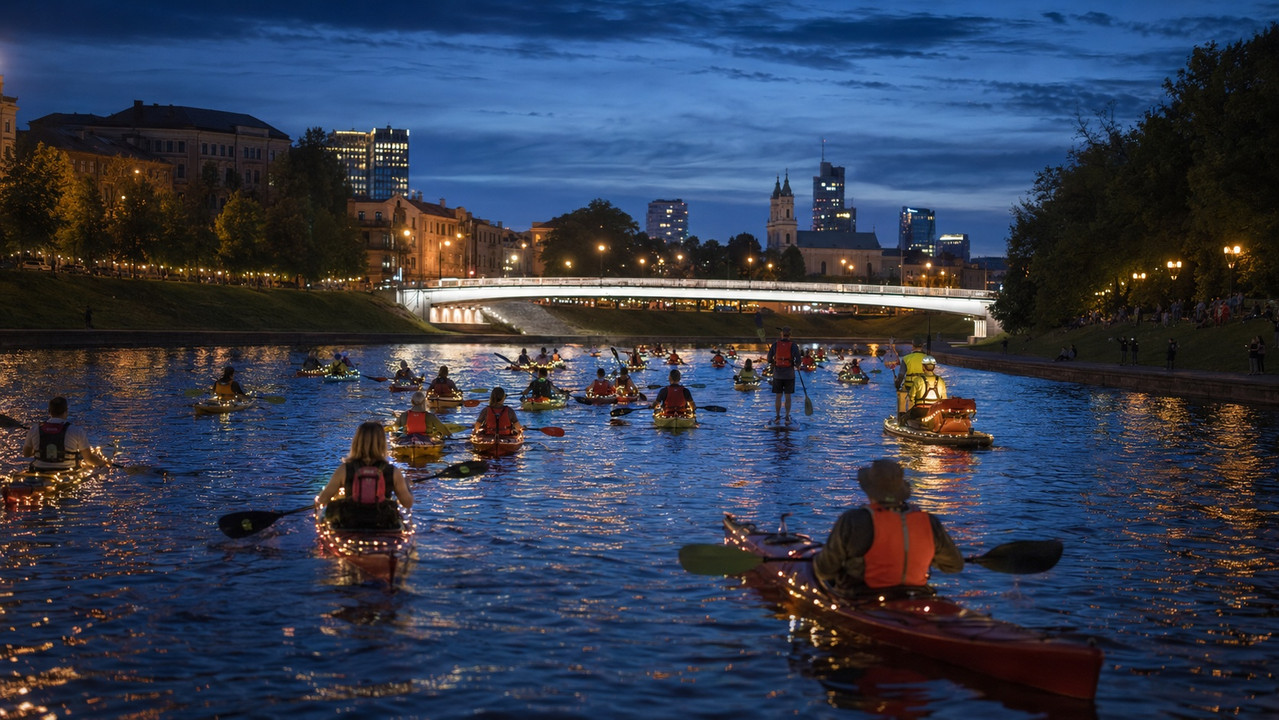
Water returned to the centre of the programme with Vilnius Kayak Night. Registration and safety instructions began at 19:00 at Valakampiai II Beach. Paddleboards started at 20:00 and kayaks at 20:02, heading towards the finish near the White Bridge between approximately 21:30 and 22:00.
Organisers described the event as a communal paddle rather than a race. Life jackets were compulsory, places were limited and advance registration was required. The format also included a competition for the best-decorated kayak or paddleboard.
From 22:00, the Energy and Technology Museum roof hosted the final electronic programme and silent disco, with Sandra Gemayel, Mesijus x Münpauzn and Valdagger. The sequence — river, embankment, floating deck and museum roof — gave visitors several different perspectives on the capital within a single day.
Mobility Was Part of the Editorial Story
A festival distributed along several kilometres required more than a stage schedule. JUDU increased the frequency of five bus routes — 1G, 3G, 4G, 6G and 43 — and eight trolleybus routes. The 3G also made an additional stop at Kražių.
Some streets and cycle paths near the festival zones were temporarily restricted. Public riverboats ran a shortened Green Bridge–Žirmūnai Beach–Green Bridge service on 25 July and skipped the White Bridge stop around the festival period.
These adjustments revealed both the strengths and the complications of a linear urban festival. Dispersed venues reduced the pressure on a single enclosure and encouraged exploration, but they also required clear wayfinding, accessible transport and careful separation of festival infrastructure from ordinary walking and cycling routes.
Part of a Longer Return to the River
The festival did not appear in isolation. On 25 July 2025, exactly one year earlier, Vilnius introduced fully electric passenger boats as part of its public transport system. Four solar-assisted vessels, each designed for up to 32 passengers, connected five stops along the Neris and used tickets integrated with buses and trolleybuses.
That initiative was linked to Vilnius’s year as European Green Capital 2025. The 2026 River Festival extended the same underlying idea from mobility to culture: the Neris should be experienced as part of daily city life.
Historically, this is a return rather than an invention. Research published by Vilnius Gediminas Technical University notes that the Neris and Vilnia supported trade, fishing, water-powered industry, recreation and urban development. Their transport role declined with the growth of rail and road networks and became particularly weak during the Soviet period.
The festival could not reverse that history in one day. It did, however, demonstrate demand for a waterfront that supports several kinds of public life at once.
What Can — and Cannot — Be Concluded
As of 26 July, organisers had not published a verified total attendance figure or a detailed post-event impact report. It would therefore be premature to describe the festival as a numerical success or to compare it with established Baltic city festivals.
What can be verified is more specific:
- The announced four-zone format operated on 25 July.
- The main cultural, sporting and night-time programmes took place.
- Red Bull Tandemynės was held as the event’s first Baltic edition and received live television and national media coverage.
- The municipality and JUDU coordinated additional public transport and temporary traffic measures.
- The festival connected an existing river-mobility policy with cultural use of the waterfront.
Future evaluation should consider attendance by zone, accessibility, waste management, transport use, effects on nearby residents and whether smaller cultural partners benefited from the distributed model.
A Credible First Chapter
Vilnius’s first River Festival succeeded most clearly as an urban proposition. It asked residents and visitors to see the Neris not as the space between two banks, but as an address in its own right.
The strongest moments came from contrast: a family film near Vingis Park, improvised bicycles plunging into the water, chamber music on a floating deck, poetry near Žirmūnai and illuminated kayaks approaching the White Bridge. Together they made the city’s geography legible through experience.
Whether the River Festival becomes an annual fixture will depend on transparent evaluation and the city’s willingness to refine transport, accessibility and environmental management. But the first edition established a useful premise: Vilnius does not need to build a new festival district when one of its most distinctive public spaces is already flowing through the centre.
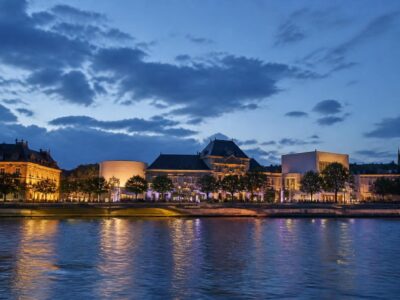
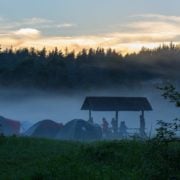
Photos: Editorial illustration created for The Baltic Review; not a documentary photograph of the event.








Comments