

 By
By 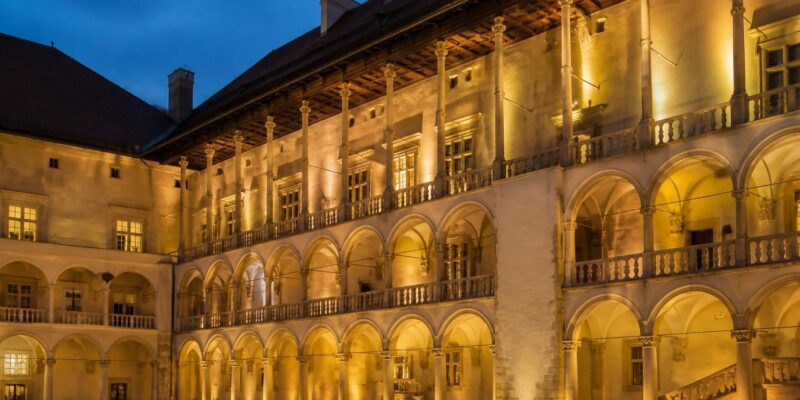
Music beneath Wawel’s illuminated arcades
KRAKÓW — The 19th edition of the Wawel at Dusk summer music festival reaches its finale on Sunday, 9 August, bringing a programme of Chopin, Mozart and Beethoven to the Arcaded Courtyard of Wawel Royal Castle. The closing concert is scheduled for 8 p.m. and will feature pianist Zitong Wang, the CORda Cracovia Orchestra and conductor Paweł Kapuła.
The event is a current cultural highlight for Kraków because it places a live classical programme inside one of Poland’s most recognisable historic settings. Rather than treating the castle as a passive backdrop, the festival presents its courtyards as part of the experience: music, evening light and Renaissance architecture are designed to work together.
A finale shaped around three composers
Wang will open the programme with two works by Fryderyk Chopin: the Waltz in E major, Op. posth. No. 44, and the Andante spianato and Grande Polonaise brillante, Op. 22. The evening will then move to Wolfgang Amadeus Mozart’s Overture to The Marriage of Figaro, included in the year marking the 270th anniversary of the composer’s birth.
The second half is devoted to Ludwig van Beethoven’s Piano Concerto No. 3 in C minor, Op. 37. The combination gives the finale a clear musical arc, moving from Chopin’s intimate piano writing to Mozart’s theatrical energy and finally to Beethoven’s large-scale concerto form.
Wang’s appearance also connects the Kraków festival with Poland’s most prominent piano tradition. The Wawel programme identifies her as the third-prize winner of the 19th International Fryderyk Chopin Piano Competition in Warsaw, held in 2025. Her participation gives the closing concert a direct link to the competition that continues to shape Poland’s international musical profile.
A festival built around place
Wawel at Dusk has run from 30 July to 9 August this year. Its organisers are Wawel Royal Castle and the Castello Creative Group, with Małgorzata Janicka-Słysz as artistic director and Hubert Piątkowski responsible for organisational management.
The 2026 programme has combined chamber music, solo recitals, symphonic works and performances by young pianists. It has also maintained a strong Polish thread, with works by Chopin and Mieczysław Karłowicz placed alongside the wider European repertoire. Karłowicz’s Serenade for Strings was presented on 7 August in a concert marking the 150th anniversary of the composer’s birth.
The festival’s two principal venues are the Batory Courtyard and the Arcaded Courtyard. The castle says the Batory Courtyard is not normally open to the general public, making the concerts an opportunity to encounter the historic complex in an unusual evening setting. The Arcaded Courtyard hosts the larger symphonic events, including the 9 August finale.
Access beyond the concert hall
Wawel Royal Castle describes the festival as an event for Polish and international audiences of different generations. Its format helps make classical music part of the city’s summer public life rather than limiting it to a conventional concert hall.
That broad approach was visible earlier in the festival, when a free young pianists’ programme presented Chopin works and jazz improvisations inspired by his music. The main concerts are ticketed, with the castle listing standard tickets at PLN 140 and reduced tickets at PLN 90 for eligible young people, students, pensioners and senior citizens.
The finale is an open-air performance, so the organisers advise audiences to prepare for changing evening conditions. The Arcaded Courtyard entrances open at 7 p.m., one hour before the concert. Tickets may remain available at the venue on the day of the performance, depending on capacity.
Culture in a historic setting
The festival’s appeal lies in the meeting of established repertoire and a highly specific place. Wawel is associated with Poland’s royal and cultural history, while the concert format invites audiences to hear familiar works through the acoustics, lighting and visual rhythm of its courtyards.
For Kraków, the closing concert is therefore more than the last item in a summer calendar. It is a compact example of how heritage institutions can use their spaces for contemporary cultural participation while retaining attention to artistic quality and historical context.
On Sunday evening, the illuminated castle will provide the setting for the final musical conversation of the 2026 edition: Chopin at the piano, Mozart in the overture and Beethoven in the concerto, brought together by Wang, CORda Cracovia and Kapuła.
















Comments