
 By
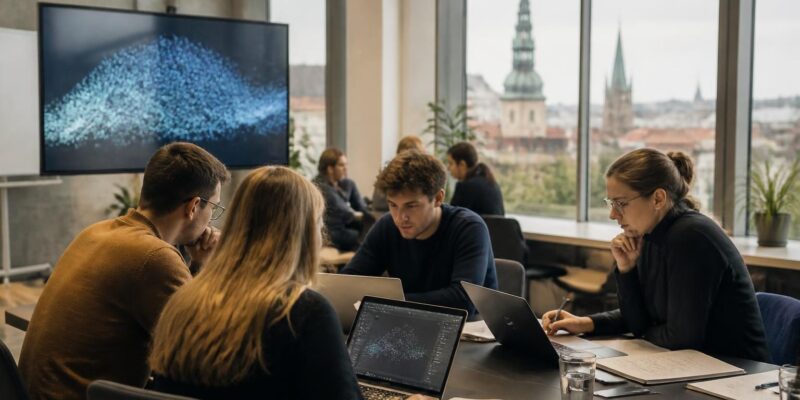
Latvia has joined New Nordics AI, a Nordic-Baltic cooperation platform designed to help businesses, researchers and public institutions develop and adopt artificial-intelligence solutions. The announcement was published on November 12, following the formal admission of Latvia, Lithuania and Estonia as partners at a high-level forum in Copenhagen on November 6.
For Latvia, the move creates a new regional channel for exchanging expertise, testing ideas and adapting digital tools to the needs of smaller language communities and public administrations. The cooperation is particularly relevant to companies and research teams that may benefit from access to partners and markets beyond Latvia’s domestic economy.
A regional platform for practical cooperation
Latvia’s National Artificial Intelligence Centre, known as AI Latvia, will act as the country’s national contact point in the network. The centre is expected to connect Latvian companies, researchers and public bodies with counterparts in the Nordic and Baltic countries.
The Latvian centre and New Nordics AI signed a three-year memorandum of understanding at the Techritory forum in Riga on October 21. The agreement identifies four main areas of cooperation: practical implementation of the European Union’s AI Act, development of technologies suited to regional languages and needs, wider adoption of AI in business and industry, and the development of digital skills. ([norden.lv](https://norden.lv/en/whats-new/news/latvia-joins-nordicbaltic-ai-cooperation/?utm_source=openai))
The focus on language is significant for Latvia. AI systems are often trained and evaluated using large-language datasets, while smaller languages can receive less attention in commercial product development. Regional cooperation could allow institutions to share tools, data practices and experience in building systems that work more effectively in Latvian and other Baltic and Nordic languages.
From shared knowledge to wider markets
The partnership is intended to move beyond discussion. According to the Nordic Council of Ministers’ Latvian office, the initiative aims to help organisations learn from solutions already tested elsewhere and to turn cooperation between government, academia and business into practical applications.
Fourteen recommendations presented at the Copenhagen forum call for closer coordination across the region. They include making it easier for AI companies to operate across national borders, expanding the use of validated AI applications in healthcare, bringing AI into teacher education and coordinating approaches to European rules affecting data centres.
For companies, the combined Nordic-Baltic market represents roughly 33 million people. That does not remove the challenges of scaling across different languages, regulations and procurement systems, but it gives smaller firms a wider base from which to test products and form partnerships. ([norden.lv](https://norden.lv/en/whats-new/news/latvia-joins-nordicbaltic-ai-cooperation/?utm_source=openai))
Digital capacity as an economic issue
The initiative also places artificial intelligence within a broader discussion about the region’s digital capacity. On November 6, Nordic and Baltic ministers responsible for digitalisation adopted a joint statement setting a direction towards 2030. It calls for stronger cooperation in areas including cloud services, digital infrastructure, research and skills.
The statement says the region should remain open to international partnerships and fair competition while improving its own ability to develop and use critical digital technologies. For Latvia, that approach links innovation policy with competitiveness: companies need skilled workers and reliable infrastructure, while public institutions need the capacity to evaluate, procure and implement new tools responsibly.
The declaration also highlights existing cross-border projects, including Nordic-Baltic digital identity cooperation and the regional AI centre. Its emphasis is not on creating a single technology market overnight, but on reducing duplication and making it easier for countries with similar public-service and business challenges to share solutions. ([norden.org](https://www.norden.org/en/declaration/common-nordic-and-baltic-approach-digital-sovereignty?utm_source=openai))
What Latvia brings to the partnership
Latvia enters the network with experience in digital public services, a growing technology sector and research institutions working on language technology, automation and data-driven applications. Its participation may also give Latvian innovators a clearer route into Nordic programmes, pilot projects and specialist networks.
The immediate result is institutional rather than financial: there is no new investment package attached to the announcement. The value will depend on whether the memorandum produces joint projects, skills programmes, shared testing environments or commercial partnerships that can be measured over time.
That practical test will be important for Latvia’s innovation ecosystem. Cooperation can widen access to expertise, but companies and public bodies will still need clear use cases, reliable data, qualified staff and transparent safeguards. New Nordics AI’s stated emphasis on responsible adoption and regional language needs provides a framework for that work.
Latvia’s entry therefore marks a modest but concrete step towards a more connected Nordic-Baltic technology market. It places Latvian organisations in a regional conversation about how artificial intelligence can be applied in public services and industry while preserving local knowledge, language and institutional trust.



















Comments