 By
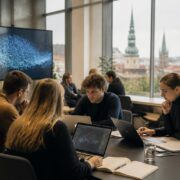
A regional environmental congress in Kraków is putting practical implementation at the centre of Małopolska’s climate conversation. The second Małopolska Climate–Circular Economy–Air Quality Congress, titled “Connected by care for the environment”, is taking place on 12 and 13 November 2026, bringing together representatives of local government, public administration, academia, business and non-governmental organisations.
The timing gives the meeting an immediate local focus. Małopolska is discussing how municipalities can turn broad environmental objectives into decisions affecting streets, homes, public buildings, waste systems and local energy planning. Rather than concentrating on a single project, the congress is structured as a regional exchange of methods and experience.
Three tracks for a regional agenda
The programme is divided into three parallel areas: the circular economy, climate and air quality, and adaptation. This structure reflects the way environmental questions increasingly overlap in everyday municipal work. Waste prevention can be linked to business innovation; energy efficiency can affect household costs and air quality; and urban greenery can support both cooling and water retention.
The circular-economy strand covers resource management, waste prevention, reducing food waste and the development of more circular business models. The emphasis is not simply on sorting and recycling after materials have been used. It also concerns how products and services are designed, how materials remain in use for longer and how local authorities can support more efficient use of resources.
For municipalities, those questions are practical. Procurement rules, public catering, renovation work and waste contracts can all influence how much material is consumed and discarded. The regional organisers describe the congress as a forum for presenting solutions and good practices that can be adapted by local governments across Małopolska.
Climate adaptation as local infrastructure
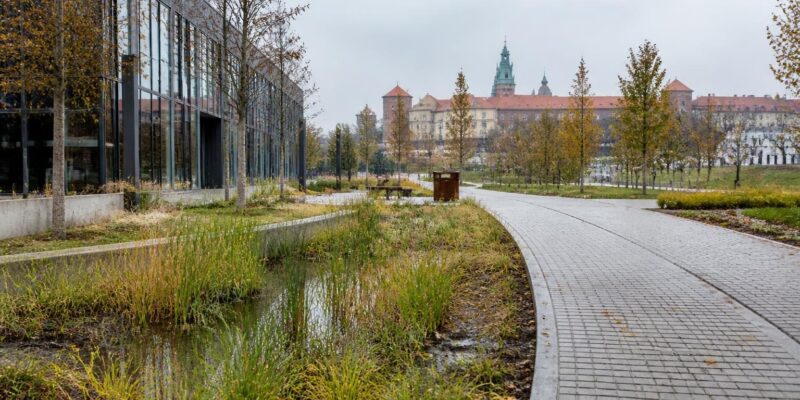
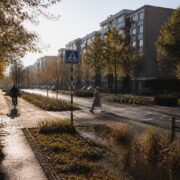
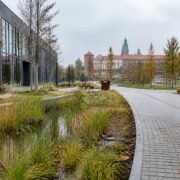
Adaptation is another major theme. The programme includes water retention, “sponge city” approaches, blue-green infrastructure and urban greenery. These measures are increasingly treated as part of infrastructure rather than decoration: trees, planted drainage areas, permeable surfaces and restored water-holding spaces can help towns manage heavy rainfall and heat while improving public space.
The European Climate Pact, which lists the Kraków event as a partner meeting, highlights the connection between adaptation and sustainable regional development. Its description of the congress includes reducing the urban heat-island effect, improving water retention and strengthening the resilience of cities and municipalities.
That approach is particularly relevant for local administrations, which often have to combine long-term planning with immediate maintenance decisions. A street redesign, school renovation or new housing project can either increase pressure on drainage and energy systems or create opportunities to make a neighbourhood more resilient.
Air quality remains a central concern
Air quality has its own programme track. The discussion links pollution reduction with the transition towards a lower-emission economy, energy efficiency and the modernisation of buildings. In a region where local authorities have spent years developing anti-smog measures, the focus is shifting towards implementation, financing and the practical choices available to households, institutions and businesses.
The regional government says it is preparing and implementing documents dealing with climate, adaptation, water management and the circular economy, while also supporting measures to improve air quality and use resources more efficiently. The congress gives those policy areas a shared setting, allowing specialists to compare experiences rather than treating them as separate administrative tasks.
Energy transition is also part of the agenda. Topics listed for the meeting include renewable energy, energy efficiency, energy communities and financing for sustainable energy investments. These themes place local governments in a coordinating role: they can connect residents, public institutions and businesses, identify suitable sites and help turn technical possibilities into projects that work at neighbourhood level.
A platform for cooperation
The congress is organised within the LIFE EKOMALOPOLSKA project, which supports implementation of the regional climate and energy action plan. It is co-financed through the European Union’s LIFE programme and Poland’s National Fund for Environmental Protection and Water Management.
That institutional framework matters because many environmental measures depend on cooperation across administrative boundaries. Air moves between municipalities, water systems cross city limits and waste or energy infrastructure often serves more than one community. A regional forum can therefore be useful not only for sharing information but also for identifying partners and coordinating future projects.
The Kraków meeting is not presented as a final assessment of Małopolska’s environmental transition. It is better understood as a working platform: a place where policies on clean air, climate resilience, resource efficiency and energy can be compared with the realities of municipal delivery.
For residents, the most important outcomes will ultimately be visible outside the conference room—in warmer or cooler public spaces, more efficient buildings, cleaner air, better water management and services that waste fewer resources. The congress’s central proposition is that those results depend on connecting expertise with decisions that local communities can actually implement.







Comments