

 By
From climate projections to local decisions
The European Climate, Infrastructure and Environment Executive Agency has placed several Lithuanian projects in the spotlight as examples of how climate adaptation can be connected with everyday public policy. The overview, published on November 6, 2026, describes initiatives involving Vilnius, Klaipėda, Joniškis and partners across the country.
Rather than presenting climate resilience as a single construction project, the European Union’s account brings together three different strands: better information about climate-related health risks, improvements to urban streets and a broader programme for energy efficiency. Together, they show how adaptation can involve research, municipal planning and changes in the way buildings, transport and industry use energy.
Vilnius tests a health-focused climate approach
One of the highlighted initiatives is AURORA, a Horizon Europe project designed to help communities in the European boreal climate region prepare for changing risks. Vilnius is one of five demonstration cities involved in developing and testing practical solutions.
The project combines climate information with health data and modelling. In Vilnius, the work addresses risks including more intense heat and cold periods, changing pollen patterns and the spread of tick-borne diseases. The aim is to help public authorities identify which groups and neighbourhoods may be more exposed and to improve the timing and precision of adaptation measures.
According to the Vilnius municipality, the project runs from September 2024 to February 2028. It has a total budget of approximately €7.21 million, including €6.10 million in European Union funding, and involves 26 organisations across Europe.
The municipality describes the planned tools as a way to monitor climate factors, produce risk maps and support early warnings. Such systems do not replace local decision-making, but can give cities a clearer basis for preparing health services, public information and nature-based measures.
A street project with a wider climate purpose
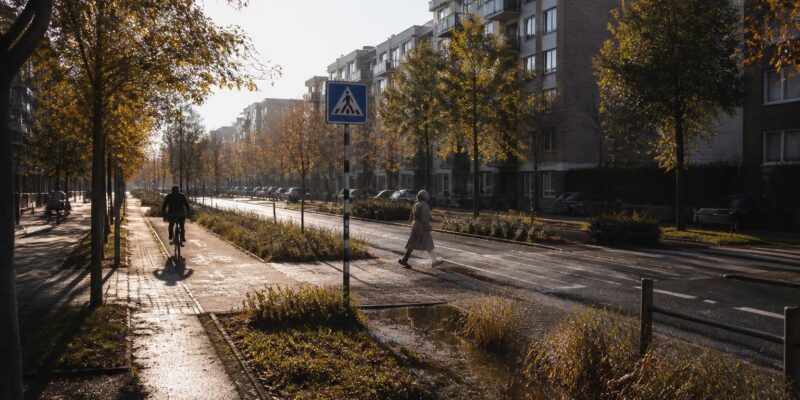
The EU overview also points to the JUST STREETS project in Vilnius. Its local focus is Medeinos Street in Pašilaičiai, a residential district where offices, a kindergarten and two schools are affected by congestion, limited pedestrian crossings and poor visibility.
The proposed approach links street safety with climate and quality-of-life objectives. Improvements to crossings and public-space infrastructure are intended to make the area more accessible for pedestrians, people with disabilities and parents with pushchairs. The project also examines residential parking and car-based school drop-offs.
That combination matters because climate adaptation in cities is often experienced through ordinary journeys rather than specialist environmental infrastructure. A safer crossing, a more comfortable route to school or fewer short car trips can reduce emissions while making a neighbourhood easier to use. The project is supported through Horizon Europe, which the European agency says has allocated €10.23 million to the wider initiative.
Energy efficiency remains the largest part of the picture
The third programme highlighted by the EU is ENERLIT, an integrated LIFE project supporting implementation of Lithuania’s National Energy and Climate Plan. Its work covers buildings, transport and industry, sectors with substantial potential for reducing energy consumption and emissions.
ENERLIT brings together public authorities, energy agencies, research institutions, municipalities and industry representatives. The programme supports energy-efficiency improvements in buildings, cleaner mobility and the modernisation of industrial energy systems. It also aims to improve the monitoring and modelling of national energy use and greenhouse-gas emissions.
The project has a budget of about €11 million, co-financed through the LIFE programme and Lithuanian national funds. Its practical value lies partly in connecting individual measures with national planning: energy renovations, transport choices and industrial upgrades can be assessed not as isolated actions but as parts of a longer transition.
Why the announcement matters
The European overview does not announce a single new construction start or a new law. Its significance is that it brings several active Lithuanian projects together at a time when cities and public institutions are looking for workable ways to respond to changing climate conditions.
For Vilnius, the initiatives provide an opportunity to connect scientific evidence with street-level planning and public health. For Klaipėda and Joniškis, the AURORA experience is intended to support future demonstration activities. For Lithuania as a whole, ENERLIT offers a framework for tracking whether measures in buildings, transport and industry are delivering the expected benefits.
The next stage will be implementation: turning models into usable guidance, involving residents in local changes and measuring whether improvements make streets healthier, infrastructure more efficient and communities better prepared for heat, cold and other climate pressures.












Comments