

 By
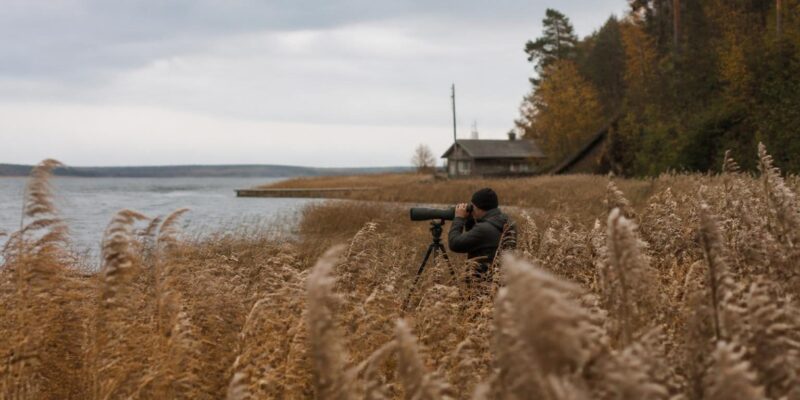
A new wildlife photography exhibition in Kaliningrad is turning a familiar regional landscape into a place of discovery. “On the Birds’ Path” opened on November 6 at the Kaliningrad Regional Museum of History and Arts, bringing together more than 40 photographs devoted to the Curonian Spit, its wildlife and the scientific work carried out at the Fringilla field station.
The museum announced the opening on November 9, making the exhibition one of the city’s most recent cultural developments. Its subject is both visually accessible and scientifically grounded: the photographs show birds, animals and coastal landscapes, while the accompanying presentation explains why the narrow sandy peninsula has long been important for the study of migration.
A meeting point for photography and field science
The exhibition marks the 70th anniversary of the Fringilla field station, a seasonal ornithological research site operated by the Rybachy Biological Station of the Zoological Institute of the Russian Academy of Sciences. The station stands on the Curonian Spit in Kaliningrad Region, where the geography of the coast concentrates the movement of migratory birds.
According to the Kaliningrad tourism information centre, the exhibition includes more than 40 images made by members of the Union of Wildlife Photographers. The photographs are intended not simply as nature pictures, but as an introduction to the work of the station and to the Curonian Spit as a living research environment.
That combination gives the project a wider public value. Visitors who may know the spit mainly as a destination for walks, dunes and forests can also encounter it as a place where observations are gathered over time. A bird in flight, a flock above the tree line or an animal moving through coastal vegetation becomes part of a longer record of seasonal change.
Why Fringilla matters
The national park’s own information describes Fringilla as a field station located along a major seasonal migration route. Millions of birds pass over the Curonian Spit during spring and autumn movements. Researchers use the station for observation, registration and bird ringing, work that helps scientists understand migration patterns and the condition of individual species.
The station was organised in 1956 at the Rybachy settlement and inherited a much older local tradition of ornithological research. Its predecessor, the Rossitten bird observatory, operated in the area from 1901 to 1944. The modern field station therefore sits within more than a century of changing scientific methods, landscapes and public interest in the birds of the Baltic region.
The name “Fringilla” refers to the chaffinch, a small songbird whose Latin genus name became associated with the station. The name also signals the exhibition’s emphasis on close observation. The project invites viewers to look beyond the postcard image of the Curonian Spit and notice the movement, habitats and seasonal rhythms that make the area distinctive.
A regional story presented in the city
Bringing the subject to a museum in central Kaliningrad makes the exhibition accessible beyond the national park itself. The Curonian Spit stretches across a sensitive coastal landscape, and visitors to the field station normally encounter the research setting as part of a specific excursion or seasonal programme. The museum display offers a quieter and more compact way to learn about the place.
This urban presentation is also useful for families and school groups. Wildlife photography can provide a direct entry point into questions about biodiversity, migration and protected areas without requiring specialist knowledge. The images give the exhibition an emotional and aesthetic appeal, while the information about Fringilla adds context about how field science is conducted.
The project also connects several forms of regional heritage: the natural heritage of the Curonian Spit, the history of ornithological research, the work of contemporary photographers and the museum’s role as a public educational institution. None of these elements is treated as separate from the others. Together, they create a portrait of the region shaped by water, sand, forests and seasonal movement.
Open through the winter season
The Kaliningrad Regional Museum of History and Arts says the exhibition will remain on view through December 20, 2026. It is suitable for a general audience and carries a 0+ age rating in the museum’s announcement. The museum is located at 21 Klinicheskaya Street in Kaliningrad.
For local residents, the exhibition offers a timely indoor cultural stop at the beginning of the winter season. For visitors planning a trip to the region, it provides useful background before travelling to the Curonian Spit. Most importantly, it presents the peninsula not only as scenery, but as a place where long-term observation helps explain the natural world.













Comments