

 By
By 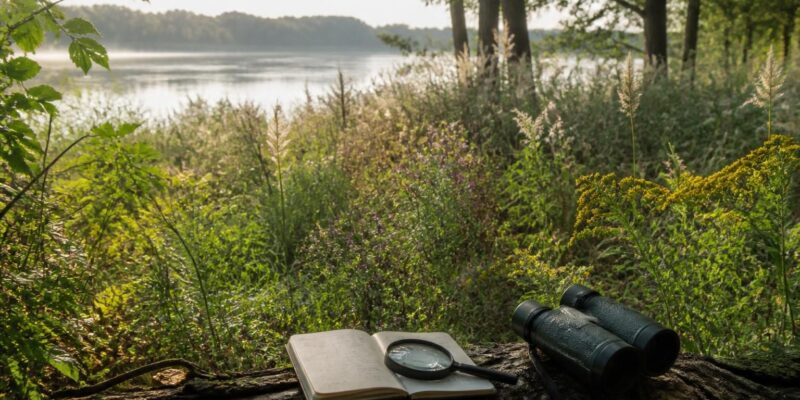
A field guide to the city’s living edges
Warsaw’s northern Młociny district is turning a Saturday nature walk into a practical scientific exercise. On 26 September 2026, researchers from the Cardinal Stefan Wyszyński University in Warsaw will lead a public BioBlitz covering the university grounds on Wóycickiego Street, Młociny Forest and a neighbouring section of the Vistula valley.
The event is part of Warsaw’s Festival of Science and is designed for non-specialists as well as biologists. Participants will search for plants, lichens, invertebrates and vertebrates during a rapid inventory of the area’s biodiversity. The organisers describe the activity as a joint survey in which specialists and residents work together rather than as a conventional guided excursion.
The meeting is scheduled for 10:30 to 12:30. Participants are encouraged to bring a telephone with the iNaturalist application, as well as binoculars, a magnifying glass or other simple observation equipment. Registration is required, with the event listing directing applicants to contact the organiser by email.
Why a BioBlitz matters in a metropolitan landscape
A BioBlitz produces a snapshot rather than a complete scientific census. Within a limited period, people record as many species as possible and place the observations in a shared database. That approach can reveal how much biological variety remains in places that are not formally presented as nature reserves but still contain woodland, open ground, river margins and university-managed land.
For Warsaw, the Młociny area offers an unusually varied setting. The survey zone links a developed campus with forest and a fragment of the Vistula valley. Such transitions are important for understanding how species move through the city and where ecological connections remain possible. The event listing does not claim that the survey will produce a definitive assessment of the area. Its value is more immediate: it gives participants a common method for observing and recording what is present.
The involvement of specialists from several taxonomic fields is intended to improve identification. Participants can compare their observations with expert guidance and use the iNaturalist platform to organise records. The result may be useful not only for the people taking part but also for future teaching, local ecological projects and discussions about urban green space.
Citizen science as environmental education
The event places citizen science within a broader programme of public learning. Warsaw’s Festival of Science has listed BioBlitz Młociny among its biology and environmental-science activities, alongside lectures and field-based sessions. The format is accessible because it begins with direct observation: looking closely at a leaf, a lichen, an insect or a bird and asking what it is, where it occurs and what that tells us about the site.
That approach can help bridge the gap between scientific institutions and neighbourhood life. The university’s Faculty of Biology and Environmental Sciences is based on the same campus where the survey begins, making the event a visible example of research and education taking place beyond lecture rooms. It also gives residents a structured way to explore an area they may already use for walking, commuting or recreation.
There is a constructive civic dimension as well. Reliable observations collected by many people can build a shared vocabulary for conversations about trees, riverbanks, woodland management and habitat quality. A single morning cannot answer every question about Młociny’s ecosystems, but it can make those questions more concrete and locally grounded.
A modest survey with a lasting record
The organisers’ emphasis is on participation, observation and identification rather than competition. Participants will look for late-summer and early-autumn flora and fauna, sort their observations and review the findings together. This creates a record of a particular moment in the seasonal cycle while encouraging people to return and notice changes over time.
Urban biodiversity is often discussed through large plans and technical assessments. BioBlitz offers a smaller-scale complement: a shared walk, an open database and a group of people learning to recognise the life around them. In Młociny, the combination of university expertise, forest habitat and the Vistula landscape provides a useful setting for that work.
The 26 September survey is therefore both a public event and a demonstration of method. By inviting residents to take part in documenting local nature, Warsaw’s Festival of Science is presenting biodiversity not as an abstract environmental issue but as something that can be observed, discussed and recorded close to home.









Comments