

 By
By 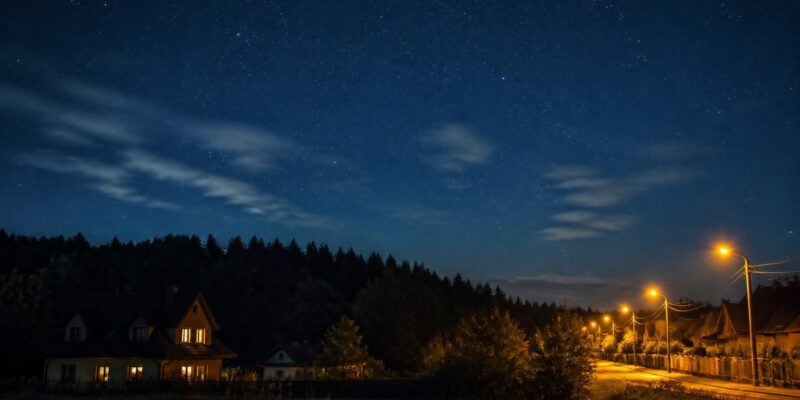
NIEPOŁOMICE, Poland — A three-day international conference in southern Poland is putting an often overlooked environmental issue into the public conversation: the spread and intensity of artificial light after dark.
The fourth International Conference on Environmental and Astronomical Light Pollution is taking place in Niepołomice from 11 to 13 September 2026. The event brings together environmental researchers, astronomers, local-government representatives, non-governmental organisations and practitioners working with public lighting, spatial planning and nature protection.
The conference is organised by the Faculty of Environmental and Energy Engineering at Cracow University of Technology, the Polish Society of Astronomy Enthusiasts and the Youth Astronomical Observatory in Niepołomice. Its current edition is being held under the honorary patronage of Poland’s Commissioner for Human Rights.
From a night-sky issue to an environmental question
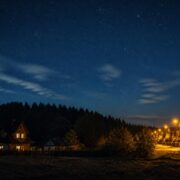
Light pollution is often associated with the loss of visible stars in towns and cities. The Niepołomice programme treats it as a broader environmental question, linking night-time illumination with natural habitats, human health, landscape planning and the efficient use of energy.
That wider framing matters because artificial light does not stop at the edge of a road, housing estate or commercial site. Poorly directed or unnecessarily intense lighting can alter the conditions experienced by insects, birds, bats and other nocturnal species. It can also change the character of parks, wetlands and forest margins that would otherwise remain dark for part of the day.
The programme also considers how artificial light affects people. Discussions are addressing the relationship between exposure to light at night and health, alongside questions of urban design and responsible lighting management. The aim is not to present darkness as an obstacle to modern life, but to examine where lighting can be more precisely planned and better matched to actual needs.
Practical choices for towns and municipalities
One of the conference’s most practical themes is the role of local authorities. Decisions about street lamps, public buildings, sports facilities, roads and new developments are usually made at municipal level. That gives cities and towns considerable influence over the quality of the night-time environment.
Possible measures include shielding lamps so that light is directed towards the ground, avoiding excessive brightness, reducing unnecessary illumination during low-use periods and selecting colour temperatures that are less disruptive to people and wildlife. The effectiveness of such measures depends on local conditions, safety requirements and the design of each site, but the underlying principle is consistent: lighting should serve a clear purpose rather than illuminate more space than necessary.
The conference is also examining the economic dimension. More carefully designed lighting can reduce energy consumption and maintenance costs, while dark-sky tourism offers a way for rural and protected areas to build public interest around their natural landscapes. In that sense, limiting unwanted light is not only a matter of conservation; it can also support local identity, education and tourism.
Connecting science with public awareness
Niepołomice provides a fitting setting for the discussion. The town lies close to the Niepołomice Forest, a major natural area near Kraków, while its astronomical observatory gives the subject a direct educational and scientific dimension.
Organisers describe the conference as interdisciplinary because the problem cannot be solved by one field alone. Astronomers can document changes in the night sky, ecologists can assess effects on species and habitats, health researchers can study human exposure, and planners can translate that knowledge into decisions about streets and buildings.
The participation of public bodies and civil-society organisations is equally important. Residents are often the first to notice glare, poorly placed lamps or the disappearance of a visible night sky. Public discussion can help communities distinguish between lighting that improves access and safety and lighting that creates avoidable environmental pressure.
The event’s significance therefore lies less in a single announcement than in its attempt to connect several policy areas. Environmental protection, energy efficiency, public health, urban planning and astronomy are being considered as parts of the same night-time landscape.
As municipalities across Poland modernise their lighting systems, that integrated approach could become increasingly relevant. The Niepołomice meeting offers a forum for comparing research, sharing practical experience and discussing how towns can remain well lit without making every hour of darkness look like daytime.














Comments