

 By
A new look at the chemistry of supposedly inert elements
A research team led by Professor Mihails Arhangelskis at the University of Warsaw has received funding for a Polish-Slovenian project exploring how noble gases react under extreme physical conditions. The project is one of six Polish-Slovenian research initiatives approved through the OPUS 30+LAP/Weave programme, with more than PLN 11.1 million allocated to the Polish teams.
The University of Warsaw announced the award on October 30, 2026. The Polish side of the project will receive PLN 1,726,372. The Slovenian partner is led by Professor Matic Lozinšek of the Jožef Stefan Institute in Ljubljana.
Why noble gases are scientifically interesting
Noble gases such as helium, neon, argon, krypton and xenon are traditionally described as chemically unreactive. Their outer electron shells make it difficult for them to form compounds under ordinary conditions. That apparent stability is one reason they have long been useful in lighting, welding, cryogenics, medical imaging and other technical applications.
The Warsaw–Ljubljana project starts from a more nuanced question: can these elements become much more reactive when exposed to pressures and temperatures far beyond those normally found at the Earth’s surface? According to the University of Warsaw, previous studies indicate that noble gases can react more readily at pressures between roughly 10 and 100 gigapascals. Additional heating can create conditions in which still more complex reactions become possible.
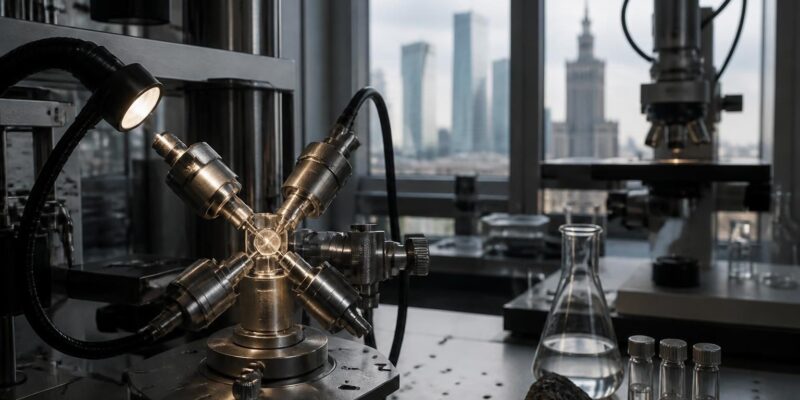
For comparison, one gigapascal is one billion pascals. The pressures involved in the project are therefore many thousands of times greater than standard atmospheric pressure. Such conditions can be created in specialised diamond-anvil cells, devices that squeeze tiny samples between two opposing diamonds while allowing researchers to observe changes using optical and spectroscopic methods.
Combining prediction with laboratory experiments
The project will use crystal-structure prediction to identify compounds and arrangements that might form when noble gases are compressed and heated. Theoretical predictions can help researchers decide which combinations of elements are worth testing experimentally, reducing the number of possibilities that need to be examined in the laboratory.
The experimental work will include laser-heated diamond-anvil techniques. A sample is compressed between the diamonds and then heated with a laser, allowing the research team to study reactions that cannot be reproduced under ordinary laboratory conditions.
The central scientific goal is not simply to produce unusual substances. It is to understand the rules governing chemical bonding under extreme conditions. That knowledge can contribute to broader research in high-pressure physics, materials science and planetary science, where similarly intense pressures and temperatures occur inside planets and other celestial bodies.
Part of a wider international funding round
The award comes through OPUS 30+LAP/Weave, a research-funding route that supports cooperation between teams based in Poland and partner countries. The National Science Centre, Poland’s main public agency for funding basic research, evaluates the Polish proposals while partner agencies approve the corresponding foreign research components.
On October 29, the National Science Centre announced six successful Polish-Slovenian projects. The projects cover a range of disciplines and bring the current number of funded OPUS and OPUS LAP projects in the wider competition to 322, with a combined value of more than PLN 645.5 million. Further results involving German partners were still expected at the time of the announcement.
The programme does not impose restrictions based on the age or career stage of the project leader. Its purpose is to support research carried out jointly with international partners, while allowing teams in Poland to compete for funding through a common assessment process.
What the project could add
High-pressure chemistry is a specialised field, but its questions reach beyond the laboratory. Understanding how matter changes when it is compressed and heated can improve models of the deep interiors of planets and help scientists interpret the formation of unusual minerals and compounds.
For Poland, the grant also illustrates the role of university-based research in international science networks. The project links the University of Warsaw with a major Slovenian research institute and combines computational chemistry with experimental methods. Its immediate output will be new scientific knowledge, but it will also support training in advanced equipment, modelling and cross-border research management.
The work is expected to proceed as a fundamental research project. That means practical applications are not promised in advance. Instead, the researchers will investigate a basic scientific problem whose longer-term value may lie in expanding the range of conditions under which chemical reactions can be understood.


















Comments