
 By
Bydgoszcz is turning its long association with Polish musical life into a compact autumn festival devoted to Ignacy Jan Paderewski. The fourth Paderewski Festival, running from 15 to 25 October 2026, continues on Monday, 19 October, with an author meeting and a mini recital. Further concerts are scheduled later in the week, giving audiences several ways to encounter the pianist, composer and public figure through music, film and discussion.
The festival is organised by the Ignacy Jan Paderewski Music Society in Bydgoszcz and is supported by the city and the Kuyavian-Pomeranian regional authority. Municipal and tourism listings describe the event as a programme that deliberately combines academic and artistic activity. This year’s edition also broadens the format with an author conversation and a presentation of the erhu, a traditional Chinese bowed string instrument. All listed festival events are free, although places are limited and registration may be required for some sessions.
Music history beyond the concert stage
The programme’s second day, taking place on 19 October at 18:00 in the Concert Hall of the Music Society on ks. Piotra Skargi Street, places biography and performance side by side. Writer Magdalena Majewska is due to discuss her book Paderewski – Short Monographs, published by PWM, Poland’s specialist music publisher. The event will be followed by a mini recital from Georgi Vasilev, who received an award for the best performance of Paderewski’s works at the 12th International Paderewski Competition in Bydgoszcz in 2022.
That structure reflects the festival’s wider intention: to make a historical musical figure accessible through more than formal commemoration. Paderewski is remembered internationally as a pianist and composer, while in Poland his public career also forms part of the country’s cultural history. The Bydgoszcz festival presents those strands through documentary film, conversation, musicological reflection and live interpretation rather than through a single anniversary ceremony.
A programme spread across Bydgoszcz
The opening event on 15 October featured documentary films by Wiesław Dąbrowski, including Paderewski: A Man of Action, Success and Fame and America for Paderewski, followed by a meeting with the director. The festival’s next major date is scheduled for 21 October at the Feliks Nowowiejski Academy of Music, where pianist William Yang will give a recital in the academy’s Chamber Hall.
Yang is presented by the organisers as the first-prize winner of the Fryderyk Chopin International Piano Competition in Miami and the sixth-prize winner of the 19th International Fryderyk Chopin Piano Competition in Warsaw in 2025. His Bydgoszcz programme is listed to include works by Schumann, Paderewski, Beethoven, Tchaikovsky, Scriabin, Bach and Ravel. For local listeners, the recital offers a direct link between Paderewski’s own repertoire and the broader tradition of international piano competition associated with Polish music.
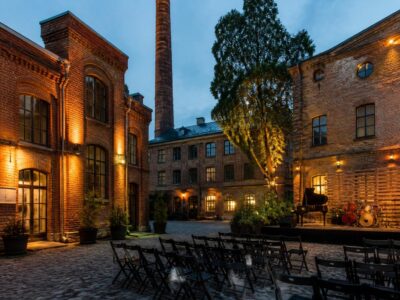
The final festival event, on 25 October at the Hala Pomp venue of the Museum of Waterworks, will move beyond the standard piano recital. Erhu player Yuebo Sun and pianist Jacek Szczepański are scheduled to perform together, extending the festival’s scope from Polish musical heritage towards a cross-cultural concert encounter.
A small-scale model of cultural participation
Although the festival is modest in scale, its format illustrates how a city can use established musical heritage to build a varied public programme. The events are distributed among a radio studio, a music society hall, an academy of music and a museum venue. That spread connects formal institutions with recognisable urban spaces and makes the festival part of Bydgoszcz’s wider cultural calendar.
The Monday event is particularly accessible because it does not require specialist knowledge of Paderewski’s music. An author conversation can provide historical and biographical context, while the recital offers an immediate musical experience. The combination may appeal both to regular concertgoers and to residents approaching the composer’s legacy for the first time.
With the festival continuing through 25 October, Bydgoszcz’s programme is less a retrospective than an invitation to listen, read and compare. Its central subject remains a major figure in Polish music, but the presentation is contemporary in its mixture of scholarship, performance, documentary storytelling and international artistic exchange.










Comments