

 By
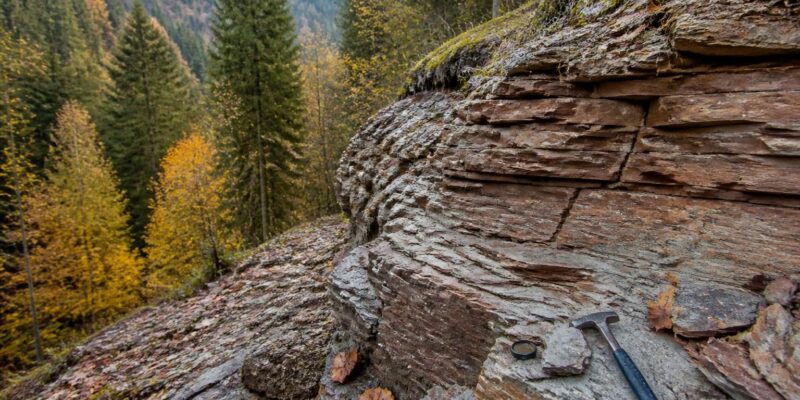
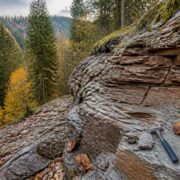
A fossil locality in the Thuringian Forest has received a new international distinction that brings together palaeontology, science communication and regional development. The Bromacker site, located between Tambach-Dietharz and Georgenthal in Thuringia, has been included in the third list of 100 IUGS Geoheritage Sites, a global selection published by the International Union of Geological Sciences.
The news was reported by Berlin’s Museum für Naturkunde on November 16, 2026. The formal recognition was presented at an IUGS Geoheritage event in southern Portugal on November 6, where representatives of Tambach-Dietharz, the UNESCO Global Geopark Thüringen Inselsberg–Drei Gleichen and the Bromacker research partnership accepted the award.
A window into the Early Permian
Bromacker is significant because it preserves much more than isolated fossil bones. The site contains exceptionally well-preserved skeletons, animal trackways, burrows, skin impressions and plant fossils within the same geological setting. Together, those remains allow researchers to reconstruct an entire terrestrial ecosystem from the Early Permian, roughly 290 million years ago, long before the emergence of dinosaurs.
The combination is unusual in the global fossil record. Researchers can compare an animal’s body structure with the traces it left behind, while also examining the plants, sediments and wider environmental conditions of the ancient landscape. That makes Bromacker valuable not only for identifying extinct species, but also for studying how early land-based communities functioned.
The Museum für Naturkunde describes the site as one of the most important Early Permian fossil localities. Its research partners include the Friedenstein Foundation in Gotha, Friedrich Schiller University Jena and the UNESCO Global Geopark Thüringen Inselsberg–Drei Gleichen. The partnership has combined field excavation with computed tomography, three-dimensional digitisation, isotope analysis, histology and sedimentology.
Recognition for science and public engagement
The IUGS designation is also a recognition of how the Bromacker project has connected specialist research with public learning. The collaborative BROMACKER project, which ran from 2020 to 2025, was designed not only to recover and analyse fossils but also to develop new ways of communicating scientific work.
The museum says the project helped strengthen education and contributed to the social and economic development of the surrounding region. That approach is important for a rural area whose identity is tied to forests, geological history and outdoor tourism. A globally recognised site can support school programmes, museum exhibitions, guided visits and future research partnerships without reducing the locality to a single fossil specimen.
The recognition is selective. According to the museum, several thousand geological sites applied for inclusion in the latest selection, while only 100 were chosen. The IUGS says the third group of sites was announced during the International Geological Congress in Portugal in November 2026. Since the programme began, 300 geological sites have been recognised across its first three lists.
A small German group
Bromacker is now part of a limited group of German sites on the IUGS list. The Museum für Naturkunde says eight German geological sites have received the designation so far, alongside locations such as the Archaeopteryx site at Solnhofen-Eichstätt, the Nördlinger Ries meteorite crater and the Messel fossil deposit.
For Thuringia, the distinction gives international visibility to a site that has already shaped decades of regional and international research. It also underlines the value of preserving geological places as living research landscapes rather than treating them only as static museum objects.
Further work at Bromacker is expected to continue. Many finds recovered during recent excavations are still being prepared and analysed, meaning that the site’s scientific story remains open. The new designation therefore marks both an acknowledgement of past discoveries and an invitation to keep investigating the deep history preserved beneath the Thuringian Forest.










Comments