 By
A public fair built around practical choices
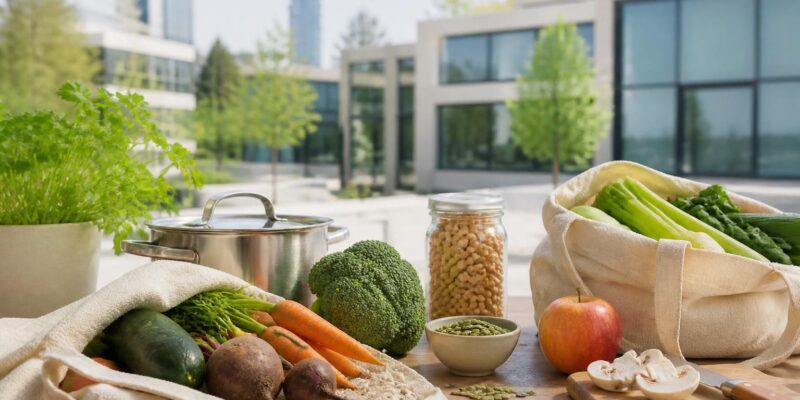
Frankfurt’s Westend campus is hosting a weekend event that treats plant-based food not as a specialist niche but as part of a broader conversation about everyday life. The Veggienale, taking place on November 14 and 15, brings food producers, sustainable-lifestyle organisations and visitors together at Goethe University’s Campus Westend.
The fair is designed for a wide audience: people who already eat vegan or vegetarian food, as well as visitors who simply want to taste new products or understand how plant-based choices fit into ordinary routines. Its programme combines food sampling with cooking demonstrations, talks and practical workshops.
That open format is significant in a city such as Frankfurt, where food culture is shaped by international influences, a large student population and a strong concentration of trade fairs, universities and consumer events. The Veggienale offers a smaller, more focused setting in which visitors can move between tasting, shopping and discussion without needing specialist knowledge.
From street food to the kitchen at home
The organiser lists vegan foods and specialities, plant-based cosmetics, vegan street food and products connected with sustainable health and consumption among the main areas represented. The event’s emphasis is therefore broader than a conventional food market. It presents plant-based eating as one element of a lifestyle that also includes personal care, household decisions and environmental awareness.
Live cooking is central to the programme. Demonstrations can make an otherwise abstract discussion about food systems more immediate by showing how familiar meals can be adapted, how ingredients are combined and how visitors might reproduce ideas at home. Talks and workshops add a second layer, offering explanations and practical information rather than relying only on product promotion.
The fair also includes exhibitors from the wider health and sustainability fields. According to the organiser, the supporting programme includes contributions from people working in the vegan and sustainability communities. Participation in the programme is included with admission and does not require advance registration, although the organiser notes that the programme can change.
An invitation rather than a declaration
One of the event’s clearest editorial and commercial choices is its attempt to welcome the curious visitor. The Veggienale presents itself as suitable for people who are already committed to vegan food and for those who are still exploring the subject. That positioning avoids making a single diet the only entry point and instead frames the fair around discovery, comparison and conversation.
For consumers, this can be useful at a time when plant-based products have moved from specialist shops into supermarkets, cafés and institutional kitchens. A public event allows visitors to compare products directly, ask questions of producers and encounter alternatives that may not yet be familiar. It also gives smaller businesses and organisations a physical platform to explain what they make or support.
The approach reflects a wider shift in lifestyle events: sustainability is increasingly presented through practical experiences such as cooking, tasting, repairing, reusing or learning a new skill. These formats do not settle every debate about nutrition or environmental impact, but they can make complex choices more accessible.
Campus setting adds a civic dimension
Holding the event at Goethe University gives the fair a setting associated with learning and public exchange. The venue is the university’s Casino building at Campus Westend, with opening hours from 10:00 to 18:00 on Saturday and from 10:00 to 17:00 on Sunday.
The location is also intended to be reachable without a car. The organiser recommends public transport, cycling or walking and provides directions from Frankfurt’s main railway station, Konstablerwache and the Holzhausenstraße underground station. There is no public parking on the university grounds, while nearby parking may be subject to charges.
Tickets are available online and at the venue. The organiser lists regular admission at €12 after the advance-sales period, with reduced admission at €10. Children up to and including the age of 14, as well as accompanying people with disabilities, are admitted free.
A modest but useful snapshot of changing food culture
The Frankfurt edition does not claim to resolve the larger questions surrounding food production, health or consumption. Its value lies in creating a concentrated public space where those questions can be approached through ordinary experiences: a meal, a new ingredient, a cooking method or a conversation with a producer.
For the city’s weekend calendar, the event offers a constructive meeting point between food, lifestyle and sustainability. For visitors, it provides a chance to taste before deciding, and to consider plant-based choices as part of a varied contemporary food culture rather than as a distant or specialised subject.
















Comments