

 By
A museum weekend built around curiosity
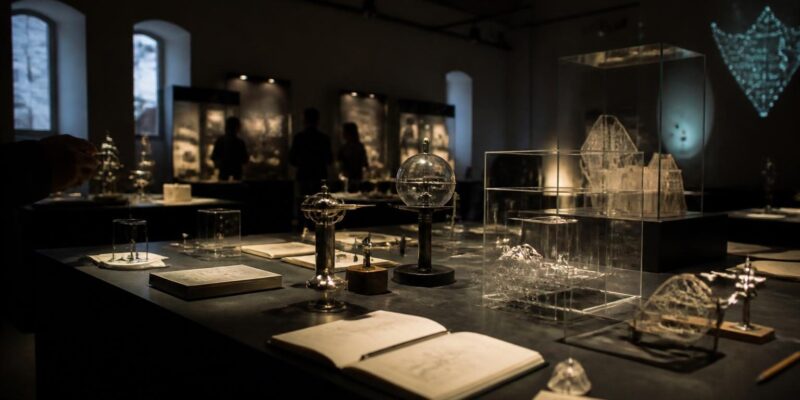
The National Museum of Lithuania’s House of Histories in Vilnius is hosting TECH Days on 14 and 15 November, bringing together museum visitors, researchers, artists and young inventors for a programme built around experimentation. The event accompanies the exhibition Shaping the Future: A History of Lithuanian High Tech, but is designed to move beyond conventional display cases. Visitors can attend lectures, try creative workshops, watch demonstrations and encounter projects developed by younger innovators. ([lnm.lt](https://lnm.lt/en/news/could-we-one-day-control-computers-with-brain-signals-young-inventors-present-their-ideas-at-the-national-museum-of-lithuanias-house-of-histories/?utm_source=openai))
The timing gives the initiative a particularly immediate quality: the programme begins on Saturday, 14 November, and continues on Sunday, 15 November. Participation in the TECH Days programme is free, while the related high-tech exhibition requires a museum ticket. The House of Histories is located at T. Kosciuškos Street 3 in Vilnius. ([lnm.lt](https://lnm.lt/en/news/could-we-one-day-control-computers-with-brain-signals-young-inventors-present-their-ideas-at-the-national-museum-of-lithuanias-house-of-histories/?utm_source=openai))
From Lithuania’s laser tradition to future interfaces
A central idea of the weekend is that technology becomes easier to understand when visitors can meet the people, questions and failed experiments behind it. The museum’s exhibition follows the development of Lithuanian high technology through fields including lasers, biotechnology, information technology, space, robotics and the relationship between technology and art.
That historical perspective will be connected with contemporary examples. One featured project comes from AXLminds, a Lithuanian neurotechnology start-up developing non-invasive brain-computer interfaces intended to allow computers and smart glasses to respond to brain signals and eye movements. The project will be presented alongside other ideas by participants in an exhibition organised by Lithuanian Junior Achievement Alumni. ([lnm.lt](https://lnm.lt/en/news/could-we-one-day-control-computers-with-brain-signals-young-inventors-present-their-ideas-at-the-national-museum-of-lithuanias-house-of-histories/?utm_source=openai))
The programme also includes a presentation by the Vilnius laser manufacturer OPTOMAN. According to the museum, the session will explain how laser mirrors are produced and why some components only a few centimetres across can involve highly precise coatings. The subject offers a direct link between the country’s industrial and research history and the engineering questions that remain relevant today. ([lnm.lt](https://lnm.lt/en/news/could-we-one-day-control-computers-with-brain-signals-young-inventors-present-their-ideas-at-the-national-museum-of-lithuanias-house-of-histories/?utm_source=openai))
Where science meets art and imagination
TECH Days is not limited to engineering demonstrations. Artist Julijonas Urbonas will give a presentation titled Can You Knit a Particle Accelerator?, drawing on his experience with CERN and on artistic work that translates complex scientific ideas into imaginative forms. The session asks where physical possibility ends and speculation begins, giving visitors a way to approach particle physics through visual and conceptual language rather than technical formulas alone. ([lnm.lt](https://lnm.lt/en/news/could-we-one-day-control-computers-with-brain-signals-young-inventors-present-their-ideas-at-the-national-museum-of-lithuanias-house-of-histories/?utm_source=openai))
Another workshop, Animatest, will explore how inventions and mechanical principles helped shape animation. Participants will draw frames and use a phone-based stop-motion process to turn still images into moving sequences. The activity is aimed at making a basic principle of visual media tangible: movement can emerge from a carefully ordered series of separate images. ([lnm.lt](https://lnm.lt/en/news/could-we-one-day-control-computers-with-brain-signals-young-inventors-present-their-ideas-at-the-national-museum-of-lithuanias-house-of-histories/?utm_source=openai))
Young inventors take a visible role
The museum is giving a prominent place to projects developed by students and early-stage innovators. Alongside the neurotechnology project, the programme includes SafeClip, a device designed by a secondary-school student and two university students to warn motorcycle riders when a helmet is not fastened correctly. The project is presented as an example of how practical questions from everyday life can become starting points for invention.
On Sunday, the Lituanica X robotics zone will allow visitors to operate competition and LEGO robots. The programme also includes a lecture by astronomer Šarūnas Mikolaitis on how humanity’s understanding of the Universe has changed, from early observations of the sky to modern ideas about an expanding cosmos. ([lnm.lt](https://lnm.lt/en/news/could-we-one-day-control-computers-with-brain-signals-young-inventors-present-their-ideas-at-the-national-museum-of-lithuanias-house-of-histories/?utm_source=openai))
A public invitation to see innovation differently
The weekend’s broader significance lies in the way it connects cultural heritage with scientific literacy. Museums often preserve the material traces of past discoveries; TECH Days adds conversation, participation and demonstration. Visitors are invited not only to learn what Lithuania has produced, but also to consider how new ideas emerge, why experiments sometimes fail and how questions from art, education and daily life can feed into research.
For Vilnius, the event offers a compact example of the museum as an active civic space: part archive, part classroom and part workshop. The programme’s free access also lowers the threshold for families and young people who might not normally associate a history museum with robotics, laser manufacturing or brain-computer interfaces.
















Comments