 By
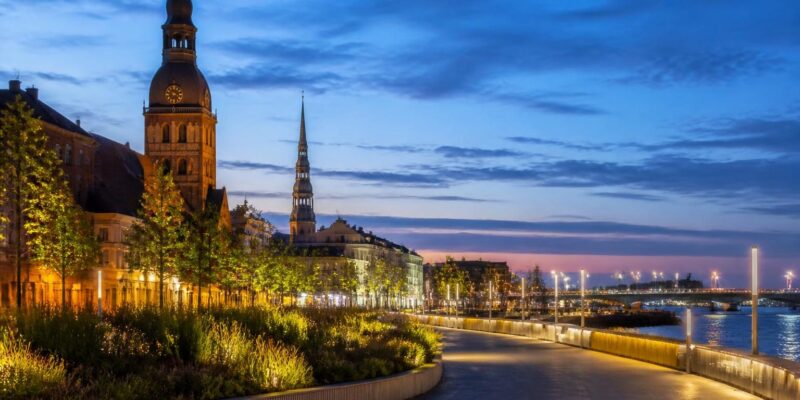
Riga has begun its annual transformation into an open-air gallery as the Staro Rīga light festival returns for four evenings from November 15 to 18. The event brings contemporary light art, projections and interactive installations into streets, parks and public spaces on both banks of the Daugava.
Organised during Latvia’s November statehood celebrations, this year’s festival is built around the theme “unum momentum” — “that one moment”. The programme invites visitors to consider moments of change, decision and perception through light, movement, video and temporary interventions in the urban environment. The festival is free to visit and runs each evening from 17:00 to 23:00. ([riga.lv](https://www.riga.lv/en/event/staro-riga-2026-invites-everyone-be-together-moments-light))
A walk through Riga’s changing cityscape
The main route stretches for almost five kilometres. It begins near the National Library of Latvia and the Mūkusalas promenade on the left bank, then continues through the Spīķeri district, the Old Town, the area around the Freedom Monument, Esplanade and Kronvalda Park before reaching Viesturdārzs.
Rather than concentrating the programme in a single fenced-off venue, Staro Rīga uses the city itself as its exhibition space. Visitors can move between installations at their own pace, combining the festival with an evening walk through Riga’s historic centre, riverside districts and parks. LiveRiga describes the event as a multi-day exhibition of urban objects, with most works placed in central areas that can be reached on foot. ([liveriga.com](https://www.liveriga.com/en/4884-festival-of-light-staro-riga))
The municipal programme lists 52 light installations. They include large-scale projections on façades, kinetic objects, interactive works and smaller installations designed for particular streets, squares or green spaces. The festival’s route is divided into several connected areas, allowing visitors to choose shorter walks or follow a longer circuit.
Latvian artists and students at the centre
A notable feature of the 2026 edition is the prominence of Latvian creative work. Riga City Municipality says that more than two-thirds of the main programme consists of new works by Latvian light artists. The programme also includes seven installations by students of the Art Academy of Latvia and four works created by students of the Latvian Academy of Culture in cooperation with students from a European university alliance spanning nine countries. ([riga.lv](https://www.riga.lv/en/event/staro-riga-2026-invites-everyone-be-together-moments-light))
The student contributions give the festival an educational dimension as well as a visual one. They place emerging artists alongside established international practitioners and show how light art can connect design, architecture, technology and public participation.
Among the larger works is “Ascend”, created by Hungarian light artist Laszlo Zolt Bordos for the façade of the National Library of Latvia. The building, known locally as the Castle of Light, forms one of the most recognisable points on the route. At the Freedom Monument, the installation “Voices of the Grand Trees” introduces a new festival setting, while the Esplanade features the “Radiating Phonograph”, an installation linked to music associated with Staro Rīga since its first edition in 2008.
International works add different perspectives
The programme also brings several international artists and creative groups to Riga. Norwegian artist Anastasia Isachen contributes an interactive installation at Pils Square that combines art and science and asks visitors to reflect on their relationship with the environment.
At the Riga Congress Hall, the Hungarian group Lightspray Visual presents a projection using analogue projectors and kinetic mechanisms. In Viesturdārzs, French artist Sebastien Lefevre’s “Soleil Nuit” is a kinetic sculpture made with more than 5,000 mirrored elements. These works broaden the festival beyond façade projection, adding movement, reflection and audience interaction to the city’s nighttime landscape. ([riga.lv](https://www.riga.lv/en/event/staro-riga-2026-invites-everyone-be-together-moments-light))
Culture designed for shared public space
Staro Rīga’s appeal lies partly in its accessibility. There is no admission fee, and the works are distributed through places that residents already use: promenades, parks, squares, streets and landmarks. The format makes contemporary art part of an ordinary evening in the city, while also encouraging visitors to see familiar architecture differently.
The festival’s theme is deliberately open-ended. “That one moment” may refer to a personal decision, a change in the surrounding city or the instant in which light alters the appearance of a building. The works do not form a single narrative; instead, they create a sequence of encounters as people move from one district to another.
For visitors, the organisers recommend allowing enough time for walking and dressing warmly, since the festival takes place outdoors. The busiest areas may be around the weekend, but the programme continues through Wednesday, November 18, giving residents and travellers several opportunities to explore the route.
With its combination of local artists, student projects, international contributions and free public access, Staro Rīga offers a constructive example of how a city can use temporary cultural programming to connect heritage, technology and everyday urban life. For four nights, Riga’s streets and parks become not only routes through the capital, but also a changing exhibition of how light can reshape public space.












Comments