

 By
By 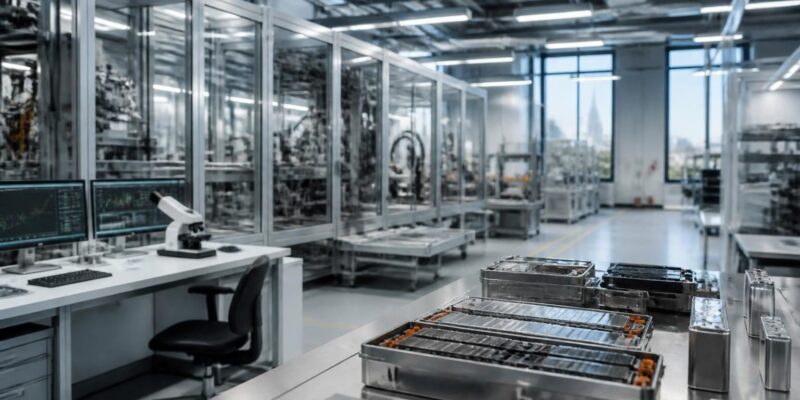
A research partnership focused on the full battery cycle
A battery research centre in Münster is expanding its international network through two new cooperation agreements with South Korean partners. The Fraunhofer Research Institution for Battery Cell Production, known as Fraunhofer FFB, announced on 5 October that the Fraunhofer Battery Alliance had signed memorandums of understanding with Pohang University of Science and Technology, the city of Pohang and the Korea Environment Corporation.
The agreements are designed to move cooperation beyond general institutional exchange. The partners intend to identify joint research projects covering battery materials, cell development, production processes, recycling and the circular use of resources. The announcement places Münster at the centre of a practical research relationship linking German applied science with one of South Korea’s important battery-industry locations.
From laboratory concepts to industrial testing
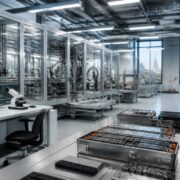
Fraunhofer FFB operates an open research infrastructure in Münster-Amelsbüren where companies and research teams can examine new battery-cell concepts and manufacturing processes under conditions designed to resemble industrial production. The facility is intended to help researchers assess whether new approaches can be scaled before they are transferred to large factories.
That industrial focus is central to the new partnership. Possible cooperation with POSTECH and Pohang includes materials for lithium-ion batteries and future battery generations, cell technologies and production systems. The partners also plan to look at recycling and circular-economy applications, areas that are becoming increasingly important as battery production expands and manufacturers face pressure to use materials more efficiently.
The agreements do not announce a new factory or a fixed investment package. Instead, they create a framework for technical exchange and future joint research. Fraunhofer said the partners discussed concrete approaches for projects during a seminar held as part of the South Korean delegation’s visit to Münster.
Recycling and regulatory knowledge form a second track
A separate memorandum with the Korea Environment Corporation, or K-eco, concentrates on used-battery recycling. The proposed work includes the characterisation of recovered materials, certification and quality-assurance procedures, and research related to European battery requirements.
This could be useful for companies working across different markets. Recovered battery materials need reliable testing and documentation if they are to be returned to industrial supply chains. By bringing together a German applied-research organisation and a South Korean public environmental institution, the partners are seeking to connect technical recycling expertise with the practical requirements of regulation and commercial production.
Fraunhofer’s announcement says the cooperation will also explore approaches that support compliance with the European Union’s Battery Regulation. The regulation establishes requirements for sustainability, recycling and information across the battery value chain. The new partnership is therefore framed not only as a scientific exchange but also as a way to help companies prepare for a more demanding market environment.
Pohang adds an industrial and regional dimension
Pohang is described by the partners as a hub of South Korea’s battery-materials industry. The city was designated by the South Korean government in 2023 as one of the country’s priority locations for battery development. Its participation gives the cooperation a regional-business dimension: joint activities may involve local companies as well as universities and research organisations.
South Korean reporting on the agreement said Pohang and POSTECH want to use the partnership to identify international research-and-development projects involving battery businesses based in the city. The proposed areas include next-generation materials, cell manufacturing and the reuse of end-of-life batteries.
For Münster, the agreement reinforces the role of its battery research infrastructure as a meeting point between science and industry. Fraunhofer FFB’s pilot facilities are intended to test ideas at a stage where technical problems, production requirements and scalability can be assessed together. That approach is particularly relevant to battery technology, where promising laboratory results must eventually be translated into repeatable manufacturing processes.
A constructive step without immediate commercial claims
The announcement offers no timetable for a specific product, plant or commercial launch. Its immediate outcome is institutional: two agreements, a defined set of research fields and an intention to develop joint projects. That makes the development modest but concrete.
Battery innovation increasingly depends on collaboration across the value chain. Materials researchers, equipment developers, manufacturers, recyclers and public authorities must work with compatible data, testing methods and quality standards. The Münster agreements address several of those links at once, while keeping the focus on research, industrial testing and resource efficiency.
In that sense, the partnership illustrates a broader direction in Germany’s innovation economy: using applied research facilities to connect international expertise with regional companies and future production needs. Whether the framework leads to funded projects or new industrial applications will depend on the next stage of cooperation, but the partners have now established a formal basis for pursuing it.




















Comments