
 By
By 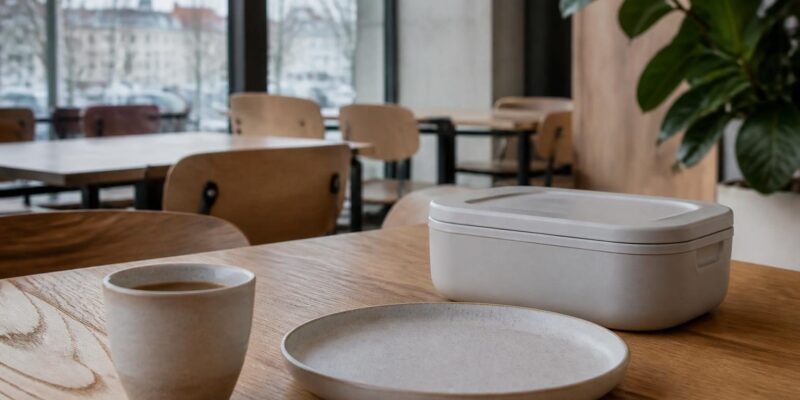
From pilot projects to ordinary meals
Estonian food and hospitality professionals are meeting in Tartu today, 5 October, for a seminar focused on one of the most visible parts of everyday consumption: the packaging used for takeaway meals, school catering and public events.
The event, titled “Food packaging in the wind of change – the future of circular food delivery systems and lessons from the Change(K)now! project”, is taking place from 13:00 to 16:30 at the Soho Hotel in Tartu. It is organised by BEF Estonia, the Stockholm Environment Institute Tallinn Centre, the Tallinn Strategic Management Office and Baltic Restaurants Estonia.
Rather than presenting reusable packaging as a simple consumer choice, the seminar is designed to look at how the complete system works. Its participants include representatives of local government, regulators, catering companies, event organisers, recycling-service providers and restaurants.
Why the discussion matters
Takeaway food is now part of ordinary urban life, but each meal also involves decisions about materials, washing, collection and logistics. A reusable container can reduce the need for single-use packaging, but only if customers can return it easily, businesses can handle it efficiently and the overall system remains affordable.
The Tartu meeting is therefore built around practical questions. Where are reusable systems already functioning? Which settings are best suited to them? What infrastructure is needed for collection and washing? And how should responsibilities be divided between public authorities, food businesses and consumers?
The organisers say the seminar will also examine whether Estonia is ready to significantly reduce the use of single-use food packaging. The discussion is intended to be grounded in examples rather than slogans, with lessons from the Change(K)now! project presented alongside contributions from Estonian institutions and businesses.
Lessons from schools, events and takeaway food
The Change(K)now! project is a Baltic Sea Region cooperation initiative running from 2023 to 2026. Its aim is to help municipalities and food-service operators move from single-use systems towards circular or multiple-use alternatives. The project has worked across several settings, including public catering, food markets, public events and takeaway services.
At the Tartu seminar, project partners are scheduled to discuss three specific areas: reducing single-use packaging in school catering, introducing reusable packaging as a normal part of public events, and making reuse compatible with the convenience expected from takeaway food.
That combination gives the event a distinctly everyday focus. School meals involve large volumes and predictable routines. Festivals and public events must cope with temporary crowds and fast service. Takeaway restaurants, meanwhile, need systems that work across different businesses and return points.
The organisers’ central question is not whether a reusable container is technically possible. It is whether a complete service can be made simple enough for regular use.
Rules, costs and consumer habits
The programme also includes a presentation on forthcoming changes in packaging regulation by Kelli Seppel, an adviser in the Circular Economy Department of Estonia’s Ministry of Climate. That contribution is expected to place the practical experiments in a wider regulatory context.
A later panel will bring together representatives of the ministry, Eesti Pandipakend, the Estonian Hotel and Restaurant Association, the Tartu Event Management Centre and restaurants. The discussion will address questions that often determine whether environmental measures survive beyond the pilot stage: who pays for reusable systems, how many different models consumers can reasonably navigate, and whether regulation should lead the market or allow businesses more time to adapt.
Convenience will be an important part of the conversation. If customers have to travel a long distance to return a container, or if every restaurant uses a different deposit and collection arrangement, participation may remain limited. On the other hand, shared systems can require cooperation between companies that normally operate independently.
A follow-up visit in Tartu
The seminar will be followed on 6 October by a visit to Tartu Raatuse School. Participants interested in practical implementation will be able to hear how the school cafeteria has reduced single-use packaging and how the change has been received by the school community.
The visit adds a useful local dimension to the broader Baltic project. It allows organisers to move from policy and panel discussion to the routines of a real institution: ordering supplies, serving meals, collecting dishes or containers, and communicating new habits to students and staff.
For Estonia’s food sector, the Tartu meeting is a constructive sign that packaging questions are increasingly being treated as part of service design rather than as a separate waste problem. The success of reusable systems will depend on many details, but today’s discussion brings the people responsible for those details into the same room.





















Comments