
 By
By 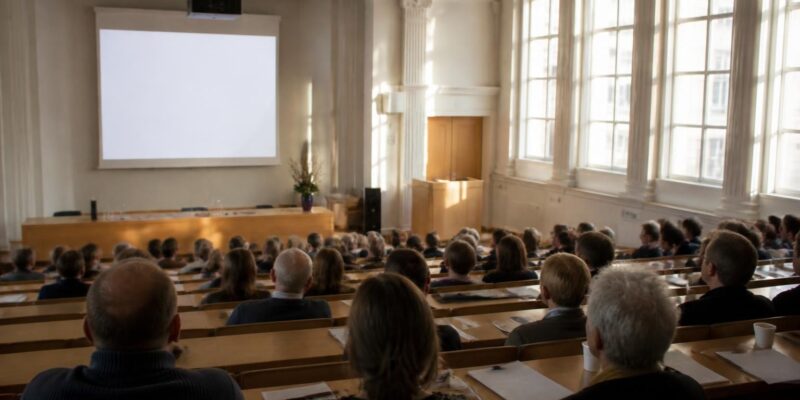
A three-day conference opening in Tartu on Monday, 17 August, is placing the practical role of science at the centre of discussions about well-being, public health and social change. The EstWell Centre of Excellence for Well-Being Sciences at the University of Tartu is hosting its annual conference under the title “The Role of Science and Scientists in Shaping Societal Turning Points”.
The event runs from 17 to 19 August and is built around a question with immediate relevance for universities, public authorities and communities: how can research move beyond published findings and contribute to decisions, services and technologies that people can use? The programme combines keynote lectures, research presentations, methodology sessions and discussions between science and practice.
From research findings to everyday services
The opening keynote is being delivered by Carl May, Professor of Health Systems Implementation at the London School of Hygiene and Tropical Medicine. His presentation, “Understanding the Dynamics of Implementation”, focuses on implementation science—the study of how evidence about effective interventions can be translated into ordinary clinical and organisational practice.
That emphasis gives the Tartu meeting a practical orientation. Rather than treating research impact only as a matter of academic recognition, the programme asks how evidence can be adopted by health systems and other institutions. It also reflects a broader challenge for contemporary science: a useful discovery may still have limited effect if professionals, organisations and decision-makers lack workable ways to apply it.
Several of the first day’s sessions connect this question with current Estonian research. Presentations include work on personalised stress-monitoring technology and a stepped-care mental-health support project. Other contributions address non-invasive detection of stress biomarkers, mental fatigue through resting-state EEG analysis, long-term trends in ADHD diagnoses using Estonian Biobank data, and the use of real-world data in decisions about public funding.
Well-being research across disciplines
EstWell’s programme brings together psychology, public health, health technology, behavioural science and data analysis. The range of topics reflects the centre’s broad understanding of well-being—not simply as an individual feeling, but as something influenced by relationships, institutions, services and the environments in which people live.
One session examines researchers’ capacity to bridge science and real life. Another considers the digitalisation of healthcare as a service sector. A further presentation introduces a “dual-wheel model” for applying behavioural science. Together, these sessions suggest that research uptake is not a single step between a laboratory and a policy document. It involves communication, professional judgement, institutional capacity and continued evaluation.
The conference also gives space to emerging methods. On Tuesday, Petr Slovak of King’s College London is scheduled to speak about generative artificial intelligence and the study of everyday cognitive processes. The programme describes possible applications in large-scale data collection and psychological interventions, while presenting the subject as an area for research rather than a ready-made solution.
Children, digital life and responsible judgement
The final day broadens the discussion to children and young people. Halla B. Holmarsdottir of Oslo Metropolitan University will address care, judgement and digital lives, linking well-being to the social and relational conditions that shape learning, belonging and participation.
Her keynote is listed alongside discussions of digital environments, attention, inequality and the responsibilities that accompany rapid technological change. The framing is constructive but cautious: technology is treated neither as an automatic answer nor as a problem isolated from society. Instead, the programme asks how evidence can help institutions make more responsible choices in uncertain conditions.
A concluding panel, “How Can We Bring Science into Practice?”, is scheduled for Wednesday afternoon. It will examine how close researchers should work with civil servants, political parties, product developers and other decision-makers when seeking evidence-informed policy or practical solutions.
A current public-interest story from Estonia
The conference is a timely development for Estonia because it presents research as part of public problem-solving. Its agenda links university-based expertise with questions faced by healthcare providers, educators, policymakers and technology developers. It also gives early-career researchers and project teams a platform to present work on measurement, data, mental health and service design.
For the public, the significance of the event lies less in one promised breakthrough than in the method it promotes: test ideas, examine evidence, involve practitioners and assess whether an intervention works in real conditions. That approach offers a measured way to discuss well-being at a time when digital tools, health data and behavioural technologies are becoming more visible in everyday life.
With its 17–19 August schedule, the EstWell Annual Conference gives Tartu a current forum for that conversation. It connects Estonia’s research community with international speakers while keeping the central question firmly practical: how can sound science help create healthier, more connected and more humane institutions?






















Comments