

 By
By 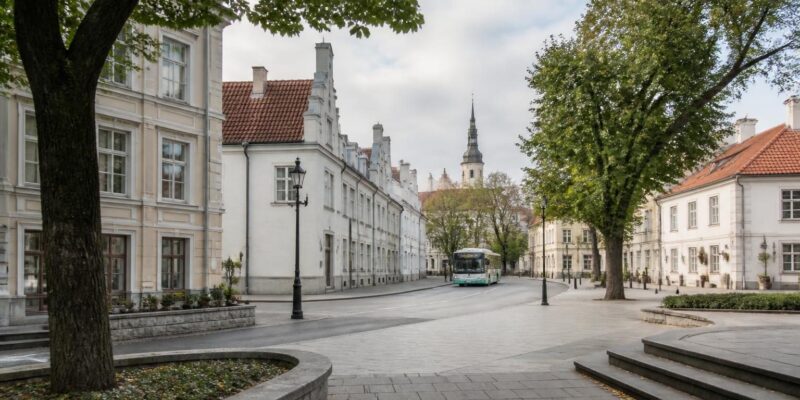
Tallinn has completed a preliminary design for the reconstruction of Väike-Ameerika Street and a section of Luha Street, opening the next stage of public discussion about how a busy central neighbourhood should balance traffic, pedestrians, greenery and local access.
The plan will be presented publicly on October 7 at Tallinn University of Applied Sciences. The project is still at the preliminary-design stage, so the presentation is an opportunity for residents, institutions and other street users to examine the proposal before later planning and construction decisions.
A more legible street layout
The proposed reconstruction covers Väike-Ameerika Street between Pärnu maantee and Tehnika Street, together with the section of Luha Street between Väike-Ameerika and Koidu streets. The area lies between the Uus Maailm neighbourhood and the city-centre transport corridors, where several streets meet in a compact urban environment.
One of the most visible changes would be the replacement of the existing five-arm junction with a roundabout designed in a square-like form. The intention is not simply to move vehicles through the intersection, but to give the junction a clearer urban structure and a more usable relationship with surrounding pavements and buildings.
Intersection areas would be raised to encourage slower driving. The planned general speed limit across most of the project area is 30 kilometres per hour, with 20 km/h zones at local conflict points, including the meeting of Väike-Ameerika, Luha and Kesk-Ameerika streets.
Pedestrian space and greenery
Two-way traffic would remain on Väike-Ameerika Street. However, the carriageway between Toom-Kuninga and Virmalise streets would be narrowed to make room for wider pedestrian areas. In front of Väike-Ameerika 11, 13 and 15, the roadway is planned to be reduced to four metres, creating additional space beside the buildings.
The landscape proposal adds trees, shrubs and low-growing plants to the street environment. This would give the route a greener character while also helping define pedestrian areas and soften the visual effect of the roadway. The project does not remove car access: 61 parking spaces are included in the draft, along with three short-term stopping spaces near Tallinn University of Applied Sciences.
That balance is central to the proposal. The plan seeks to improve walking conditions without turning the neighbourhood into a traffic-free enclave or eliminating the ability to reach homes, businesses and the educational institution by car. The final arrangement will depend on the detailed design process and feedback gathered during the public presentation.
Changes for public transport
Public transport routing would also be adjusted. Bus route 32 is planned to run along Tehnika Street in the future, rather than following its present alignment through the project area. The change is part of the wider effort to clarify movement through the central districts and make the rebuilt street network more predictable.
Any route change matters beyond the immediate construction zone because Väike-Ameerika and Luha streets connect residential areas with major routes, schools, workplaces and city-centre services. For residents, the practical question will be how the new street design affects walking distances, transfers, loading, parking and access during different times of day.
Public presentation scheduled for October 7
Tallinn’s city government says the preliminary design has now been completed and will be introduced at Tallinn University of Applied Sciences on October 7. The event gives local people a chance to see the proposed junction, street cross-sections, parking arrangement and planting concept in greater detail.
The project is therefore best understood as a concrete planning proposal rather than a completed construction decision. Its significance lies in the way it brings several everyday urban questions into one scheme: how to reduce vehicle speeds, how to make a complicated junction easier to cross, how to add greenery and how to preserve practical access in a dense neighbourhood.
If the plan proceeds, the reconstruction would give Väike-Ameerika and Luha streets a more defined public-space role. The combination of a square-like junction, raised intersections, planting and additional pedestrian room reflects Tallinn’s continuing shift toward streets that function not only as traffic corridors, but also as places where people walk, meet and spend time.

















Comments