 By
By 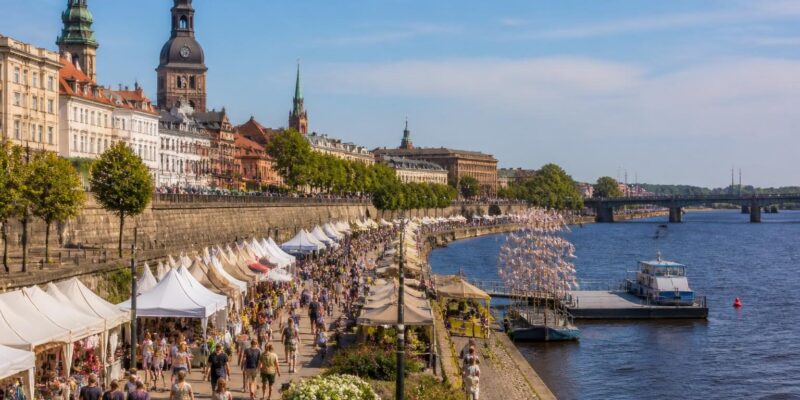
A city anniversary designed to spread activity across Riga
Riga used its 825th birthday on Saturday, 15 August, to present the capital not as a single festival site but as a network of public spaces, neighbourhoods and cultural venues. Under the theme “Open Riga! Code: 825!”, the anniversary programme brought together concerts, street performance, craft production, food, sport and family activities across the historic centre and several districts.
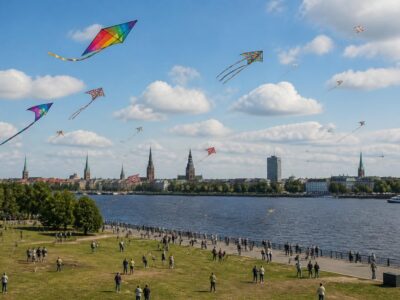
The format is significant for a city whose visitor economy is closely linked to its public spaces. Instead of concentrating the programme in one central square, the municipality invited residents and visitors to move between the 11 November Embankment, Old Riga, Vērmanes Garden, Victory Park, Eksporta Street, Esplanade, Opera Square and the area around the Riga Congress Centre. The result was a city-wide cultural itinerary that connected established attractions with parks, waterfront areas and neighbourhood meeting places.
Crafts, food and performance in the public realm
Old Riga was given a particularly broad cultural role. Street musicians, jazz, Dixieland, classical music and percussion were paired with mime, clowning and movement theatre. The programme was intended to bring performance into streets and squares rather than keep it inside concert halls, allowing visitors to experience the historic centre as a living cultural environment.
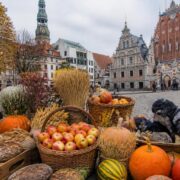
Dome Square hosted an artisan market featuring traditional crafts from different parts of Latvia. For small producers and makers, such markets offer more than a seasonal retail opportunity: they provide direct contact with visitors, a visible setting for regional products and a way to connect heritage skills with contemporary urban tourism.
Food was another central part of the anniversary. Opera Square became the site of a temporary Riga Anniversary Festival restaurant on 14 and 15 August, combining local flavours with live music. A separate campaign, “Riga’s Sweetest Secret”, continued until 16 August and invited bakeries and cafés to reinterpret the traditional “Vecrīga” pastry. The initiative linked a familiar local dessert with a city-wide tourism story, encouraging visitors to explore different establishments rather than treating food as a supporting detail to the main programme.
Sport, public art and a diverse audience
Riga’s anniversary also extended beyond culture in the narrow sense. Esplanade hosted the 24-hour “Krastu mačs” basketball tournament, while a football festival took place near the Riga Congress Centre. These activities added a participatory dimension to the weekend and helped broaden the audience beyond concertgoers and museum visitors.
Victory Park hosted “Discover the Wonder!”, a programme built around street artists from Latvia and several European countries. Children’s activities, games and performances were scheduled alongside more ambitious street-art presentations. The approach reflects a wider trend in European cities: using parks and open spaces as informal cultural venues where residents do not need specialist knowledge or a formal ticket to take part.
The anniversary programme also included a large-scale motorsport show in the city centre, presenting racing technology and professional drivers as a public spectacle. Its inclusion underlined the municipality’s effort to combine cultural programming with technology, sport and entertainment in a single visitor-oriented weekend.
Riga’s “open” idea is also an economic proposition
Although the anniversary is primarily a civic and cultural celebration, its structure has an economic dimension. Public events create demand for cafés, restaurants, accommodation, transport, retail and independent cultural producers. Spreading activity across several locations can also direct visitors towards businesses and venues outside the most heavily visited streets of the Old Town.
Riga municipality has presented the anniversary as a way to generate economic activity and promote the city to visitors from neighbouring countries. The programme’s combination of markets, concerts, food and sport supports that goal without reducing the celebration to a commercial campaign. It gives small businesses and creative practitioners a visible role while keeping most of the public programme accessible.
The anniversary also offers a useful snapshot of how Riga wants to describe itself in 2026: historically grounded, but not confined to heritage; open to international performers, but focused on local participation; and capable of turning everyday urban places into temporary cultural infrastructure.
Celebrations continue beyond the main day
While the main birthday programme took place on 15 August, Riga’s anniversary month continues with musical parks, neighbourhood events and further cultural activity. The gastronomic campaign dedicated to the “Vecrīga” pastry runs through 16 August, and the broader summer programme continues later in the month with street art, traditional culture and public events.
That extended timetable gives the anniversary a longer life than a single concert or fireworks display. It also allows residents and visitors to encounter the city at different tempos: through a market in the morning, a performance in the afternoon, sport in the evening or a meal connected to Riga’s culinary identity. In that sense, the 825th birthday has functioned as both a celebration and a temporary invitation to explore how the capital’s culture, public realm and visitor economy fit together.



Comments