

 By
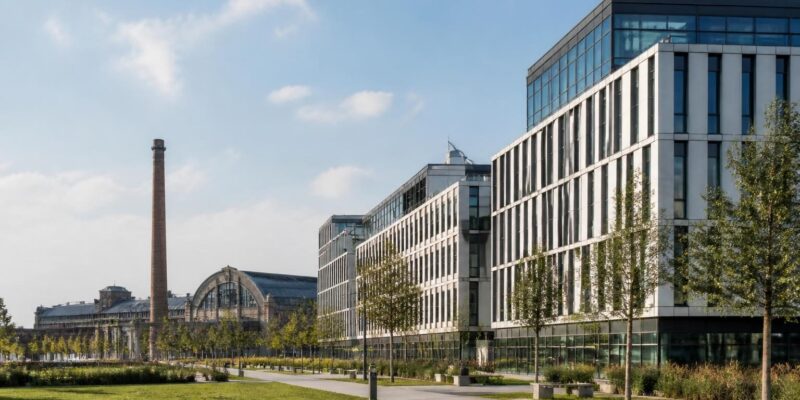
Construction has begun on a new artificial-intelligence data centre at Leipzig’s Alte Messe site, marking a significant step in the city’s plans to strengthen shared digital infrastructure for science and education. The Leipzig University AI Data Centre, known as KIRZL, is being designed to serve the university as well as other higher-education and research institutions in the region.
The construction launch took place on Friday, November 20, 2026. The project is planned as a common resource for data-intensive research, teaching and cooperation with public administration and industry. According to the project announcement, the building is scheduled to be completed by the end of 2028, with technical installation and commissioning expected to bring it into operation in summer 2029. ([idw-online.de](https://idw-online.de/de/news881295?utm_source=openai))
A regional platform for computing-intensive work
KIRZL is intended to address a practical challenge facing universities: research projects increasingly require access to powerful computing, large datasets and specialist technical support. Rather than treating those needs as the responsibility of a single department, Leipzig University is presenting the centre as a shared regional platform.
The facility will support the development of artificial-intelligence methods, applied projects linking science and business, and the training of students and specialists. The university’s project description also identifies possible fields of cooperation including medicine and digital health, biotechnology, energy and environmental technology, logistics, smart-city applications, media and the creative industries.
That combination gives the centre a role beyond server capacity. It is intended to connect research infrastructure with practical experimentation, professional training and the transfer of academic knowledge into public and commercial projects. The university has described the initiative as part of a broader effort to establish a stronger AI ecosystem in central Germany. ([urz.uni-leipzig.de](https://www.urz.uni-leipzig.de/ki-rechenzentrum-leipzig?utm_source=openai))
Nearly €53 million investment
The new building is budgeted at just under €53 million. Most of the funding comes from the Structural Development Fund for Saxony’s lignite-mining regions, under Germany’s investment programme for coal regions. The project therefore combines two policy aims: expanding research capacity and supporting the economic transition of a region undergoing structural change.
The building is planned with a net floor area of approximately 6,700 square metres. It will include server rooms, cooling systems, battery storage and a control centre for monitoring operations. The technical design is intended to support efficient and resource-conscious operation, with plans to feed usable waste heat into the district-heating network.
In its earlier planning information, Leipzig University said the centre would initially be equipped for approximately 1.4 megawatts of IT capacity, with a modular design allowing expansion to as much as 4.4 megawatts if demand grows. The centre will combine high-performance computing, AI infrastructure, virtualisation, backup and archiving services. ([uni-leipzig.de](https://www.uni-leipzig.de/newsdetail/artikel/ki-rechenzentrum-fertig-geplant-bau-und-uebergabe-bis-2028-2026-04-17?utm_source=openai))
Supporting skills as well as machines
For students and early-career researchers, the importance of the project will depend not only on the hardware but also on access to training and collaboration. The university says the centre will help develop new methods and educate future researchers. That could include work across disciplines in which AI is a tool rather than an end in itself, from analysing biomedical information to modelling environmental systems or improving urban services.
The shared model may also make it easier for smaller research groups and regional partners to use infrastructure that would be difficult to establish independently. Leipzig University has said that research institutions, businesses and public authorities will be able to work with the centre through joint projects and services.
Part of Leipzig’s evolving science landscape
The centre is being built at the Alte Messe, an area that has developed from a historic exhibition ground into a mixed science, business and urban-development district. Its location gives the project a visible place within Leipzig’s wider transformation and links advanced computing with the city’s ambitions as a research and innovation centre.
The construction launch does not mean that the new computing capacity is available immediately. The building must first be completed, fitted out and tested before operations begin. The planned summer 2029 opening nevertheless gives the university and its partners a clear timetable for preparing research projects, training programmes and cooperation models.
For Leipzig, KIRZL represents a long-term investment in the basic conditions of modern research: reliable computing, shared technical expertise and spaces where universities, public institutions and companies can develop practical applications together.
















Comments