

 By
By 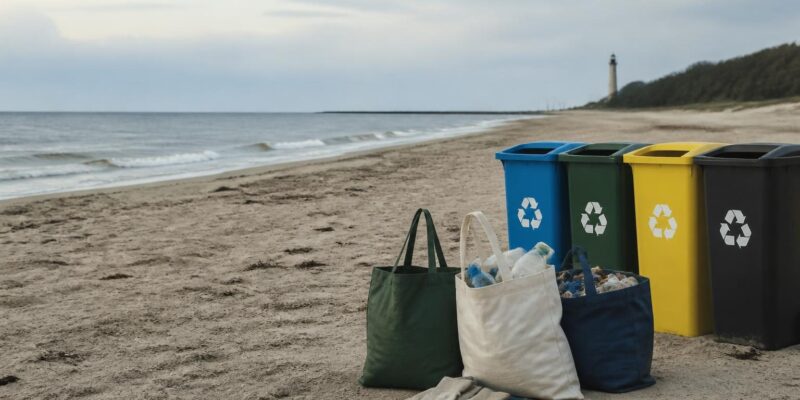
The Kaliningrad region is preparing a new public clean-up of beaches and other waterfront areas, with the main event scheduled for Saturday, 5 September 2026, in Baltiysk. The announcement was published on 19 August by the Kaliningrad Regional Children’s and Youth Centre for Ecology, Local History and Tourism, which is coordinating the initiative through its Ekostantsiya environmental education unit.
Called the “Big Eco-Jog / Water of Russia” action, the programme combines a practical clean-up with environmental education. Organisers say participants will work on selected sections of waterfront in municipalities across the region, including the Baltic Sea coast. The central event is due to take place from 11:00 to 14:00 on Baltiysk’s city beach, near the monument to Empress Elizabeth Petrovna.
A regional day of environmental action
The format is deliberately broader than a one-off beach tidy-up. The organisers invite teachers, pupils, preschool children, parents and representatives of educational institutions to take part. Schools and other organisations may choose a nearby waterbody or coastal site, carry out a clean-up and report the results after the event.
The regional centre describes the campaign as part of the wider “Water of Russia” initiative. Its stated purpose is to improve the condition of shorelines, support the health of aquatic ecosystems and strengthen practical environmental awareness. For participants, that means the work will be visible and straightforward: collect litter, separate recoverable materials and leave the shoreline in better condition than it was found.
The action is being conducted with the support of the Kaliningrad regional education authorities and in partnership with the regional Ministry of Natural Resources and Ecology. Other named partners include the regional environmental centre “Ekat” and the municipal waste-management system.
Sorting waste is part of the event
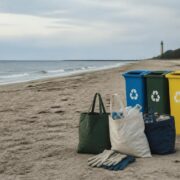
At the Baltiysk beach, collected materials are expected to be separated into plastic, metal and glass. Part of the sorted waste will then be transferred for recycling. This operational detail gives the event a second purpose beyond removing litter: it introduces participants to the basic logic of source separation and shows how material collected in a public space can enter a different waste stream.
The organisers also allow local groups to add workshops, sports activities and educational sessions. Suggested themes include recycling, water resources and responsible treatment of waste. That flexibility makes it possible for schools and civic groups to adapt the day to the character of their own site rather than following a single centrally scripted programme.
The approach has a recent regional precedent. In September 2025, a similar “Big Eco-Jog” at Baltiysk’s city beach brought together teams from Baltiysk, Kaliningrad, Slavsk and Svetlogorsk. The regional waste operator reported that the clean-up produced both mixed waste and separately collected cardboard, plastic, glass and metal for recycling. The 2026 announcement therefore builds on a format that has already been tested locally, while extending participation to a wider network of educational organisations.
Why the coastline matters
Kaliningrad’s geography makes shoreline stewardship a recurring civic task. The region includes the southern Baltic coast as well as the Curonian and Kaliningrad lagoons, and its water network contains thousands of kilometres of rivers, canals and other watercourses. The Federal Water Resources Agency lists the area among the Baltic Sea’s coastal and river-connected territories, where land-based waste can ultimately affect larger aquatic systems.
A public clean-up cannot by itself resolve the region’s broader waste or water-management challenges. It can, however, connect environmental information with direct action. Participants see the types of litter found on a beach, learn which materials can be separated and experience the labour required to keep public waterfronts usable. For younger participants in particular, the combination of outdoor activity and practical sorting can turn an abstract lesson about pollution into a local observation.
Open participation, local organisation
The central event is being organised in Baltiysk, but the campaign is intended to operate across the region. Educational organisations can select their own shoreline or waterbody and add local activities. The organisers have asked participating groups to publicise their involvement and submit reports by 10 September.
That reporting element may also help build a clearer picture of the campaign’s reach: which municipalities participate, what types of sites are chosen and how much material is removed or separated. No final participation or collection figures have been announced for the 2026 event, so the results will only become available after the clean-up.
For now, the announcement offers a constructive invitation rather than a warning: spend part of a September day outdoors, improve a shared coastal space and learn how waste sorting can support the protection of water environments. In a region defined by its relationship with the Baltic shoreline, the organisers are placing environmental responsibility in the hands of schools, families and local communities.
Sources
- Kaliningrad Regional Children’s and Youth Centre for Ecology, Local History and Tourism: announcement of the 5 September 2026 action
- Regional waste operator: report on the 2025 Baltiysk clean-up and separated waste collection
- Federal Water Resources Agency: water resources and geography of Kaliningrad region









Comments