

 By
By 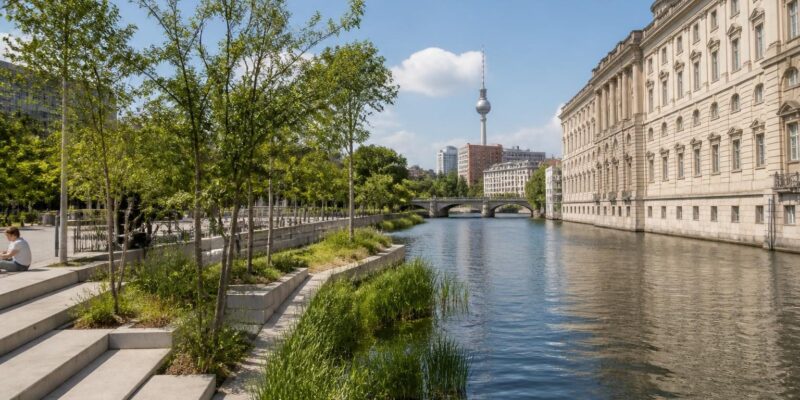
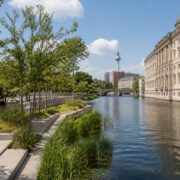
Berlin’s relationship with water is being brought into the open this weekend through a public walking programme on Spree Island. The Humboldt Forum’s “Whatever the Weather” tour, scheduled for Saturday, August 22, 2026, invites participants to examine how water shapes the city’s ecology, public life and infrastructure.
The 90-minute route begins and ends at the Humboldt Forum and is linked to the exhibition On Water – WaterKnowledge in Berlin in the Humboldt Lab. Rather than treating water as a distant scientific subject, the programme moves the discussion into the streets, where visitors can see how the Spree, public amenities and built surfaces interact.
From exhibition to city street
The exhibition presents current water-related research from the Berlin University Alliance alongside artistic perspectives. Its central premise is that water is both familiar and unpredictable: it sustains daily life, but also becomes a challenge when cities face intense rainfall, heat or changing water availability.
The walking tour extends that approach into the urban environment. According to the programme description, the route looks at water quality and the question of swimming in the Spree, as well as drinking fountains, ornamental fountains and historic hand pumps. These features are presented not only as parts of Berlin’s visual character, but also as elements of public infrastructure and shared urban experience.
That combination gives the event a practical focus. A fountain can be a place of refreshment during hot weather; a hand pump can reveal how earlier generations accessed water; and a river can be understood simultaneously as an ecological system, a transport corridor, a recreational space and a subject of public debate.
Climate adaptation at street level
Climate adaptation is another central theme. The programme highlights measures such as removing sealed surfaces and installing systems that allow rainwater to infiltrate the ground. These approaches are increasingly relevant in dense cities, where paved surfaces can speed up runoff during cloudbursts and leave less water available for trees and soil during dry periods.
The walk also addresses the cooling effect created by evaporation from trees and greenery on building facades. In practical terms, this points to a broader understanding of urban resilience: adaptation is not limited to large engineering projects, but can also involve planting, shading, permeable surfaces and the careful design of public spaces.
By placing these subjects along a familiar route, the organisers create a format that can be followed by people with different levels of technical knowledge. Participants do not need to be specialists in hydrology, architecture or environmental policy. The structure is based on observation, explanation and discussion, with specific locations serving as starting points for wider questions.
A public conversation about Berlin’s future
The event reflects a growing interest in connecting scientific research with the places where people live and move. Museums and universities often explain complex issues through exhibitions, lectures or publications. A water-side walk adds another layer: it encourages visitors to look at ordinary features of the city as evidence of decisions about infrastructure, land use and public access.
That perspective is especially useful for climate adaptation, which can otherwise appear abstract. The effects of heat, heavy rain and water stress are experienced locally, but the measures that respond to them are often distributed across many small interventions. Streets, courtyards, parks, facades and riverbanks all form part of the same urban water system.
The Humboldt Forum describes the tour as a meeting point between urban observation and background knowledge, with dialogue across different academic perspectives. Its setting on Spree Island also makes Berlin itself part of the subject. The walk does not present a single technical solution; instead, it asks how the city’s relationship with water can be understood and improved through research, public discussion and everyday design.
Practical information
The German-language tour begins at 16:00 on August 22 and lasts approximately one and a half hours. It is intended for visitors aged 14 and over, and the listed price is €12. Tickets are available online or at the Humboldt Forum foyer box office, subject to availability.
The On Water – WaterKnowledge in Berlin exhibition remains on view at the Humboldt Lab through September 27, 2027. Together, the exhibition and the walking programme offer a constructive example of environmental communication: research is not isolated from public life, but used to help visitors read the city around them.









Comments