

 By
By 
The 29th Informatica Feminale begins at the University of Bremen on Monday, 24 August 2026, bringing two weeks of computer science teaching, practical workshops and professional exchange to the campus. Running until 4 September, the international summer university is designed for women from different fields of study, levels of higher education and professional backgrounds who want to deepen their understanding of computing, digitalisation and artificial intelligence.
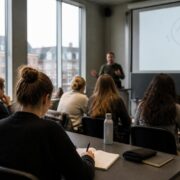
The programme is notable for its breadth. Rather than treating computer science as a single specialist track, Informatica Feminale combines introductory courses with advanced subjects and related skills for research, work and public life. The organisers describe the event as a meeting place for participants from Bremen, elsewhere in Germany and the international community. Teaching is offered in German and English.
A broad programme with practical entry points
The University of Bremen said the 2026 edition includes 38 workshops and courses. The official course catalogue for the opening week illustrates how widely the programme ranges. Participants can study Big Data Systems and Analytics, Design Patterns in Software Engineering, Introduction to Natural Language Processing, Introduction to Cryptography and Introduction to Quantum Computing.
Other courses connect computing with wider social and environmental questions. Environmental Data Science with R and Python introduces tools that are increasingly used to examine complex datasets, while an introduction to energy economics links digital and technical learning to a major field of public policy and industry. A course on programming intelligent household robots uses a virtual research environment to give participants a practical route into robotics and applied software development.
The timetable also includes mathematical and conceptual subjects, such as Proofs and Programs: Rethinking Mathematical Truth and Logic in Action: Time, Inconsistency, and Computation. This mixture reflects the organisers’ effort to present computing not only as coding, but also as a discipline built on reasoning, modelling, communication and collaboration.
Learning beyond the lecture room
Informatica Feminale’s academic offer is supported by visits to research institutes, companies and other institutions in the Bremen region. According to the University of Bremen, the 2026 programme includes excursions to Airbus Bremen, ArcelorMittal Bremen, a waste-to-energy plant and the Seehausen wastewater treatment plant.
Participants can also visit research centres and technology facilities including the Center of Applied Space Technology and Microgravity, the Bremen Fabrication Laboratory, the Fibre Institute Bremen, the Leibniz Institute for Materials Engineering and the German Research Center for Artificial Intelligence. These visits offer a direct view of how computing, engineering, data and research are applied outside conventional classroom settings.
The supporting programme includes lunch talks, networking events with women experts from academia and industry, cultural activities and opportunities for informal exchange. The university has also highlighted free childcare throughout the event, an element that can make participation more realistic for students, researchers and professionals with family responsibilities.
Building confidence and connections
The summer school’s structure places equal emphasis on technical knowledge and access to professional communities. Participants may attend several courses, and the organisers say that certificates of participation or credit points may be available depending on the course. The programme also includes workshops related to communication, careers and professional development.
That combination gives the event a wider purpose than a short training course. For newcomers, it can provide a low-threshold introduction to subjects that may otherwise appear difficult to enter. For experienced participants, it creates an opportunity to refresh technical skills, test new areas of interest and meet lecturers working in research and industry.
The timing is also significant. Digital systems and artificial intelligence are now part of nearly every academic and professional field, from energy and manufacturing to environmental research and communication. A programme that welcomes participants from outside traditional computer science degrees can help broaden the pool of people able to understand, question and develop those systems.
A continuing Bremen tradition
Informatica Feminale is organised by Professor Nicole Megow and the Faculty of Mathematics and Computer Science at the University of Bremen, with support from UniTransfer and the university’s Competence Center for Women in Science and Technology. The 2026 edition continues a long-running Bremen model in which focused teaching is combined with mentoring, networking and contact with the region’s research and technology institutions.
For two weeks, the campus becomes a meeting point for people approaching computer science from different directions: as students, professionals, researchers or simply interested learners. Its central message is practical and constructive: digital expertise can be expanded through accessible teaching, shared experience and opportunities to connect learning with real-world applications.
Sources
University of Bremen: Informatica Feminale 2026





















Comments