
 By
By 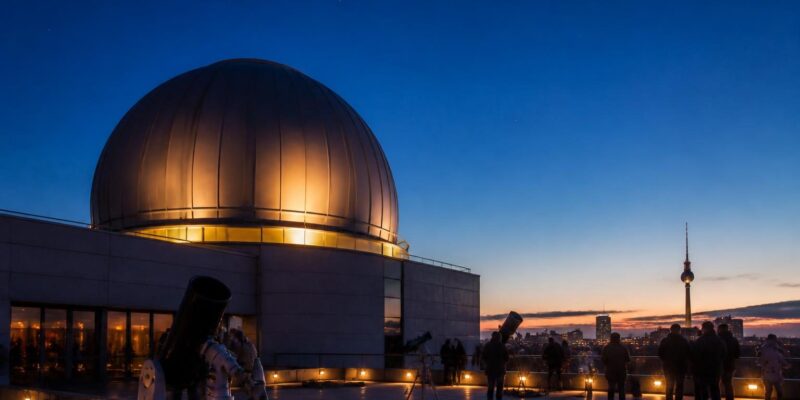
A nationwide invitation to look up
Germany’s astronomy community is turning Wednesday, August 12, into a nationwide public science event, with planetariums, observatories, astronomy clubs and research institutions inviting visitors to explore the night sky. The third nationwide edition of the Long Night of Astronomy combines telescope observations, lectures, planetarium shows and practical activities for families and amateur observers.
The event is being organised by the Stiftung Planetarium Berlin, the Astronomische Gesellschaft, the Gesellschaft Deutschsprachiger Planetarien and the Vereinigung der Sternfreunde, with support from the Federal Ministry for Research, Technology and Space. Participating institutions are offering programmes in locations across Germany, making the initiative broader than a single city festival.
Two celestial highlights on one day
The timing gives the event an unusual scientific focus. Germany will experience a partial solar eclipse on August 12, while the Perseid meteor shower reaches its annual peak during the following night. Organisers say that, under favourable conditions, observers may see as many as 100 meteors per hour. The combination gives visitors a chance to discuss both solar and planetary science within a single public programme.
In Berlin, the partial eclipse begins at approximately 7:15 p.m., reaches its maximum around 8:08 p.m. and ends close to sunset at about 8:37 p.m. Up to roughly 85 percent of the Sun’s disc will be covered in the capital, according to the Stiftung Planetarium Berlin. The eclipse must be observed with suitable solar protection; ordinary sunglasses are not sufficient.
The eclipse will be total in parts of Spain and elsewhere along the path of totality. Berlin’s Zeiss-Großplanetarium will show live coverage from Spain, allowing visitors to follow the event even as the Sun sets locally.
Berlin programme runs into the night
The Zeiss-Großplanetarium will host a free programme from 5 p.m. until 1 a.m. Activities include short fulldome presentations, telescope observations, science talks, children’s workshops and demonstrations by astronomy organisations. A mobile planetarium will offer additional short programmes outside the main building.
After the eclipse, the programme shifts towards night-sky observation. Telescopes will be available from around 9:30 p.m., with Perseid observations beginning at approximately 10 p.m. Saturn is scheduled to become an observation target later in the evening. The programme also includes talks on the MMX and BepiColombo missions, gravity, light pollution and citizen science.
Visitors do not need specialist knowledge to take part. The organisers describe the evening as a family-oriented introduction to astronomy, with experts available to explain what can be seen and how observations are made. Some planetarium presentations require free admission cards collected on site, while the wider outdoor programme is open without charge.
Science communication as a public service
The event illustrates how scientific institutions can connect advanced research with everyday public experience. Astronomy depends on sophisticated detectors, imaging systems and data-processing methods, but its starting point can be as simple as observing the Moon’s shadow or identifying a meteor. The organisers emphasise that public curiosity is an important part of the research ecosystem.
The federal research ministry has also presented the event as an opportunity to show how basic research supports future technologies. Data analysis, imaging and sensor development used in astronomy can contribute to fields including medicine, microelectronics and artificial intelligence. That link is especially relevant as Germany seeks to strengthen public understanding of science and the practical value of long-term research.
For communities beyond Berlin, the national format offers a chance to participate locally through observatories, planetariums, astronomy clubs and university institutions. Programme details vary by location, but the shared theme remains the same: observation, explanation and open access.
A shared evening under the sky
The Long Night of Astronomy is therefore more than a calendar entry for specialist enthusiasts. It is a coordinated effort to make scientific institutions visible, give families direct access to experts and encourage people to experience astronomy together. The eclipse provides a clear daytime focus, while the Perseids extend the invitation into the night.
With free events in Berlin and participating venues across the country, Germany’s astronomy organisations are using a rare combination of celestial events to turn public attention towards science. The result is a constructive, low-threshold programme that links research, education and community life without requiring visitors to be experienced stargazers.














Comments