

 By
A new research direction for functional ceramics
A team of young researchers at Vilnius University has received €350,000 in funding for a three-year project to develop ceramic materials that can be shaped into highly detailed three-dimensional structures using light. The project, announced by the university on November 20, is led by Dr Greta Merkininkaitė of the Faculty of Chemistry and Geosciences and brings together chemists and physicists from across the university.
The work will focus on materials that are first formed from light-sensitive chemical systems and then converted into crystalline ceramics through heat treatment. The researchers aim to preserve the precision of the printed form while giving the finished material useful optical properties, including the ability to absorb and emit light in controlled ways.
Printing with light rather than layers
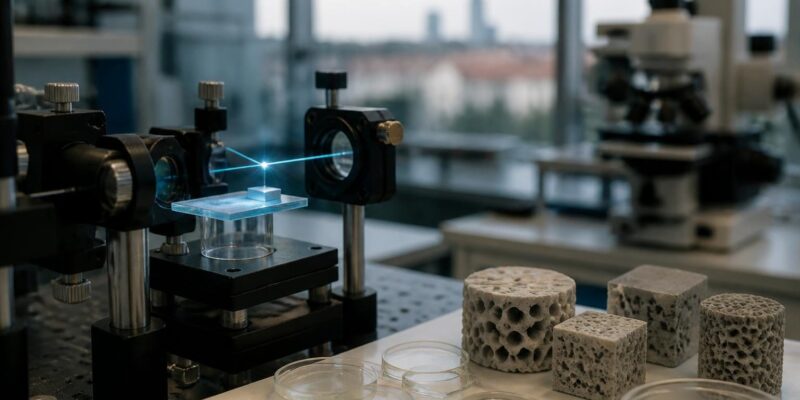
The project uses two related approaches. Ultraviolet printing can rapidly harden larger selected areas of a resin, while multiphoton laser lithography can create much finer structures inside the material. In the latter process, the laser hardens only the tiny volume at the focus of the beam, allowing researchers to draw complex forms directly inside the resin.
This is different from a conventional 3D printer, which normally builds an object layer by layer. The Vilnius team is instead designing both the material and the manufacturing process together. Chemical components will be distributed at molecular level, with optically active ions added to influence how the resulting ceramic interacts with light.
The challenge comes after printing
The research is not simply about producing an intricate shape. During heating, organic components must be removed and the remaining material must become ceramic. Uneven shrinkage can deform or crack the structure, while unwanted crystalline phases can affect how light travels through it.
For optical applications, these details matter. Defects or an irregular internal structure can scatter light and reduce performance. The researchers therefore plan to study the relationship between chemical composition, printing conditions, thermal treatment and the final crystalline structure.
That integrated approach is important because a geometrically accurate microstructure does not automatically have the desired physical properties. The project will seek to align the shape of the object with the way its material behaves after processing.
From university research to possible applications
The immediate outcome will be new knowledge about functional materials and precision fabrication rather than a finished commercial product. In the longer term, the materials could contribute to miniature light sources, laser components, optical sensors or other microstructures that guide and control light.
The project builds on cooperation between the university’s Faculty of Chemistry and Geosciences and its Laser Research Center. The partners have previously demonstrated that laser-formed microstructures can become crystalline, glowing ceramics after heating. The new project is intended to move that line of research towards a broader and more deliberately designed materials platform.
International cooperation is also part of the plan. The team will work with researchers from the University of Twente in the Netherlands, including Dr Arturo Susarrey-Arce, and expects joint experiments and research internships to support the exchange of expertise.
Backing early scientific leadership
The award comes through the Research Council of Lithuania’s “My First Research Team” programme. The scheme is designed to give talented researchers an opportunity to lead an independent project, assemble a research group and develop international partnerships. In June, the council said that 89 young researchers had been selected to establish their first teams under the programme.
For Vilnius University, the project illustrates how Lithuania’s established strengths in laser science can be connected with chemistry and materials engineering. It also gives an early-career researcher the opportunity to shape a distinct research direction while involving students, university colleagues and international partners.
The project’s practical promise lies in its combination of scale and precision: relatively rapid ultraviolet processing for larger forms, combined with laser writing for details measured at microscopic or smaller levels. Whether those materials eventually enter photonics products will depend on the results of the research, but the starting point is clear. Vilnius scientists are treating ceramic fabrication as a joint problem in chemistry, optics and manufacturing.



















Comments