

 By
By 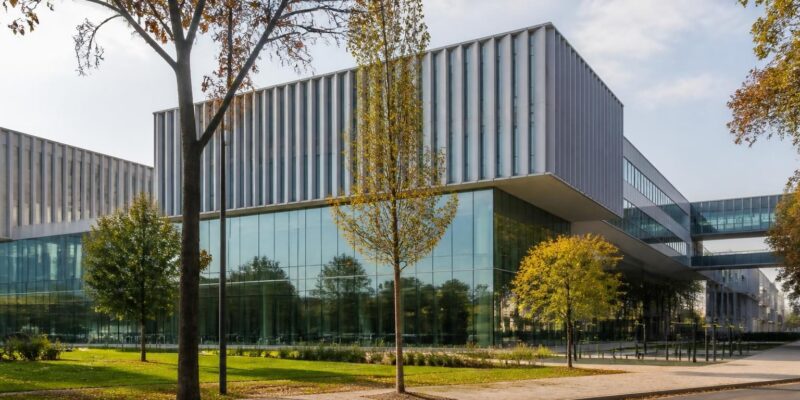
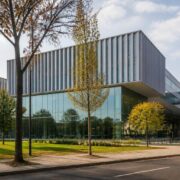
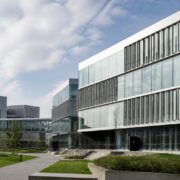
Rīga Stradiņš University has opened a new sports, study and research centre in Pārdaugava, creating a shared base for sports education, practical training, university teams and research into human physical performance.
The facility at 3 Cigoriņu Street was officially opened on Wednesday, 9 September 2026. The project gives RSU and its Academy of Sport a modern setting in which classroom knowledge, physical activity and applied research can operate side by side. The university says the centre is also intended to serve academic staff, employees and members of the surrounding community who want to take part in sport.
A university facility with several purposes
The centre covers 3,627 square metres and represents an investment of almost €13.4 million. According to RSU and the Latvian research information portal Research Latvia, the project was financed through university resources together with co-financing from the European Union’s Recovery and Resilience Facility.
Its main sports hall is designed for basketball and volleyball. The building also includes a gym with strength, cardio and functional-training areas, rooms for gymnastics, Pilates and yoga, and a multifunctional hall for group activities and other uses.
For students, however, the most significant element may be the infrastructure dedicated to teaching and research. The centre includes a scientific laboratory for measuring human-body and physical parameters, physiotherapy rooms and a medical point. These spaces are intended to support practical instruction for students of the RSU Academy of Sport, as well as research connected with health, movement and athletic performance.
From theory to practical experience
The opening comes at an important moment for sports education at RSU. The former Latvian Academy of Sport Education became part of Rīga Stradiņš University in July 2024 and began operating under the name RSU Academy of Sport on 1 September 2026. The academy traces its institutional history back to 1921, when Latvia established its first higher-education institution specialising in sport.
RSU says the new building will allow students to complement theoretical studies with practical experience in a purpose-built environment. That can include instruction in sports pedagogy, physiotherapy, exercise assessment and health-related physical activity. The combination is particularly relevant to a university whose wider profile includes medicine, healthcare and social sciences.
The facility also gives university sports teams a permanent location for training and home competitions. Previously, RSU’s sports infrastructure was spread across older or less suitable premises. Consolidating activities in one centre is expected to make training, teaching and university sport easier to coordinate.
Research connected to everyday health
The new laboratory gives the centre a role beyond conventional university sports provision. Measuring physical and physiological parameters can support studies of exercise, recovery, rehabilitation and the relationship between physical activity and public health. The building’s physiotherapy facilities add another practical dimension, linking sports science with injury prevention and recovery.
That approach reflects a broader trend in health education: research is increasingly expected to produce knowledge that can be used in everyday settings, from schools and amateur clubs to clinical practice and community health programmes. RSU’s sports research structures already cover topics including physical activity, nutrition, psychological adaptation and the health of young people.
The university has also emphasised accessibility in the design of the complex. The building includes a lift, adapted sanitary facilities and universal-design solutions. Bicycle and electric-mobility parking spaces are provided as part of the site’s infrastructure.
An opening with a local dimension
RSU has presented the centre not only as an internal university investment but also as a place with a role in the surrounding neighbourhood. Local residents are expected to be invited to selected activities, while the university plans to use the facility to promote healthy lifestyles and public engagement with sport.
For Pārdaugava, the project adds a specialised educational and research site close to Arkādijas Park. For Latvia’s higher-education system, it offers a visible example of infrastructure designed to serve several functions at once: student learning, applied science, organised sport and public health.
The immediate value of the centre will be measured in daily use rather than in the opening ceremony itself. Its longer-term contribution will depend on how effectively RSU integrates the laboratory into research projects, gives students regular access to practical learning and opens selected activities to the wider public. The basic platform is now in place.








Comments