

 By
By 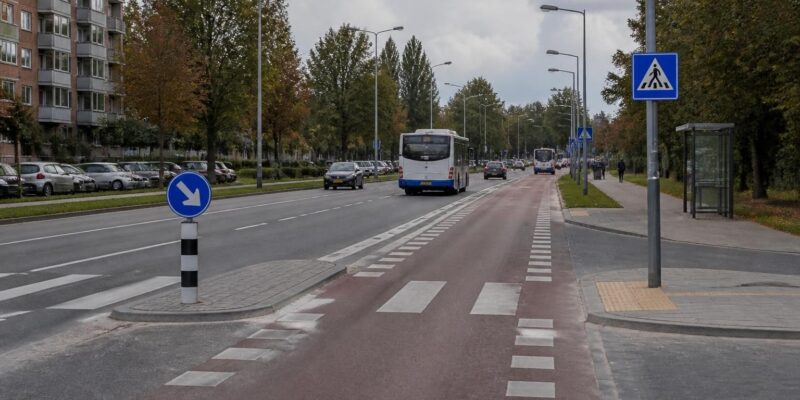
Riga has introduced a dedicated public-transport lane on part of Rostokas Street, a practical intervention designed to make bus journeys more predictable in the city’s western district. The municipality announced the measure on September 1, saying the lane would help buses avoid recurring congestion between Anniņmuižas Street and Zolitūdes Street.
The change affects the direction towards Zolitūdes Street. According to the municipal transport data cited in the announcement, 164 bus departures operate through this section on a typical weekday. Because the lane is being created within the existing road arrangement, the city says the number of general traffic lanes available to other vehicles will not be reduced.
A response to recurring delays
Rostokas Street is affected by congestion near a railway crossing and the traffic signal that follows it. Queues in that area can delay buses even when their routes do not continue through the entire problematic section. Since the routes using this part of Rostokas Street begin their journeys there, a delay at the start can continue to affect the timetable farther along the line.
The municipality says the problem has been measurable but variable. During the autumn season of 2025, average delays on the section reached three minutes in the morning and as much as ten minutes in the evening. In spring 2026, the reported average was one minute in the morning and up to five minutes in the evening.
Those figures describe averages rather than a guarantee of future performance, but they explain the city’s decision to give buses more consistent priority. A dedicated lane cannot remove congestion from the surrounding road network, yet it can prevent buses from being held in the same queue as other traffic for at least part of the journey.
Bus priority without a wider road
Riga’s municipal mobility department describes dedicated bus lanes as one of the main tools for giving public transport priority. The aim is to allow buses to bypass congestion and reduce timetable deviations, particularly on corridors where demand is high and road space is limited.
The Rostokas Street measure follows that approach without a major reconstruction project. Instead of widening the road, the city has changed the traffic arrangement and introduced restrictions on stopping. Vehicles may no longer stop on either side of the relevant carriageway, except in specially created widened areas. The measure is therefore based on reorganising existing space rather than adding a new road.
That choice also makes the project relatively easy to understand for passengers and residents: buses receive a clearer path, while general traffic retains its existing lane count. The trade-off is that curbside stopping becomes more limited, requiring drivers to use the designated widened areas and observe the new markings.
Pedestrian crossings included in the same intervention
The work is not limited to bus movement. At pedestrian crossings, the city is creating visual and physical narrowing effects through road markings. The intention is to reduce the width of the area pedestrians need to cross and make the crossing points more visible and manageable.
Riga says the adjustments should improve conditions for pedestrians without requiring a large-scale reconstruction of the street. Narrower crossing zones can make it easier for people to judge traffic movements and reduce the time spent in the carriageway. The municipality presents the bus lane and crossing changes as part of one traffic-organisation package rather than as separate projects.
The current intervention is being implemented in stages. An earlier municipal notice said the initial works were expected to be completed by September 6, with some remaining solutions dependent on resurfacing work on Zolitūdes Street. That means the arrangement should be understood as an active street-management project rather than a finished long-term reconstruction of the whole corridor.
A small project with a wider mobility lesson
Rostokas Street is not one of Riga’s headline infrastructure megaprojects. Its significance lies in the way the city is using a targeted measure to address everyday reliability. For passengers, a delay of several minutes at the start of a route can affect connections, school arrivals, work commutes and confidence in the timetable. For the operator, early disruption can accumulate across the rest of a route.
The project also illustrates the balance involved in urban transport planning. Giving buses priority does not automatically eliminate car congestion, and restricting stopping can inconvenience some road users. But the city’s stated approach is to improve the performance of a high-frequency service while maintaining the existing number of general traffic lanes and making crossings more legible.
Riga is simultaneously working on a broader metropolitan mobility plan and has identified public transport, walking and cycling as areas requiring long-term coordination. Against that wider background, the Rostokas Street lane is a modest but visible example of how a city can adjust street space to improve reliability before undertaking a more extensive redesign.

















Comments