 By
Riga will place Latvia’s contemporary music scene in an international setting this week as Riga Music Week returns to the Tallinas Street Quarter from November 4 to 6. The event combines a professional conference with a public city festival, creating a meeting point for performers, songwriters, managers, labels, promoters and listeners.
The Latvian Ministry of Culture announced on October 29 that the second edition will bring together more than 50 artists from Latvia and abroad, alongside music-industry professionals from across Europe. The programme is designed not only as a series of concerts but also as a practical forum about how music is discovered, developed and taken to audiences beyond its home market. ([km.gov.lv](https://www.km.gov.lv/lv/jaunums/riga-music-week-starptautiska-muzikas-industrija-jaunrade-un-vairak-neka-50-koncertu-riga?utm_source=openai))
A festival built around discovery
The public-facing part of Riga Music Week will run through two main festival evenings on November 4 and 5, followed by partner events at venues around Riga on November 6. The organisers say the showcase programme will feature more than 50 emerging and established artists across several stages, with genres ranging from indie, rock and electronic music to hip-hop, experimental, folk, world music and jazz.
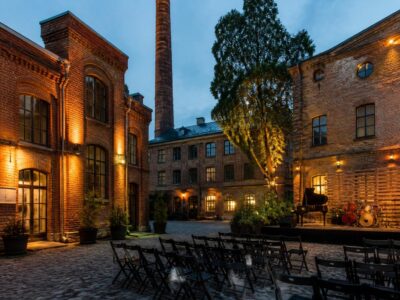
Rather than concentrating the programme in one conventional concert hall, Riga Music Week uses the Tallinas Street Quarter as an urban cultural setting. The official event programme lists stages at Angārs, Ezītis Miglā and other venues in the district, as well as an outdoor stage. This format allows audiences to move between performances and gives smaller acts the kind of concentrated exposure usually associated with showcase festivals. ([rigamusicweek.lv](https://rigamusicweek.lv/?utm_source=openai))
The organisers say the festival selection followed 1,126 applications from 89 countries. That figure indicates the scale of interest surrounding the event, although the festival’s editorial focus remains closely connected to the Baltic and European music ecosystem. Several stages are curated by Latvian music organisations, labels, media platforms and concert agencies, giving local industry actors a visible role in shaping the programme. ([piletilevi.ee](https://www.piletilevi.ee/en/series/EQA34OIVD3/riga-music-week-2026?utm_source=openai))
From local talent to international circulation
The conference programme addresses a practical question for smaller music markets: how can artists and companies become more visible in an online environment dominated by global platforms? Discussions will examine digital recommendation systems, music-export strategies, international touring, copyright, artist development and the role of booking agents and managers.
One panel will consider whether music-submission platforms genuinely widen access or simply create another layer between artists and audiences. Other sessions will look at the gap between artistic talent and the business capacity needed to develop long-term international careers. These themes are especially relevant to Latvia, where a strong pool of musicians must often reach listeners abroad in order to build sustainable touring and recording opportunities.
The event will also include practical sessions on choosing European showcase festivals, digital music distribution and the work of music managers. The emphasis is therefore on skills and professional connections as much as on visibility. For artists, the value of a showcase can lie in a conversation with a promoter or publisher that continues well after the final performance.
European recognition comes to Riga
A notable part of the opening day will be the announcement of the 15 nominees for the European Union’s Music Moves Europe Awards 2027. The Latvian Ministry of Culture describes the announcement as a first for Latvia. Hosting that moment gives Riga a role not only as a concert destination but also as a place where the next generation of European artists is formally introduced to the wider public.
That combination of public performance and industry attention is the central idea behind the week. Audiences can encounter new music in an informal city setting, while professionals can assess artists in a live environment and discuss the structures needed to support them. The model is constructive for both sides: musicians gain access to potential partners, and the city strengthens its profile as a platform for creative exchange.
A cultural event with an urban dimension
Riga Music Week also reflects the wider transformation of former industrial and mixed-use districts into cultural spaces. The Tallinas Street Quarter has become associated with concerts, creative businesses, food, design and community-oriented events. By placing the festival across several connected venues, organisers are presenting music as part of everyday urban life rather than as an isolated cultural product.
For Riga, the event offers a concise way to show visitors and residents how Latvia’s music scene connects local identity with international cooperation. For the artists involved, it provides a concentrated opportunity to test new material, meet collaborators and reach audiences looking beyond the most established names.
Riga Music Week runs from November 4 to 6, 2026. The public festival programme is centred on November 4 and 5 at the Tallinas Street Quarter, with additional partner events scheduled across the city on November 6.












Comments