
 By
By 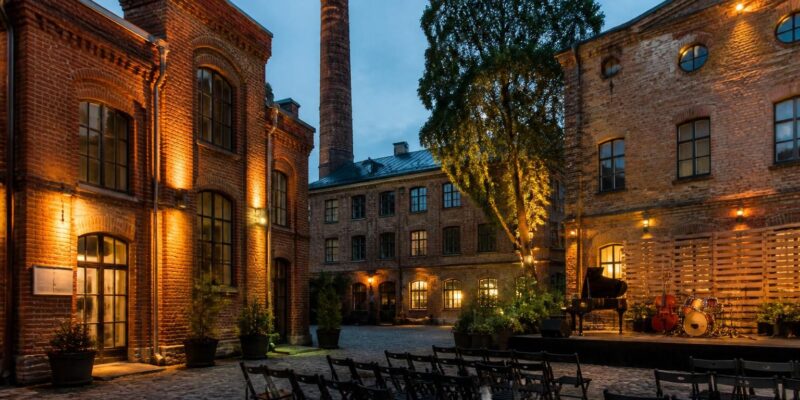
Riga’s international world-music scene gets a fresh meeting point on Thursday, 20 August, when the PORTA 26 summer concert brings three contrasting acts to K.K. Fon Stricka Villa. The programme begins at 19:00 and is built around a conversation between Baltic polyphony, southern Italian musical traditions and contemporary Finnish folk experimentation.
The event is a current cultural highlight in Latvia’s capital rather than a large-scale festival spread across several days. Its compact format gives the evening a clear editorial identity: audiences can encounter three different approaches to tradition in one setting, with each performance representing a distinct musical geography and performance language.
A Baltic opening rooted in polyphonic singing
The programme features The Baltic Sisters, an international traditional-music project whose members come from Latvia, Lithuania and Estonia. The group includes Estonian singer Marion Selgall, Latvian performers Vineta Romāne and Liene Skrebinska, and Lithuanian singer Laurita Peleniūtė.
The ensemble works with the folk-song traditions and multipart singing of all three Baltic countries. Its approach is not presented as a historical reconstruction alone: the project combines inherited vocal practices with a contemporary concert setting, allowing the different traditions to be heard as part of a shared regional musical language.
The Baltic Sisters’ debut album, Värav / Vārti / Vartai, was released in 2025. According to the group’s official biography, the record received international recognition and was nominated by Folk Alliance International in the global music album category. That background gives the Riga appearance a wider context, connecting local and regional singing traditions with the international world-music circuit.
From the Mediterranean to northern experimentation
Italy is represented by Yaràkä, a trio from Taranto in southern Italy. The ensemble draws on southern Italian roots, Mediterranean melodies, and rhythms associated with African and Amazonian musical traditions. Its work is described by the festival as ritual-driven and closely connected with ideas of nature, memory and ancient cultural practices.
The group’s 2023 album Curannera takes its title and inspiration from a traditional healer figure. The music is sung in the Taranto dialect, giving the performance a strong regional character while the arrangements look beyond a single local tradition. For PORTA’s audience, Yaràkä offers a different way of thinking about folk music: not as a fixed archive, but as a living form capable of absorbing distant influences.
The third act is Finnish accordionist and composer Antti Paalanen. His distinctive style combines folk accordion with dance rhythms, metal-influenced energy, vocal techniques and a highly physical solo performance. The festival presents him as an artist who pushes the diatonic accordion beyond conventional expectations, creating layers of bass, harmony, melody, percussion and voice within a one-person format.
A small venue for a wide musical map
Holding the concert at K.K. Fon Stricka Villa places the programme within one of Riga’s regenerated urban cultural spaces. The venue’s courtyard setting is suited to a summer concert that depends on atmosphere as much as on scale, while its central location makes the event accessible to residents and visitors already exploring the city’s cultural programme.
The ticketing information lists the organiser as Pasaules mūzika, the association behind the PORTA festival. Children up to and including the age of 11 can attend free of charge, while discounted tickets are available for students and pensioners with valid identification. The event is also listed in Riga’s public events and tourism calendars.
PORTA 26’s 20 August programme therefore offers more than a conventional concert listing. It brings together three ways of carrying tradition forward: collective Baltic singing, a southern Italian project shaped by regional memory and global rhythmic exchange, and a Finnish solo performance that treats an old instrument as a platform for experimentation. In a summer city programme already filled with outdoor music, the evening’s strongest feature is its concentrated international scope.











Comments