

 By
By 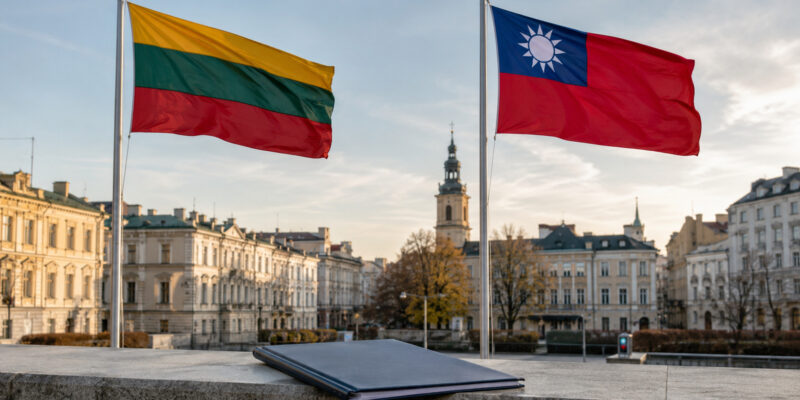
Ravi Balgobin Maharaj argues that Lithuania’s response to pressure over Taiwan should be guided neither by Washington nor Beijing, but by decisions made independently in Vilnius.
By Ravi Balgobin Maharaj
Editor’s note: This is a guest commentary. The views expressed are those of the author and do not necessarily reflect the position of The Baltic Review.
The letter sent on 10 August by the four co-chairs of the US Congressional Taiwan Caucus to Lithuania’s political leadership should not be treated as routine diplomatic correspondence. Signed by Republican representatives Mario Díaz-Balart and Andy Barr and Democratic representatives Ami Bera and Greg Stanton, it carries weight beyond the position of a single party. Its central request is clear: Lithuania should continue its substantive relationship with Taiwan despite pressure from Beijing.
The letter also raises a larger question. How far should democratic states be prepared to defend their right to decide for themselves with whom, and on what terms, they conduct international relations?
For Lithuania, that question cannot be separated from history.
The country understands better than most what it means to live in a world where a larger power claims the right to determine the fate of a smaller one. Lithuania’s experience of occupation and repression is not a remote chapter confined to textbooks. It remains present in families, cities, museums and public memory. Independence was restored because people refused to accept that Lithuanian statehood could be decided in another capital.
That is why the Taiwan question has a particular resonance in Lithuania.
More than a dispute over a name
When the Taiwanese Representative Office opened in Vilnius in 2021, Lithuania was doing more than expanding practical relations. It was asserting that Lithuanian foreign policy is made by the Lithuanian Republic.
China responded by downgrading diplomatic relations. Lithuanian exporters and European companies using Lithuanian components encountered serious trade obstacles. In January 2022, the European Union challenged China’s measures at the World Trade Organization. The case was ultimately terminated in November 2025 after the EU said that relevant trade had resumed and the dispute’s key objectives had been met. Its political lesson nevertheless remains: economic relations can become an instrument of pressure.
The choice before Lithuania should not be reduced to Beijing or Taipei. Nor should Lithuania become an instrument of American policy in Europe. The congressional letter asks for something more specific: that Vilnius not abandon a substantive relationship with Taiwan merely because Beijing objects to it.
That request deserves serious consideration — not because the United States is always right, but because alliances among democracies should be built on interests, trust and the ability to speak honestly even when partners disagree.
In this case, the American argument carries particular weight. Lithuania’s choices regarding Taiwan are part of a broader test: can small and medium-sized states shape their foreign policy freely when a larger power is willing to impose economic costs?
Lithuania should understand that dilemma instinctively.
Europe’s strategic test
Lithuania’s withdrawal from the China-led 17+1 format in 2021 signalled that Vilnius did not want its relationship with Beijing to develop separately from Europe’s wider strategic interests. Latvia and Estonia followed in 2022. What once appeared to be a relatively small country’s decision inside a much larger geopolitical contest now looks like an early warning of a debate that has become central to European policy.
Europe has learned that dependence in energy, trade, infrastructure and technology can acquire security consequences. Taiwan belongs to this broader discussion, although easy historical analogies should be avoided. Taiwan is not Ukraine, China is not Russia, and the circumstances are different. The common principle is narrower: a democratic state should not be compelled to abandon international relationships solely because an authoritarian power objects to them.
Lithuania’s position is complex. It is a member of the European Union and must take account of the Union’s broader China policy. It has legitimate interests in trade, investment and international cooperation. It also faces immediate security challenges that can seem distant to other European countries.
That is precisely why Lithuania’s voice matters. Vilnius has rarely enjoyed the luxury of pretending that geopolitics happens somewhere else.
The US lawmakers are not asking Lithuania to sever relations with China. They are asking it to maintain its relationship with Taiwan. That distinction leaves room for a policy that rejects a false binary. Lithuania can keep diplomatic and economic channels open with China while sustaining meaningful, unofficial relations with Taiwan — and make clear that both are determined in Vilnius.
That is not necessarily provocation. It is an exercise of sovereignty.
Sovereignty has a price
Foreign policy decisions do not remain inside ministries. They reach businesses, jobs, export markets and public budgets. If China restricts trade, the consequences may be felt by a Lithuanian company or employee long before they are absorbed by the state. Any responsible government must take those costs seriously.
But accommodation also carries a risk. If a democratic state reverses policy solely because economic pressure has been applied, it may demonstrate that coercion works. The issue then ceases to concern only Lithuania and Taiwan; it becomes a test of Europe’s political resilience.
The EU’s Anti-Coercion Instrument, adopted in 2023, recognises this danger. It is designed to deter third countries from using trade or investment measures to force policy changes and allows EU countermeasures as a last resort. Its existence sends an important signal: a member state subjected to economic coercion should not be left to respond alone.
In this sense, Lithuania’s question is also Europe’s question.
An ally, not a satellite
The United States remains central to Lithuania’s security, and NATO remains its foundation. Yet Lithuania should not respond to the congressional letter merely out of loyalty to Washington. It should respond according to its own interests and principles.
Lithuania should not be Washington’s satellite. It should be Washington’s ally.
An ally has a voice. It can disagree, ask difficult questions and expect the United States to consider European interests. It can also conclude that certain principles matter more than short-term convenience.
Lithuania can adhere to its One China policy while developing practical relations with Taiwan. It can pursue trade with China while opposing economic coercion. It can act within the European Union while preserving a recognisably Lithuanian voice. It can remain committed to the transatlantic community without surrendering its independence as a sovereign state.
These are not contradictions. They are the substance of a mature foreign policy.
The Act of the Re-Establishment of the State of Lithuania on 11 March 1990 was more than a legal document. It declared that the source of Lithuania’s statehood was the Lithuanian people. The circumstances today are entirely different, but the underlying principle endures.
When Lithuania speaks about Taiwan, the world hears more than its view of Taiwan. It also hears what Lithuania believes about its own sovereignty.
The most important question, therefore, is not whether Lithuania chooses Washington, Beijing or Taipei. It is whether the final choice is made in Vilnius.
That is the meaning of sovereignty — and Lithuania knows better than most when it is worth defending.
About the author
Ravi Balgobin Maharaj is a political commentator and social activist from Trinidad and Tobago. Since 2013, he has written on democracy, governance, human rights, public administration and foreign policy. He has also pursued public-interest legal challenges concerning constitutional accountability and access to information. Learn more about the author.




















Comments