 By
By 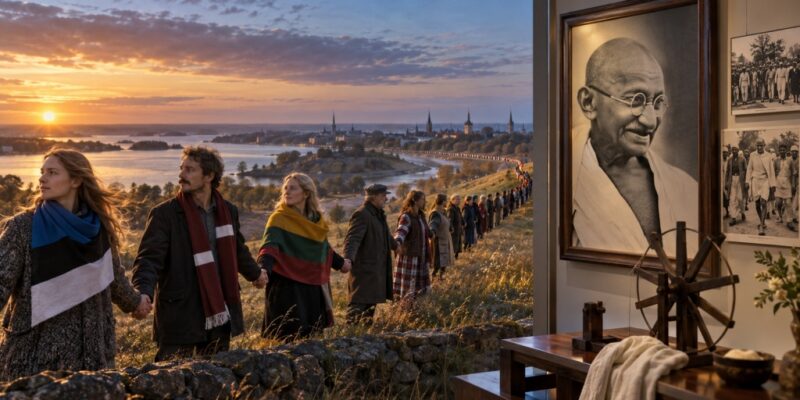
School of International Studies
Jawaharlal Nehru University
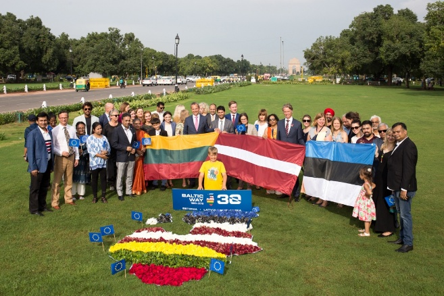
On 23 August 2026, the embassies of Lithuania, Latvia and Estonia commemorated the 37th anniversary of the Baltic Way at the National Gandhi Museum in Rajghat, New Delhi. The ceremony, presented as a tribute to Mahatma Gandhi, brought together two geographically distant but morally connected traditions of nonviolent resistance.
The event highlighted the links between Gandhi’s philosophy and the Baltic struggle for independence—an area of long-standing interest in relations between India and the Baltic states. Lithuania’s Ambassador to India, Diana Mickevičienė, described Lithuania as “a reflection of the Northern Lights of Gandhian ideas in the Far North”, emphasising the universality of Gandhi’s philosophy.
The Baltic Way: an unbroken human chain for freedom
The Baltic Way was an approximately 600-kilometre human chain linking the Baltic capitals of Vilnius, Riga and Tallinn. On 23 August 1989, around two million people joined hands to demand freedom and the restoration of the independence of Lithuania, Latvia and Estonia. Organised by Lithuania’s Sąjūdis, Latvia’s Tautas Fronte and Estonia’s Rahvarinne, it became a defining moment in the wider peaceful independence movement known as the Singing Revolution.
The three Baltic republics had established independent states in 1918, but their sovereignty was extinguished in 1940 following the division of Eastern Europe into Nazi German and Soviet spheres of influence under the secret protocols of the Molotov–Ribbentrop Pact, signed on 23 August 1939. The Baltic Way was therefore held on the pact’s 50th anniversary, drawing international attention to the secret protocols whose existence the Soviet authorities had long denied.
Later in 1989, the Soviet Congress of People’s Deputies acknowledged and condemned the secret agreements. The Baltic Way helped internationalise the three nations’ demand for freedom. Lithuania declared the restoration of its independence on 11 March 1990; Estonia restored its independence on 20 August 1991, followed by Latvia on 21 August 1991. The Soviet Union recognised their independence in September 1991.
The Baltic Way has since become an enduring symbol of Baltic unity, solidarity and peaceful civic resistance. In 2009, documentary records of the event were inscribed in UNESCO’s Memory of the World Register.
Freedom as living memory
During my visits to Lithuania, Latvia and Estonia, I encountered striking personal recollections that reveal how the Baltic Way—and the wider nonviolent struggle for independence—continues to live in Baltic memory. Some people also recalled the influence of India’s freedom movement and Gandhian ideas on contemporary thinking about peaceful resistance.
“We studied the Indian national movement against the British Empire and decided to follow the Gandhian way of nonviolent resistance against the Soviet Empire in order to re-establish national freedom,” one political scientist told me.
Another person recalled the symbolic impact of Richard Attenborough’s film Gandhi, which was shown on Lithuanian television during the period of national awakening. Remembering the risks involved in peaceful mobilisation, a participant recounted:
“It was so thrilling to participate in a nonviolent protest at Vilnius Cathedral Square against the giant Soviet army. I remember when a bullet flew near my left ear; I stood firm with my eyes closed.”
The continuing emotional resonance of 1989 was captured more simply in another reflection: “The Baltic Way matters a lot for us today.”
Such recollections show that the Baltic Way remains deeply rooted in personal experience and collective memory. Memories of Gandhi also form a bridge between the Baltic states and India, giving contemporary commemorative and diplomatic engagement a deeper resonance.
Gandhian nonviolence and the Singing Revolution
Gandhi’s ideas travelled far beyond India, helping to shape a universal framework of nonviolent resistance based on satyagraha, civil disobedience, mass mobilisation and moral authority. At its core was the recognition that political rule ultimately depends on the consent and cooperation of the people. The Baltic Way and the broader Singing Revolution echoed many of these principles, including the disciplined mass action associated with Gandhi’s 1930 Salt March.
Baltic leaders studied and adapted the experience of earlier nonviolent movements, including India’s. The work of theorists of strategic nonviolent action, notably Gene Sharp, also informed civil-resistance thinking. Lithuania played an especially important role in developing concepts of nonviolent civilian defence.
In a 2012 conversation, the late Professor Gražina Miniotaitė, a prominent Lithuanian scholar of nonviolent resistance and an intellectual associated with Sąjūdis, recalled that nonviolence had been regarded as essential from the beginning. As the threat of Soviet aggression grew, “Gandhi’s way” was seen as the most effective means of resistance. Baltic thinkers also drew on the legacy of Martin Luther King Jr. and other international traditions of civil resistance.
The history of Baltic engagement with Gandhi includes the Lithuanian-born Jewish architect Hermann Kallenbach’s close friendship with him; the philosopher Vydūnas’s interest in Indian thought; the traveller and anthropologist Antanas Poška’s encounters with Gandhi; the work of Gandhi’s South African secretary Sonja Schlesin, whose family came from the region; and the Estonian scholar Linnart Mäll’s translations of Gandhi.
During the period of national awakening, Attenborough’s 1982 film Gandhi was broadcast on Lithuanian television. When confronting Soviet forces, peaceful demonstrators repeated messages such as “We won’t fight”, “We follow Gandhi” and “We are peaceful people”.
These connections do not mean that the Baltic movements simply copied the Indian experience. Rather, Gandhi formed part of a wider intellectual and moral repertoire through which nonviolent resistance could be understood and adapted to Baltic history and circumstances.
Gandhi’s legacy as an India–Baltic bridge
Gandhi’s legacy offers a valuable historical and cultural resource for the evolving partnership between India and the Baltic states. Since diplomatic relations were established in the early 1990s, cooperation has expanded into clean technology, renewable energy, artificial intelligence, digital innovation, manufacturing, green finance, sustainability, the blue economy and culture.
Growing trade complements these political and cultural ties. According to Indian government figures, bilateral trade in the 2025–26 financial year reached approximately US$490.62 million with Lithuania, US$475.66 million with Latvia and US$219.69 million with Estonia.
A tribute to Mahatma Gandhi
The 37th-anniversary commemoration in New Delhi gave tangible expression to the historical and symbolic connections between Gandhi and the Baltic states. The Lithuanian Embassy presented the National Gandhi Museum with a portrait of Mahatma Gandhi by Lithuanian artist Darius Tamkevičius. The embassies of Lithuania, Latvia and Estonia also donated framed historical photographs of the 1989 Baltic Way, while a temporary exhibition of additional images was displayed at the museum.
Marija Tamkevičiūtė, the artist’s daughter, travelled to Delhi and spoke about the inspiration behind her father’s portrait of Gandhi, a global symbol of nonviolent resistance. Placing photographs of the Baltic Way alongside Gandhi’s portrait brought two distant traditions of peaceful struggle into a shared commemorative space.
The ceremony was attended by representatives of the National Gandhi Museum, diplomats, artists and academics. Among the guests were Tara Gandhi Bhattacharjee, Mahatma Gandhi’s granddaughter and chairperson of the National Gandhi Museum Trust, and Vinayak Bhattacharjee, his great-grandson.
Other commemorative links include annual observances at the Gandhi–Kallenbach monument in Rusnė, Lithuania; the unveiling of a bust of Gandhi at the National Library of Latvia in 2019; the installation of a Gandhi statue in Mustamäe, Tallinn, in 2025; and the launch of the Kallenbach Memorial Lectures in 2024.
The Baltic tribute to Gandhi reaffirms nonviolence, freedom and human dignity as enduring points of connection between India and the Baltic states. It also reminds us that freedom is not only a historical achievement. It is a living memory—renewed whenever people choose solidarity over fear and peaceful resistance over coercion.
About the author: K. B. Usha is an Associate Professor at the School of International Studies, Jawaharlal Nehru University, New Delhi. She teaches and supervises research on the Baltic states, India–Baltic relations and nonviolent movements.










Comments