

 By
By 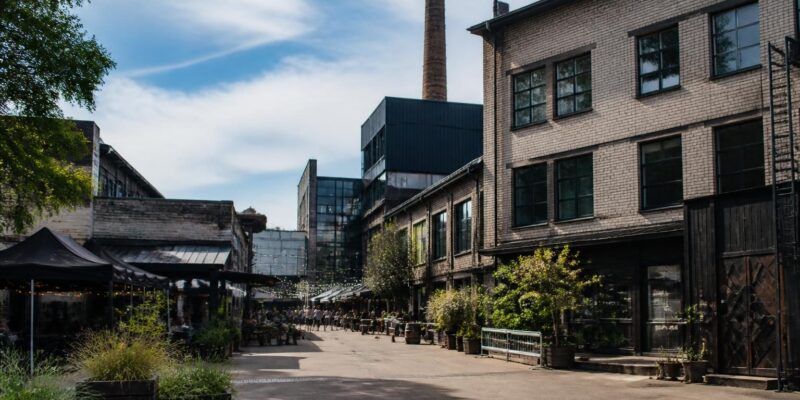
A food festival in a neighbourhood shaped by reuse
Visitors to Tallinn’s Telliskivi Creative City are being offered a distinctly urban weekend experience as the Tallinn Food Truck Festival takes place on Saturday and Sunday, 8–9 August 2026. The event brings more than 50 food trucks to the former industrial quarter, alongside a concert programme, DJ sets and public voting for the festival’s best food truck.
The festival is a current, small-scale example of how Tallinn’s former industrial spaces continue to function as public places rather than simply as preserved buildings. Telliskivi’s courtyards and former factory structures are being used for food, culture, commerce and social activity, giving the northern Tallinn district a temporary pedestrian focus during the height of the summer season.
From railway workshops to a creative district
Telliskivi Creative City is located in a former industrial complex between the Kalamaja and Pelgulinn areas. According to Visit Tallinn, the old factory buildings have been adapted for galleries, studios, cafés, restaurants and cultural venues. The city tourism office describes the site as a cultural and business centre where industrial heritage and contemporary creativity meet.
The transformation is part of a wider change in northern Tallinn. Places that were once associated mainly with manufacturing, storage and railway activity have gradually become accessible urban destinations. Their value now lies not only in the buildings themselves, but also in the way they connect different uses: workspaces, independent shops, restaurants, exhibitions and public events.
Telliskivi’s own history records the start of its redevelopment in the late 2000s. The creative district now presents itself as a community platform for Estonia’s creative industries, with events and businesses operating alongside the retained industrial character of the site. That combination gives the food festival a setting that is more distinctive than a conventional temporary market on an open square.
A temporary route through the city
The 2026 festival is organised as an open-air event at Telliskivi 60. The official event listing says that participating vendors include Estonian food businesses and street-food operators from neighbouring countries. The programme also includes a burger-eating competition on both days, while visitors can vote on awards in two categories: Best Design and Best Food.
Those details make the festival more than a collection of stalls. The event creates a temporary route through the creative city, encouraging visitors to move between food points, music and the surrounding businesses. In a district already known for galleries, restaurants and design, the festival adds another layer of activity without requiring a new permanent structure.
Such events also show how urban districts can accommodate different rhythms. During ordinary weekdays, Telliskivi functions as a mixed business and cultural quarter. At weekends, its courtyards can support markets, performances and social gatherings. The food-truck format is particularly suited to that flexibility because it can occupy existing public space for a limited period and then leave the area available for its regular uses.
Public space, local business and visitor flow
For Tallinn, the festival contributes to the city’s broader visitor offer while remaining rooted in a neighbourhood rather than a single landmark. Telliskivi is close to Balti Jaam railway station and within walking distance of the Old Town, making it part of a wider movement corridor between the historic centre, the railway area and northern districts.
The event listing does not make claims about visitor numbers or economic impact, so its significance should not be overstated. Its immediate contribution is more straightforward: it gives food entrepreneurs a shared platform, offers residents and visitors a reason to spend time in the district, and demonstrates how adapted industrial environments can host public life.
That is also why Telliskivi remains relevant to discussions about urban development. The area illustrates a model in which regeneration is not limited to new construction. Existing structures, open courtyards and a recognisable local identity can support new activity while preserving traces of the city’s industrial past.
A summer event with an urban backdrop
The Tallinn Food Truck Festival continues through Sunday, 9 August. Its combination of food, music and audience voting is deliberately accessible, but the setting gives the weekend a larger urban dimension. Visitors are not only attending a festival; they are experiencing a district whose current identity has been built by layering new uses onto an older industrial landscape.
For Tallinn, that is a constructive story about city life: a former closed production area now functioning as an open meeting place, with short-term events helping to keep the public realm active and commercially diverse.













Comments