

 By
By 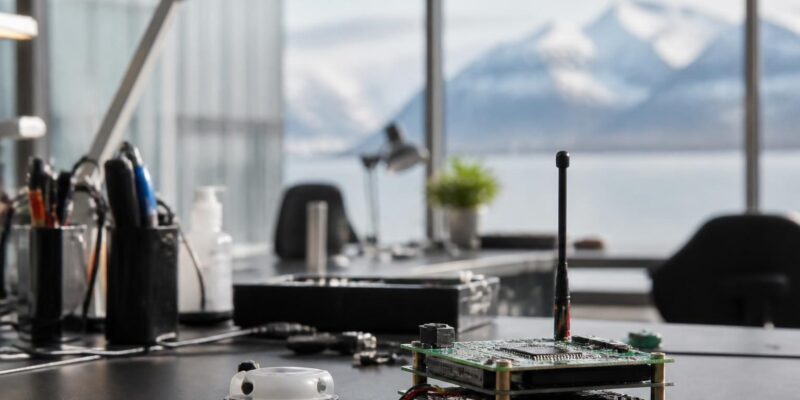
Growth across chips, software and connected devices
Norwegian technology company Nordic Semiconductor reported a stronger second quarter on August 6, with revenue rising to USD 218.6 million, up 33.2% from the same period in 2025. The Oslo-based developer of low-power wireless semiconductors also reported a gross margin of 53.1% and EBITDA of USD 33.7 million.
The figures make Nordic Semiconductor’s latest report one of the more notable Scandinavian technology updates of the week. The company’s products are used in connected devices that rely on Bluetooth Low Energy, cellular connectivity and other wireless standards. Its customers span consumer electronics, industrial equipment and healthcare applications.
For the first half of 2026, revenue reached USD 411 million, an increase of 28.8% compared with the first half of last year. Operating profit almost doubled year on year to USD 32.4 million, while net profit rose to USD 27.1 million from USD 11.3 million.
Industrial and healthcare demand gains ground
Nordic’s results show that growth is not limited to consumer products. Revenue from industrial and healthcare customers reached USD 86.1 million in the second quarter, 45.5% higher than a year earlier. Consumer-related revenue rose by 24.9% to USD 125.2 million.
The distinction matters because industrial and healthcare devices often require long product lifecycles, low energy use and reliable communication between sensors, machines and cloud platforms. Nordic said the quarter reflected demand from both established large customers and a broader base of smaller and mid-sized customers.
The company’s largest business remains short-range wireless connectivity. That area, which includes Bluetooth Low Energy, Thread, Zigbee and Matter products, generated USD 199.8 million in quarterly revenue, up 29.5% year on year. Long-range revenue, including cellular products and cloud services, increased by 93.8% to USD 14.6 million, albeit from a smaller base.
From wireless chips to a chip-to-cloud platform
Nordic is positioning itself as more than a component supplier. Its strategy combines semiconductor hardware with development tools, software and cloud services that help customers manage devices after they have been shipped.
During the quarter, the company expanded nRF Cloud with remote battery-health monitoring and fuel-gauging functions. It also introduced firmware-vulnerability scanning designed to help customers monitor software risks and prepare for regulatory requirements such as the European Union’s Cyber Resilience Act.
That move reflects a broader change in the electronics industry. Connected products increasingly need updates, diagnostics and lifecycle management, not only a processor or radio chip. For manufacturers, a more integrated platform can reduce the time needed to move from prototype to commercial deployment and simplify maintenance once devices are in the field.
New tools target faster prototyping
Nordic also highlighted the wider availability of AI-assisted development tools. The company says the tools can support engineers across the product lifecycle, from initial prototype work to production and field diagnosis. The stated aim is to reduce development iterations and shorten the route from an idea to a working connected product.
A new nRF54L15 Tag development platform was introduced during the quarter. It supports applications including asset tracking, smart-home products, Bluetooth Channel Sounding, Matter and edge-AI experimentation. The platform is part of Nordic’s broader nRF54 product family, which the company expects to become a long-term growth driver.
Edge AI refers to processing information directly on or near a device rather than sending every task to a distant data centre. For battery-powered products, this can help limit connectivity needs and allow devices to react locally. In practical terms, the approach is relevant to wearables, sensors, tracking equipment and other products where energy consumption and response time are important.
A growing Norwegian technology employer
Nordic Semiconductor ended the quarter with 1,465 employees, 10.5% more than a year earlier. The company said the increase reflected both organic recruitment and staff added through acquisitions completed in 2025.
Research and development spending also increased. Nordic reported quarterly research and development costs of USD 49.8 million, compared with USD 36.9 million in the second quarter of 2025. The investment is supporting new wireless platforms, cloud services and development tools while the company broadens its addressable market.
The report does not remove the normal uncertainties of the semiconductor sector. Nordic noted that industrial revenue remains influenced by individual large customers and that currency movements affect operating expenses. Inventory and cash management will also remain important as the company invests in product expansion.
Still, the direction presented on August 6 is constructive: stronger sales, improved margins and a widening product offering. For Norway’s technology economy, the report illustrates how a specialist company can build international scale by combining hardware expertise with software, cloud services and developer support.





















Comments