

 By
A vacuum that loses suction a week after a new filter. A brush roll that stops turning halfway across the rug. A cordless stick that pulses on and off. Owners often read these as the end of the machine.
Usually they are a damp filter refitted too early, a cutout protecting the motor, or a blockage the bin cannot show you.
Vacuum and floor-care maintenance takes only a few minutes, and the manual for your exact model tells you which parts you can wash or replace yourself. Here is how to use it for Hoover, Dyson and Shark machines.
Vacuum and floor-care maintenance starts with the right manual
Find the model number on the rating label, usually on the body, under the bin or in the battery compartment. Uprights, cordless sticks, canisters and wet floor cleaners can have completely different parts, even within one brand.
| Brand | Background | Worth knowing |
| Hoover | The US brand belongs to TTI; in Europe, Hoover is part of Haier | Same name, different companies and model ranges |
| Dyson | British company; its first bagless cyclonic vacuum, the DC01, launched in 1993 | Many filters are washable but need long drying |
| Shark | Brand of SharkNinja | Many models have anti-hair-wrap brush rolls |
Hoover
Because Hoover machines in the US and Europe come from different companies, search the hoover manuals collection with the full model number, not just the range name. If the machine has a belt, the manual explains how to check and replace it, and which brush-roll parts are owner-serviceable.
Dyson
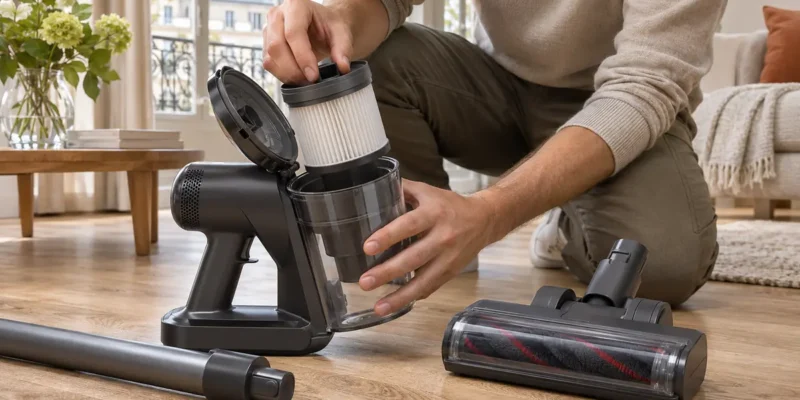
Dyson manuals show which filters can be washed and how to remove them. Dyson’s guidance for its washable filters is to rinse in cold water only, without detergent, and leave them to dry completely for at least 24 hours. Check the instructions for your model in the dyson manuals collection.
Shark
Shark floor heads vary a lot between models. The shark manuals collection shows which covers and brush-roll parts are designed for owner removal and where to look for blockages.
If a search fails, contact the manufacturer with the number from the label.
Empty the bin and look after the filters
Unplug a corded machine before opening anything. On a cordless model, remove the battery if the manual says so.
Empty the bin before debris reaches the fill line, or replace the bag as directed. An overfilled bin cuts suction. Pet hair and fine dust, such as plaster or flour, fill a bin and clog filters much faster than ordinary household dirt.
Know your filters
Most machines have more than one filter, and each has its own rules:
| Filter | Usual position | Typical care |
| Pre-motor filter | Between the bin and the motor | Often washable; check the manual |
| Post-motor or HEPA filter | After the motor, at the exhaust | Washable on some models, replace-only on others |
| Bin or cyclone shroud | Around the bin | Wipe or brush as directed |
Washing a filter that is not designed for it can ruin the filter media. A filter can feel dry on the surface while still holding moisture inside. Refitting it damp is a common cause of musty smells and reduced suction.
Wet floor cleaners
After each use, rinse out the dirty-water tank and clean any washable rollers or pads as the manual describes. Let them dry before storage. Keep electrical parts dry, and never use a dry vacuum to pick up liquids unless the manual says it can.
Clear brush rolls and airways
Disconnect power first. Check the floor head for wrapped hair and thread. If the manual allows access, cut the tangles across the brush roll with scissors, keeping the blades clear of the bristles. Do not yank material caught under a cover.
Finding a blockage
When suction is weak and the bin is empty, work along the airflow path:
- Floor-head inlet.
- The neck or joint between the floor head and the wand.
- Wand and hose.
- Bin inlet.
A folded piece of paper or a clump of hair can block an airway completely. A pulsing cordless stick is a common sign: the motor speeds up and slows as airflow is blocked. Do not push a tool into a passage you cannot see. If the blockage is out of reach, seek service rather than taking the machine apart.
Match common problems to first checks
| Symptom | Possible cause | First step |
| Weak suction | Full bin or bag, clogged filter, blocked airway | Empty the bin, check filters, then the airway |
| Brush roll stops | Tangles, protective cutout | Disconnect, clear tangles, follow the restart procedure |
| Pulsing on and off | Blockage or clogged filter | Check the airway and filters |
| Will not charge | Charger, outlet, battery seating | Test the outlet; reseat the battery and charger |
| Burning smell | Belt, motor or electrical fault | Stop using it and contact service |
Many machines stop the brush motor automatically when the roll jams, to protect it. The manual explains how to clear the jam and restart.
For charging problems, look up the indicator lights in the manual. Many batteries will not charge when they are too hot or too cold. A damaged battery, a burning smell or a persistent fault means stop using the machine. Do not open electrical components.
Charge and store the machine correctly
Use only the specified charger. Store the machine and its battery somewhere dry, within the temperature range the manual gives, and away from direct heat. On corded models, wind the cable loosely, without tight bends at the plug or the body.
Keep the manual with the model number noted on it, and set a reminder for filter checks. Check them more often if you have pets, or after renovation work.























Comments