

 By
By 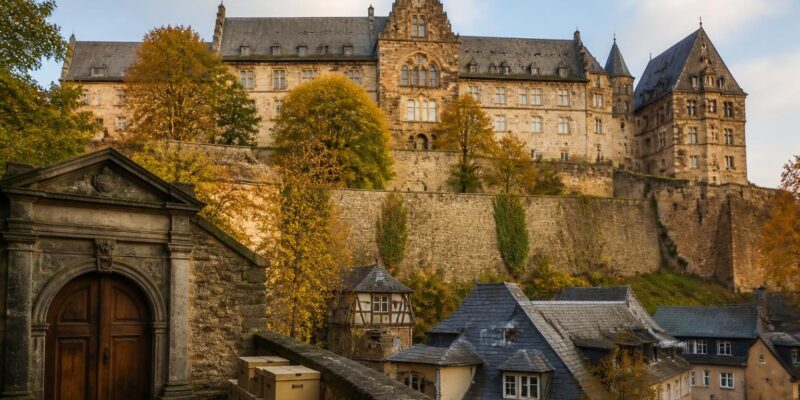
A university anniversary begins with an invitation to look closely
Philipps-Universität Marburg has begun its anniversary year with a public exhibition that turns five centuries of academic history into a story told through objects. “500 Years of the University of Marburg – What Remains of History” opened at the Museum of Art and Cultural History in the Landgrafenschloss on 15 October and will remain on view until 28 February 2027.
The exhibition is the first major public-facing element of a programme leading to the university’s 500th anniversary in 2027. Rather than presenting the institution’s past only through famous names and formal milestones, the display brings together material from the university archive, library and museum. Its selection includes founding documents, ceremonial insignia, historical scepters, records connected with women’s education and documents relating to the university’s history during the Nazi period. The Nobel Prize certificate awarded to Emil von Behring is also on display.
The approach gives visitors a chance to understand the university through both its symbols and its surviving everyday traces. A founding charter or academic scepter may represent institutional authority, while less conspicuous documents can show how education, administration and social change were experienced over time. The university says the exhibition is intended to make that history accessible through concrete objects rather than leaving it at the level of abstract chronology. ([uni-marburg.de](https://www.uni-marburg.de/de/aktuelles/news/2026/was-bleibt-was-kommt-ausstellung-im-marburger-landgrafenschloss?utm_source=openai))
From Homberg to Marburg
The exhibition follows a ceremonial opening to the anniversary year on 14 October. A group of students from the Collegium Philippinum travelled by bicycle from Homberg (Efze) to Marburg, following the new Philipp500 cycle route. The journey linked two historical moments: the Homberg Synod of 1526, associated with the introduction of the Reformation in Hesse, and the foundation of the Marburg university in 1527 by Landgrave Philip of Hesse.
On arrival, the cyclists were welcomed at Marburg’s Old University. University members then moved in a procession through the city towards the Landgrafenschloss, where a celebration brought together students, researchers and staff from administration, technical services and academic management. According to the university’s report published on 15 October, the handover of a relay baton from Homberg marked the symbolic start of the anniversary year.
The ceremony was aimed primarily at the university community, but the exhibition provides the broader public with a lasting point of access. It also places the anniversary in a building that is already one of Marburg’s most visible historical landmarks and a long-standing museum venue. ([uni-marburg.de](https://www.uni-marburg.de/de/aktuelles/news/2026/jubilaeumsstartfest?utm_source=openai))
History as a shared civic resource
Marburg’s anniversary programme is designed to extend beyond a commemorative display. The university has announced lectures, exhibitions, concerts, conversations, performances and conferences across the anniversary year. One strand, called “Marburg Knowledge Spaces”, uses digital tools to make historical places of learning visible, including sites that no longer exist. The project is being developed with student participation and is intended to connect buildings and locations with stories about the production and circulation of knowledge.
Other planned elements include an escape game for school pupils focused on recognising disinformation, public pianos, a sports week and an artistic performance involving university members. These projects place the anniversary in the present: they treat the university not only as an institution with a long past, but also as a social environment that can meet residents, schools and visitors outside the lecture hall.
That emphasis matters in a university city such as Marburg, where academic life is closely intertwined with the urban landscape. The anniversary therefore offers a practical question as well as a historical one: how can a university make its collections, research and public responsibilities more visible to the people who live around it?
A five-month window into institutional memory
The exhibition itself offers a manageable starting point. It runs from 15 October 2026 through 28 February 2027 at the Museum of Art and Cultural History in the Landgrafenschloss. The university’s event listing identifies students, staff, alumni and guests as its target groups and notes barrier-free access, accessible sanitary facilities, public-transport connections and parking.
For visitors, the value of the display lies in its range. The objects do not tell a single celebratory story. They also point to changing educational opportunities, difficult historical periods and the ways in which universities are shaped by wider society. By bringing these materials together, Marburg is using its anniversary to encourage a more layered form of public memory—one that can acknowledge achievement while leaving room for questions about exclusion, responsibility and change.
The exhibition is open from Tuesday to Sunday, 10:00 to 17:00. Further anniversary projects are scheduled to develop throughout the academic year, giving Marburg residents and visitors several ways to encounter the university’s history and its future ambitions. ([uni-marburg.de](https://www.uni-marburg.de/de/aktuelles/news/2026/was-bleibt-was-kommt-ausstellung-im-marburger-landgrafenschloss?utm_source=openai))


















Comments