

 By
By 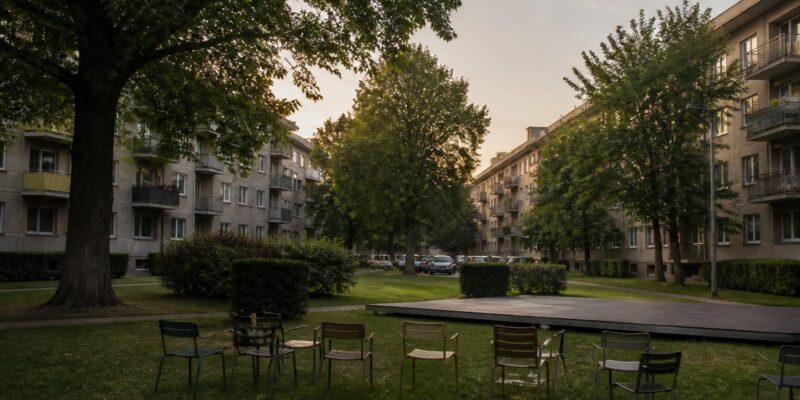
A city-wide cultural programme begins in everyday spaces
Kaunas has begun its 2026 “Culture into Courtyards” programme, a free summer series that moves professional performances out of conventional venues and into residential neighbourhoods. The event opened on Monday, 17 August, and will continue across the final part of the month, with the organiser’s listing covering 17–26 August and the launch report by Lithuanian public broadcaster LRT describing a programme running through 27 August.
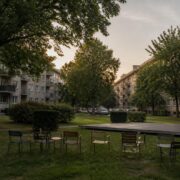
The central idea is straightforward: instead of asking residents to travel to the city centre for a concert, play or film, the programme brings cultural activity to the courtyards where people live. This year, more than 20 activities and performances are planned in ten Kaunas neighbourhoods, according to LRT. The programme includes live music, theatre, contemporary circus, outdoor cinema, photography projections, workshops and informal activities prepared with local residents.
From concerts to cinema under the open sky
The opening event takes place in Aleksotas, where singer Rūta MUR launches the series at a courtyard on Europos Avenue. The programme then moves through several parts of the city. In Žaliakalnis, audiences can hear music combining Latin American folk influences with contemporary work. In Šančiai, musician Pijus Opera and percussionist Arkadijus Gotesmanas present the poetic-percussive performance “Pagava”. A dance duet at Karaliaus Mindaugo Prospektas explores ideas of closeness in the digital age.
Other evenings are built around film and visual culture. Dainava hosts a programme of Lithuanian short films assembled by the Vilnius Short Film Festival, while Petrašiūnai is scheduled to show director Aistė Žegulytė’s documentary “Dust, Bones and Miracles”. In Panemunė, photography projects including “Classmates’ Kaunas” and “Grotesque” are projected onto apartment walls, turning familiar architecture into a temporary outdoor screen.
The series also includes a contemporary circus performance, “Stork”, in Eiguliai. In Vilijampolė, actor and director Paulius Markevičius presents the monologue performance “Tomas Peinas (based on nothing)” with a live band, alongside a concert by the acoustic trio Golden Parazyth. The closing event listed in the launch coverage is scheduled for Šilainiai, where the group Graži ir ta galinga will perform on 27 August.
Residents are part of the programme
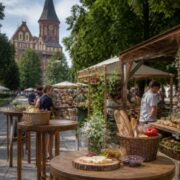
“Culture into Courtyards” is not presented simply as a touring stage placed beside apartment blocks. A major part of the project is the participation of the residents who host it. According to LRT, children in one Dainava courtyard will contribute a concert and dance performance, while a resident DJ will help open the programme in Žaliakalnis. Šančiai will again include a local initiatives market, and some hosts are expected to open their homes or balconies to visitors seeking views across the city.
The accompanying education programme extends the idea of the courtyard as a shared space. Activities include juggling workshops, creative sessions led by visual artist Ilona Miknevičiūtė, an exploration of the world of fungi with expert Aurelia Plūkė, and “give-away courtyards” in Aleksotas and Šilainiai. These events are designed to encourage conversation and participation without making attendance dependent on prior knowledge of the arts.
Art shaped by the neighbourhood
In an earlier interview published by LRT, the organisers and participating artists described the neighbourhood itself as part of the artistic material. Theatre director Paulius Markevičius said that courtyards bring their own routes, sounds, distances and unexpected interruptions. For visual artist Ilona Miknevičiūtė, the work can change with the people and plants already present in a place rather than arriving as a finished object.
That approach gives the programme a civic dimension without turning it into a formal community meeting. Residents can watch from a distance, stop briefly on their way home or take part more actively. The organisers emphasise that participation should remain voluntary and welcoming. The aim is to create a temporary situation in which neighbours meet under different circumstances and begin to see familiar spaces in a new way.
Kaunas Menininkų Namai, the municipal cultural institution organising the series, says the project began in 2020 as an effort to decentralise culture and bring professional artists into residential districts. Its continuation in 2026 reflects a broader interest in using ordinary urban spaces for public culture. For residents and visitors, the result is a late-summer programme that combines accessible entertainment with a more lasting question: what can happen when a courtyard becomes not only a place to pass through, but a place to gather?









Comments