 By
By 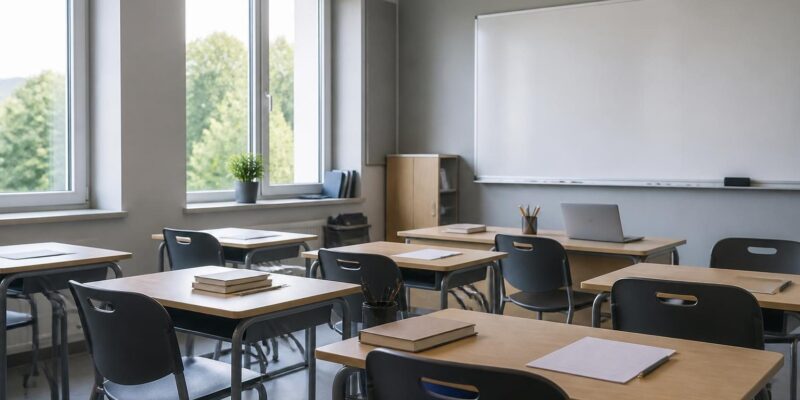
A common framework for a flexible school day
Latvia is introducing a nationwide framework for blended learning as the 2026/2027 school year begins. On 25 August, the Cabinet approved rules prepared by the Ministry of Education and Science that establish common principles for combining in-person teaching with remote, online and technology-supported learning.
The regulations will take effect on 1 September 2026. Their central message is that blended learning should supplement classroom education rather than replace it. Schools will have to plan how digital tools and remote lessons are used, taking account of pupils’ age, learning needs and ability to work independently.
The decision gives Latvia’s schools a clearer operating framework after several years in which digital learning became an important part of education but was organised in different ways across institutions. The new rules aim to make that flexibility more predictable for pupils, parents, teachers and municipalities.
Different limits for different age groups
The regulations set maximum proportions for remote and online learning in general education. For third-grade pupils, these forms may account for up to 5% of the planned annual lesson total. The limit rises to 10% in grades four to six, 15% in grades seven to nine and 20% in grades ten to twelve.
Preschool education and grades one and two will remain fully based on physical attendance. Technology may be used to enrich lessons in those age groups, but pupils and teachers must remain in the same physical location. This distinction recognises that younger children generally require more direct guidance, routine and social interaction in the classroom.
The gradual increase in permitted online learning reflects the expectation that older pupils can take greater responsibility for organising their work. It also gives secondary schools more room to invite outside teachers, offer specialised subjects or connect pupils with learning opportunities that may not be available locally.
Access beyond the nearest school
The Education and Science Ministry presents the framework partly as an access measure. In Latvia’s smaller municipalities, schools may not always be able to employ specialists for every subject or maintain a full range of upper-secondary courses. Carefully planned online participation can help schools connect pupils with teachers and expertise elsewhere.
That possibility is particularly relevant for advanced subjects, languages, science modules and interdisciplinary projects. A pupil does not necessarily need to travel to another town to join a lesson led by a specialist, provided that the school can offer suitable supervision, equipment and support.
At the same time, the rules preserve clear boundaries. Practical classes, workplace training and professional skills that require hands-on activity must take place in person. In vocational education, blended learning can be used more broadly when all prescribed learning outcomes are achieved, but remote and online elements remain subject to an overall limit of 20% in professional secondary and craft programmes.
Each school must publish its own arrangements
Every education institution will now be required to prepare its own procedure for organising blended learning. It must explain when remote or online lessons may be used, which digital environment the school will rely on, how technical difficulties will be handled and how pupils will gain access to the necessary equipment.
The procedure must also set out communication and safety arrangements. In practical terms, that means families should be able to understand how a remote lesson fits into the timetable, how attendance and participation are recorded, where assignments are submitted and whom to contact if a connection or device fails.
This school-level planning is important because a national rule cannot by itself resolve differences in internet access, staffing, classroom equipment or pupils’ home circumstances. The framework gives schools common parameters while leaving room for local decisions about subjects, timetables and teaching methods.
A measured step into the new school year
Latvia’s approach is neither a return to fully remote schooling nor a rejection of digital education. Instead, it treats online tools as one element in a broader learning model built around the classroom.
For teachers, the coming school year will bring the task of translating the national limits into workable school policies. For parents and pupils, the most visible change may be greater clarity: blended learning will have defined boundaries, and the amount of remote or online teaching will depend partly on age.
The framework also leaves room for experimentation. Schools can use technology-enhanced lessons, online cooperation and access to specialist teachers without abandoning the social and practical advantages of being together in a classroom. Its success will ultimately depend on the quality of planning, teacher preparation and the reliability of the digital environment.
With the rules entering into force on 1 September, Latvia is placing blended learning within the ordinary architecture of its education system. The result is a common national baseline for a more flexible school experience, while face-to-face teaching remains the foundation.










Comments