
 By
By 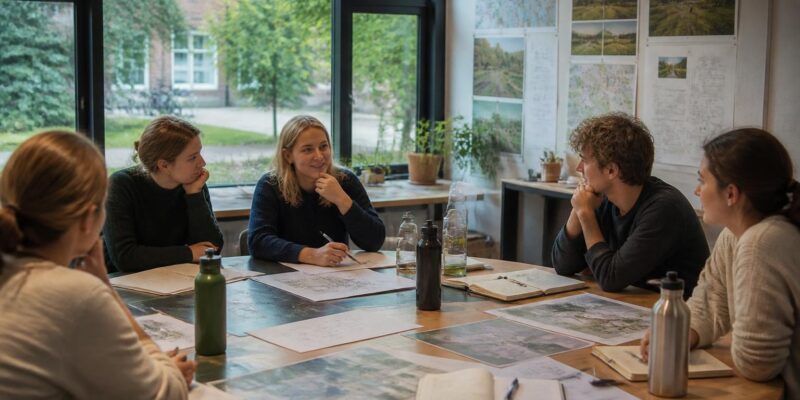
A classroom for the many meanings of sustainability
A three-week sustainability course at the University of Copenhagen is under way this week, offering students an interdisciplinary introduction to one of the defining policy and practical questions of the present: how should societies understand and pursue sustainable development?
The course, titled Understanding Sustainability, began on 3 August and continues through 21 August 2026. It is offered in English and has a stated capacity of 65 students. The course description places environmental questions alongside social, economic, political and philosophical perspectives, reflecting the fact that sustainability decisions rarely belong to one field alone. ([efteruddannelse.kurser.ku.dk](https://efteruddannelse.kurser.ku.dk/course/2026-2027/NIFB21000U?utm_source=openai))
Rather than presenting sustainability as a single formula, the University of Copenhagen says the course examines the different ways the concept is defined, measured and applied by researchers, public authorities, companies and civil-society organisations. That approach gives the programme a practical relevance beyond the classroom: policies on energy, food, transport, waste, biodiversity and nature restoration all involve trade-offs between competing objectives.
From environmental science to public policy
The course is linked to the university’s Study Board of Natural Resources, Environment and Animal Science and is organised by the Department of Food and Resource Economics. Its academic structure combines natural-science and social-science perspectives, with the stated aim of helping students reflect on sustainability in their own education and future professional practice.
Topics listed in the course description include climate-change mitigation and adaptation, energy production, food production, transportation systems, waste and recycling, nature restoration and biodiversity protection. The programme also addresses political tools, environmental justice, governance and the practical implementation of the United Nations Sustainable Development Goals. ([efteruddannelse.kurser.ku.dk](https://efteruddannelse.kurser.ku.dk/course/2026-2027/NIFB21000U?utm_source=openai))
That breadth is significant because environmental policy is increasingly shaped by decisions that cross institutional boundaries. A transport plan can affect emissions, land use and household finances at the same time. Food policy may involve agricultural production, public health, biodiversity and trade. Nature restoration can require scientific monitoring, local participation, financing and long-term governance.
The course therefore treats sustainability not only as an environmental objective but also as a field of public reasoning. Students are expected to consider the assumptions behind different approaches, identify possible synergies and examine where goals come into conflict. The university describes the purpose as providing a “roadmap” for understanding these different perspectives, rather than prescribing one universal solution. ([efteruddannelse.kurser.ku.dk](https://efteruddannelse.kurser.ku.dk/course/2026-2027/NIFB21000U?utm_source=openai))
Learning through cases and outside perspectives
The programme is designed to connect theory with practice. According to the course information, specific cases and themes of current interest are used to explore how sustainability challenges are handled in real settings. Guest lecturers from private companies, non-governmental organisations and public agencies may also contribute perspectives on how organisations put sustainability principles into operation.
This case-based approach can help students understand why environmental decisions often move slowly even when scientific evidence is strong. Different actors may agree on a broad goal—such as reducing emissions or improving biodiversity—while disagreeing about costs, timelines, responsibilities or acceptable compromises.
The course is open to bachelor’s and master’s students from all disciplines. It carries 7.5 ECTS credits and includes lectures, preparation, practical exercises and a written assignment. Teaching is scheduled until 17 August, followed by a take-home examination period ending on 21 August. ([efteruddannelse.kurser.ku.dk](https://efteruddannelse.kurser.ku.dk/course/2026-2027/NIFB21000U?utm_source=openai))
Why interdisciplinary study matters
Universities across Scandinavia already offer a wide range of environmental and sustainability programmes. The Copenhagen course is notable less for a single new technology or policy announcement than for the educational model it represents: environmental competence is being built through collaboration between fields that traditionally use different methods and languages.
For students preparing to work in government, business, research or civil society, that combination may be especially useful. Environmental decisions increasingly require people who can read scientific evidence, understand economic incentives, assess social consequences and communicate with communities affected by change.
The University of Copenhagen’s current summer-course programme describes its intensive courses as opportunities for students to study in English during July and August. Understanding Sustainability places that format firmly within the environmental and natural-resource sphere, while inviting students from a broad academic base. ([science.ku.dk](https://science.ku.dk/english/courses-and-programmes/other-study-opportunities/summer-courses/?utm_source=openai))
As the course proceeds through Copenhagen this week, its central question is deliberately open-ended: not simply what sustainability means, but how different forms of knowledge can be brought together to make environmental action more workable, accountable and durable.















Comments