

 By
By 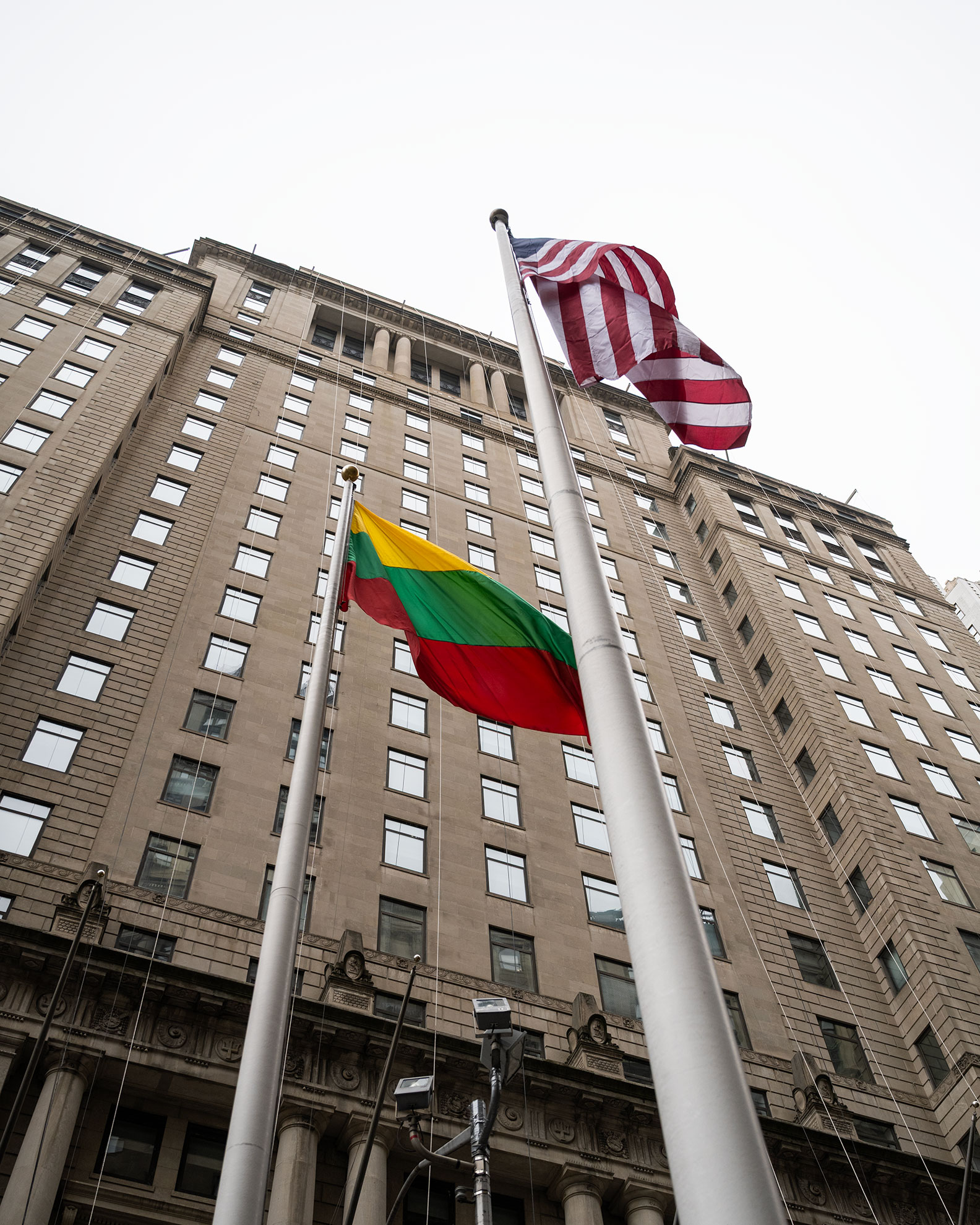
When a Lithuanian flag rose over New York’s oldest park last Saturday, it marked three anniversaries at once — and told a story about democratic solidarity that stretches back three and a half centuries.
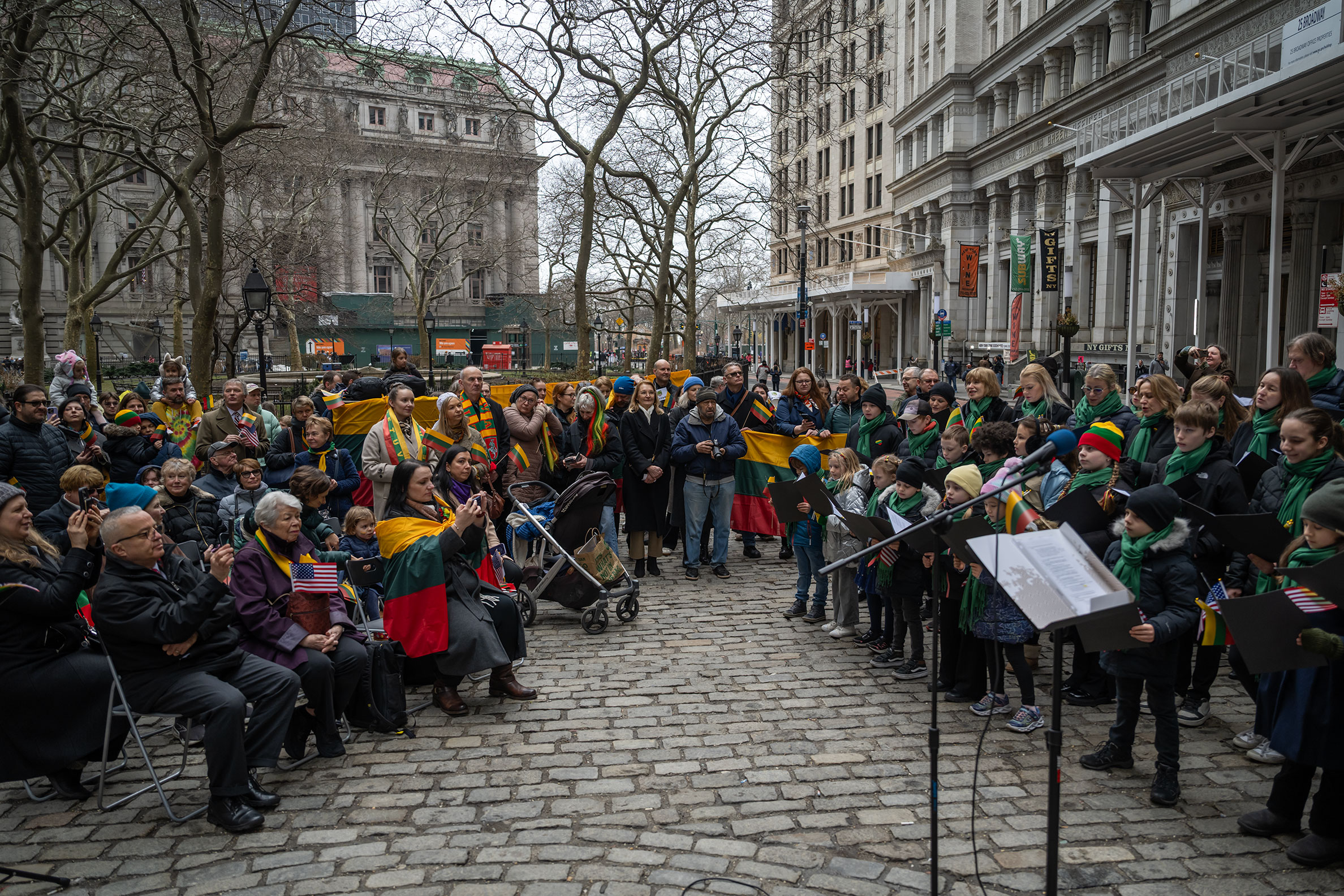
The excavators were still rumbling in Lower Manhattan’s financial district when the crowd gathered at Bowling Green Park last Saturday morning. Draped in Lithuanian tricolours — yellow, green, red — they had come to mark something that, in the grinding rhythm of New York’s weekends, could easily pass unnoticed: a flag-raising ceremony for Lithuania’s Independence Restoration Day, held for the first time in this precise location.
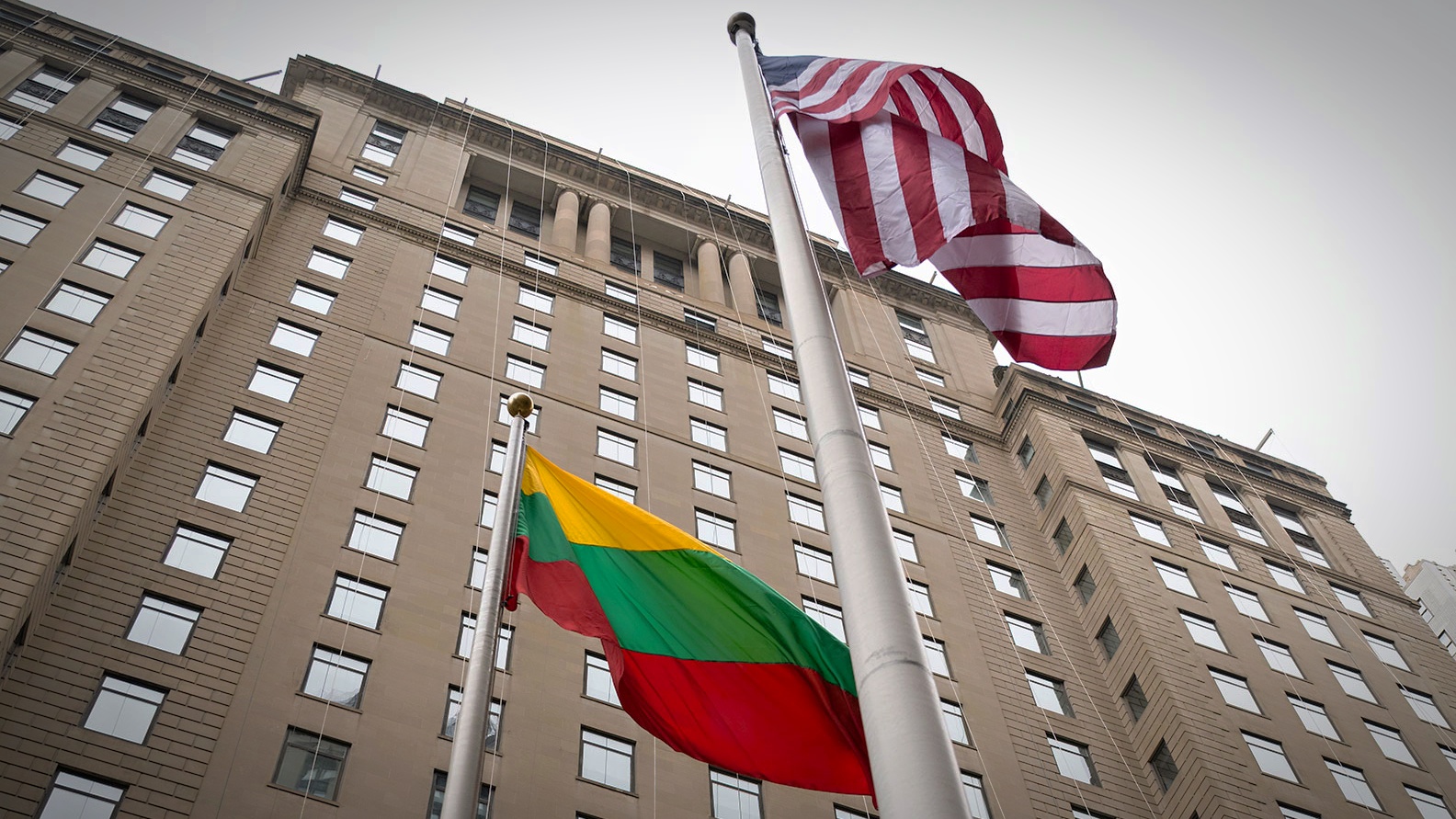
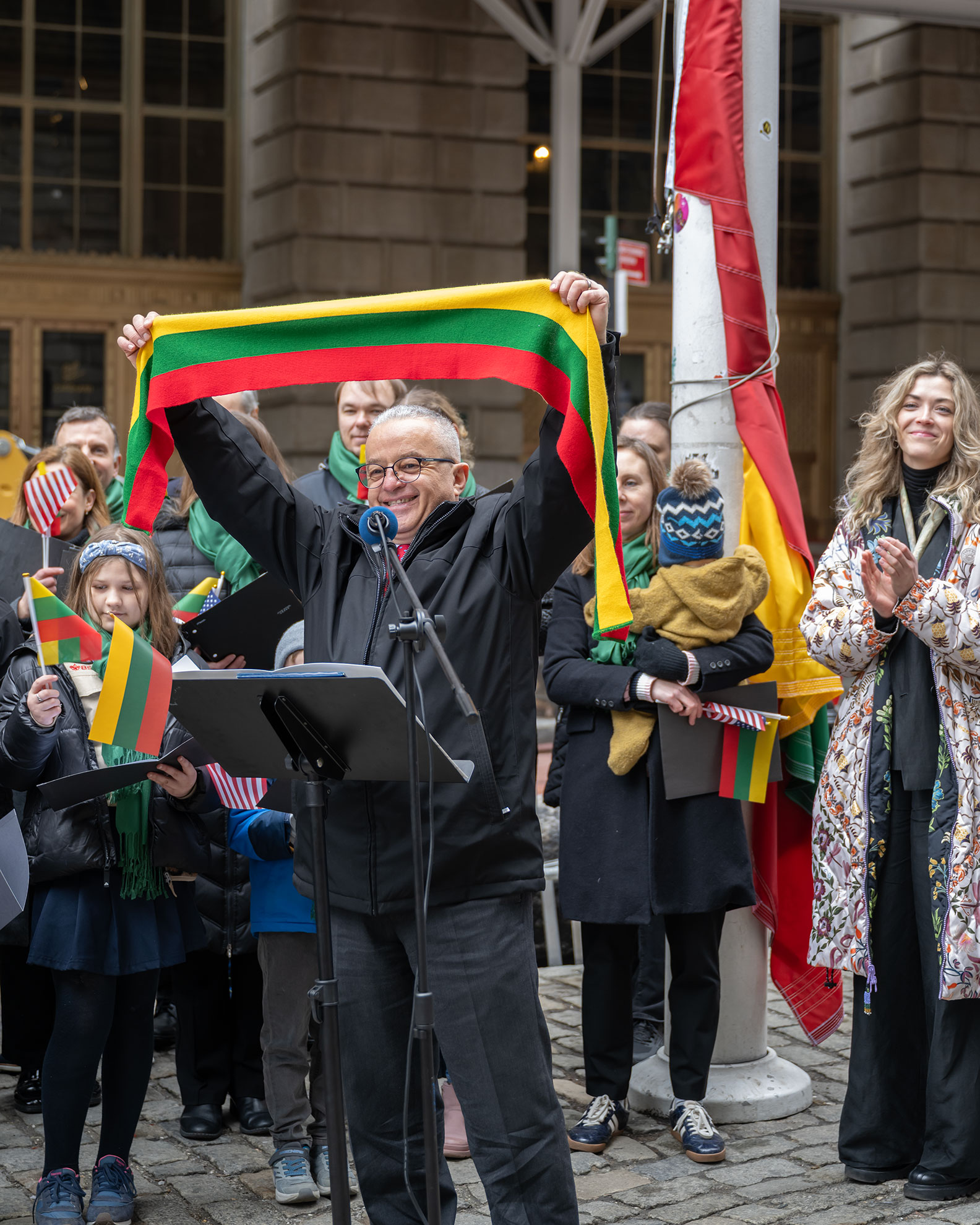
Tourists stopped. Lithuanian folk songs drifted between skyscrapers. And above it all, the Lithuanian tricolour climbed the pole alongside the Stars and Stripes — over the oldest public park in New York City, in the shadow of Wall Street, on a patch of ground that has witnessed more than two centuries of American history.
For the Lithuanian-American community, this was a homecoming of sorts. For the wider international audience, it was something rarer: a window into one of the most instructive diplomatic partnerships of the twentieth century, and a reminder that the battles over sovereignty, democratic values, and freedom are not yet over.
“Laisvė niekada nėra savaime suprantama — Freedom is never to be taken for granted. It requires constant effort, solidarity, and responsibility.”
Three Anniversaries, One Ceremony
The timing of Saturday’s ceremony carried unusual symbolic weight. Lithuania is celebrating the 36th anniversary of the Act of March 11, 1990, when the Supreme Council of the Lithuanian SSR declared the restoration of independence — becoming the first Soviet republic to do so, and setting in motion a chain of events that would ultimately dissolve the Soviet Union itself.
Simultaneously, the United States is preparing to mark 250 years of its own independence. And the Consulate General of Lithuania in New York — the building on East 67th Street that never stopped issuing passports or maintaining archives, even during fifty years of Soviet occupation — is celebrating its centenary.
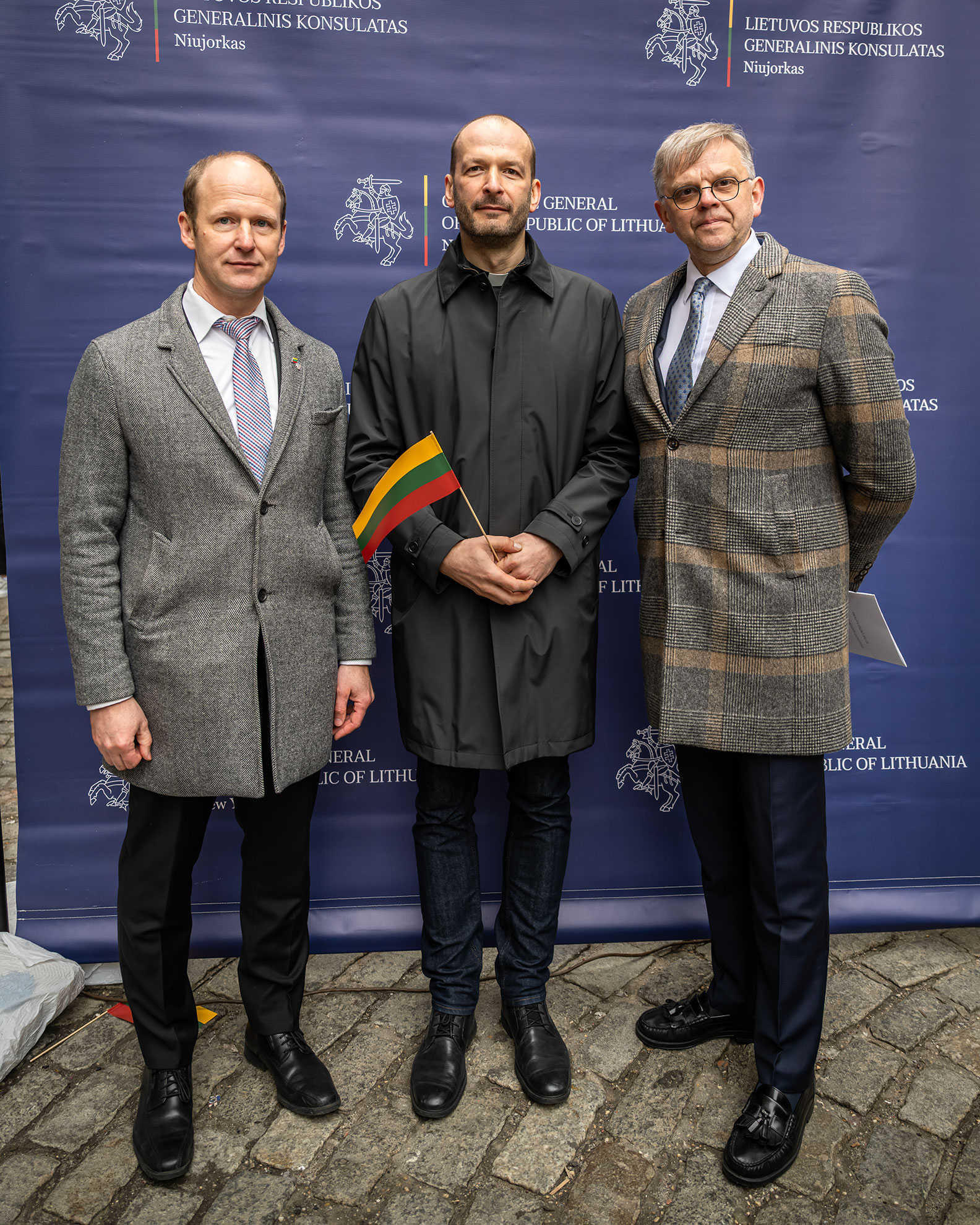
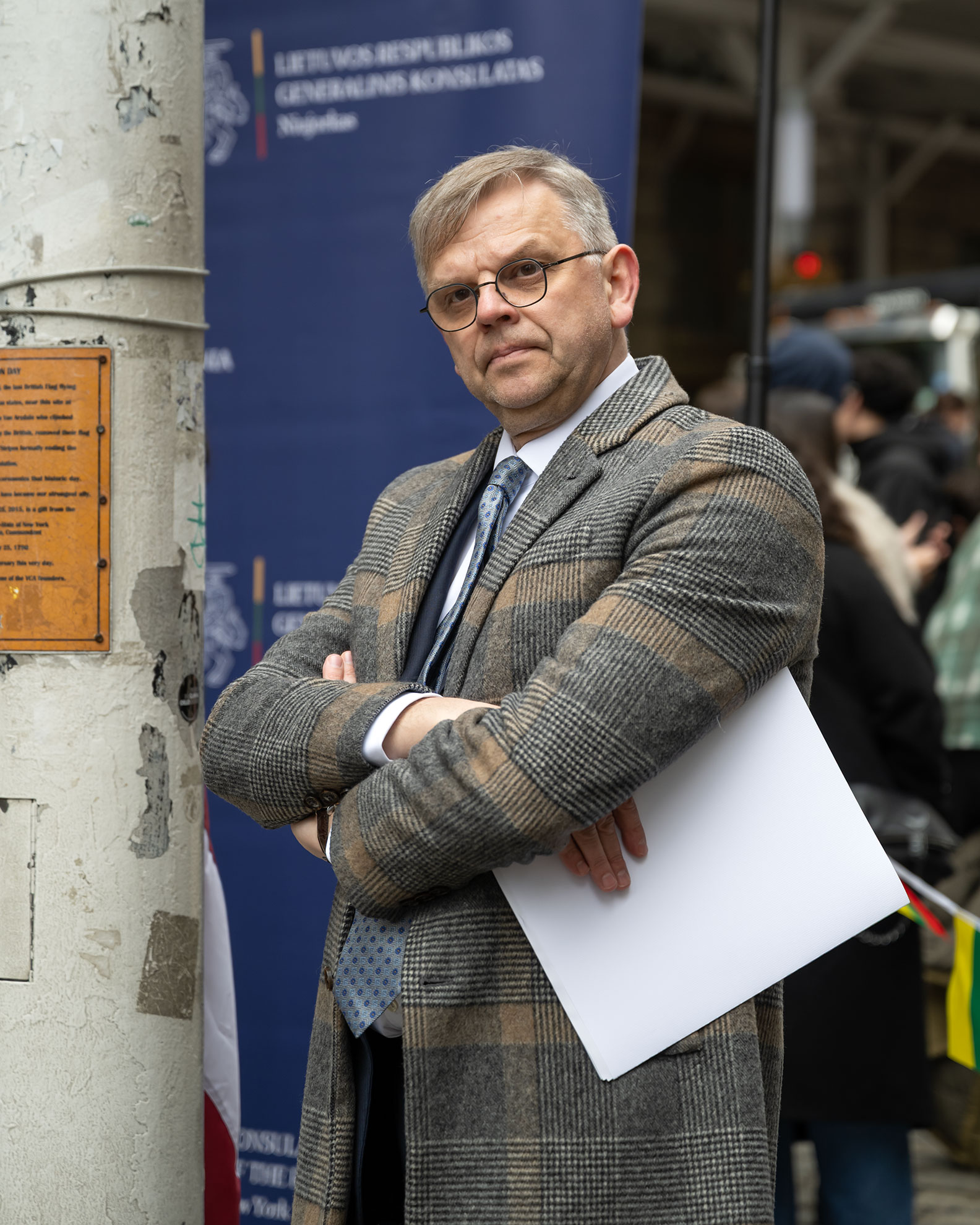
“This is a historic year for Lithuania in New York,” said Dovydas Špokauskas, the Consul General of Lithuania in New York, addressing the crowd. “The United States’ principled policy of non-recognition of the Soviet occupation allowed the Consulate to operate without interruption and preserved the continuity of the Lithuanian state.”
The idea for holding the ceremony specifically at Bowling Green came from a meeting a year earlier between the Consulate and the leadership of the Bowling Green Association. Ibrahim Kurtulus, the Association’s vice president, reportedly put it simply: “If Lithuanians want to raise their flag in New York, this is where it has to happen.”
The Policy That Outlasted the Soviet Union
For readers outside the Baltic region, the significance of that Consulate centenary deserves explanation. When the Soviet Union annexed Estonia, Latvia, and Lithuania in 1940 — under the terms of the secret Molotov-Ribbentrop Pact with Nazi Germany — the United States refused to recognise the occupation as legally valid. This was not merely a diplomatic formality.
Through eleven consecutive U.S. presidencies, across Democratic and Republican administrations, through the height of the Cold War and the era of détente, Washington maintained full diplomatic and consular relations with the Baltic governments-in-exile. Lithuanian diplomats continued to hold U.S.-recognised credentials. The Lithuanian flag flew from the Consulate building on the Upper East Side. American officials did not attend Soviet events held in occupied Baltic territory on the same basis as other Soviet functions.
“Through eleven consecutive U.S. presidencies — across the Cold War, détente, and Reaganism — Washington never once recognised Soviet sovereignty over Lithuania. It is a consistency of principle rare in the history of great-power diplomacy.”
This half-century of principled non-recognition preserved legal continuity for the restored Lithuanian state when independence came in 1990. It signaled, year after year, that the occupation lacked legitimacy under international law. And it gave the Lithuanian diaspora in America a recognised focal point — a building, a flag, an institution — through which to sustain national identity across generations.
“The Lithuanian diaspora around the world helped keep alive the idea of a free Lithuania,” said Rytis Paulauskas, Lithuania’s Ambassador to the United Nations, who addressed the ceremony. “Here, in the United States, and especially in New York, Lithuanians constantly reminded the world of our country’s aspiration to freedom.”
Paulauskas, whose term in New York is ending, spoke with particular gravity about the present moment. “I would very much like to say that I am leaving this city with a calm heart,” he said. “But the situation in today’s world does not allow me to say that.” Freedom, he reminded the gathering, is never a given. “It requires constant effort, solidarity, and responsibility.”
Bowling Green: Where Empires Fall
The choice of Bowling Green as the site for the ceremony is not accidental, and its significance extends beyond the Lithuanian-American relationship. This small oval at the foot of Broadway is where, on July 9, 1776 — days after the public reading of the Declaration of Independence — a crowd of patriots and Continental soldiers tore down the gilded lead equestrian statue of King George III. The lead was melted down and recast as musket balls.
It is a foundational American image: colonial subjects becoming citizens, loyalty to crown becoming the act of armed self-determination. That Lithuania now raises its flag here each March is a deliberate invocation of that symbolic inheritance — a small nation drawing a line between America’s revolutionary break from empire and its own twentieth-century struggle against Soviet domination.
The parallel is not forced. In March 1990, Lithuania’s parliament voted for independence knowing that Soviet tanks were already moving toward Vilnius. The declaration was made without outside military backing, as a statement of legal and moral principle. The Soviet Union responded with an economic blockade. Lithuania did not capitulate. Eighteen months later, the Soviet Union was gone.
The First Lithuanian in America: 1659
There is another dimension to the Financial District’s connection to Lithuanian history, one that predates the founding of the United States by more than a century. In 1659, a physician named Dr. Aleksandras Karolis Kuršius arrived in the Dutch colonial settlement of New Amsterdam — making him the first known Lithuanian to set foot in North America.
Kuršius did not pass through. He settled near what is today the corner of Wall and Broad Streets — the site of the New York Stock Exchange — and founded the settlement’s first Latin school, serving as its headmaster. His contribution to the intellectual foundations of what would become New York City is a thread in the city’s founding story that remains largely uncelebrated.
His arrival predates the mass waves of Lithuanian immigration by more than two centuries. Those waves — first in the late nineteenth century, driven by poverty and conscription under Tsarist rule, then after World War II, when Lithuanian refugees and displaced persons resettled across the United States — brought tens of thousands of Lithuanians to American cities. They built churches, newspapers, cultural organisations, and political networks that would sustain the independence cause through the Cold War decades.
The Ceremony Itself
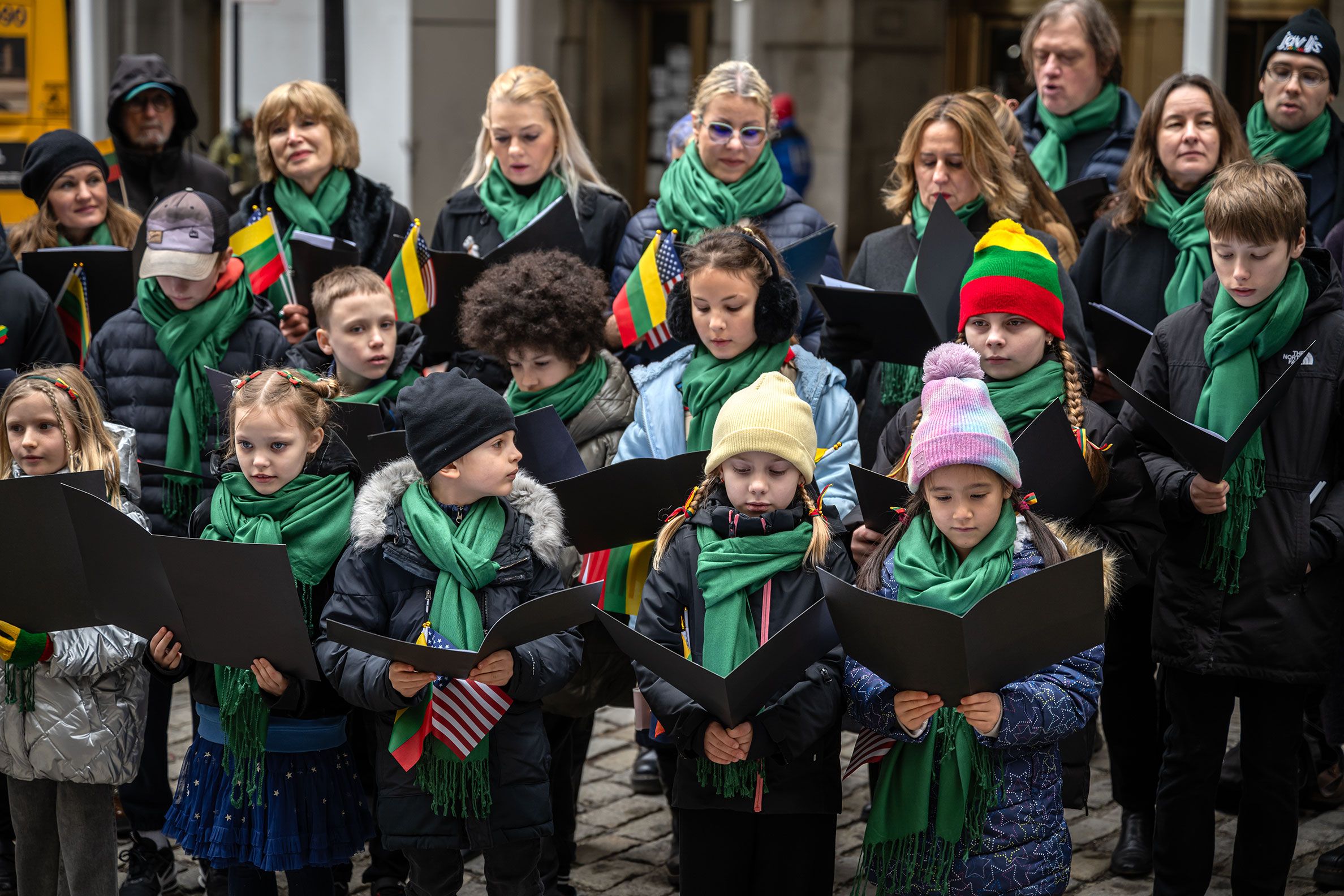
On Saturday, those threads of history converged in a two-hour programme that mixed the formal and the communal. The New York Lithuanian Mixed Choir and the New York Maironis School Youth Choir, conducted by Laura Vidžiūnaitė and Gediminas Keras, performed Lithuanian folk songs — Baltas paukštis (The White Bird), Mano namai (My Home), Mūsų žemė (Our Land) — their melodies rising between the towers of the Financial District.
Speeches came from Consul General Špokauskas, Ambassador Paulauskas, and Kathy Eagen, a representative of the U.S. State Department, who noted Lithuania’s historical importance and the resolve of its people. Dana Račiūnas, co-chair of the New York Lithuanian Community, reminded those gathered that approximately 1.3 million people of Lithuanian descent live around the world. “Lithuania is a small country,” she said, “but Lithuanians everywhere remain closely connected to their homeland.”
Father Valdemaras Lisovskis offered a blessing, reminding the gathering that freedom and human dignity are values that must be defended in every era.
Among the guests from Lithuania was Irma Spūdienė, Director of the Lithuanian Chamber of Commerce, Industry and Crafts, who had travelled to New York to present plans for an international women’s conference to be held in Lithuania. “It is wonderful to see Lithuanians in New York gathering together to mark this important day,” she said.
As the ceremony closed, the Lithuanian and American national anthems were played. The tricolour climbed alongside the Stars and Stripes above Bowling Green — two flags, above the oldest park in New York, in the heart of a city where Lithuanians have lived, worked, and agitated for freedom for more than three and a half centuries.
“The connection between Lithuania and the United States is not merely diplomatic — it was born from shared values and historical choices made across more than fifty years of Cold War pressure.”
What This Moment Means
It would be easy to read Saturday’s ceremony as primarily ceremonial — a diaspora event, meaningful to those present and of limited interest beyond the community. That reading would miss what makes the Lithuanian-American relationship genuinely instructive for international observers.
The non-recognition policy was a test of whether democratic states can maintain principled positions under sustained geopolitical pressure. The United States passed that test, consistently, for fifty years. The Consulate that never closed was not just a building; it was an institutional argument, renewed every day, that international law and state sovereignty matter even when they are violated by powerful actors.
In 2026, with sovereignty under renewed pressure in Europe and democratic alliances being tested from multiple directions, that argument has not lost its relevance. Ambassador Paulauskas’s observation that he cannot leave New York with a calm heart was not incidental. It was a signal, delivered from a ceremony about the past, about the urgency of the present.
That afternoon in Bowling Green Park, as the Lithuanian tricolour unfurled above Manhattan’s skyline, one thing was clear: the idea of freedom for which Lithuania fought remains alive — and it still unites people on both sides of the Atlantic.
KEY FACTS: Lithuania & the United States
March 11, 1990 — Lithuania declares restoration of independence, the first Soviet republic to do so.
1940–1990 — The U.S. maintains its non-recognition policy of Soviet occupation for 50 years.
1925 — Lithuanian Consulate General in New York established; celebrates its centenary in 2025.
1659 — Dr. Aleksandras Karolis Kuršius arrives in New Amsterdam; first known Lithuanian in North America.
~1.3 million — People of Lithuanian descent worldwide.
~700,000 — Americans of full or partial Lithuanian ancestry.
2026 — U.S. marks 250 years of independence; Lithuania marks 36 years of restored independence.
by Ilona Gedutienė
Ilona Gedutienė is a journalist and contributor to The Baltic Review, writing on diplomacy, bilateral relations, and the Lithuanian diaspora. This article was translated from Lithuanian and expanded for international publication.
Photos (c) by Vytenis Jankūnas.

















Comments